‘Theory and Practice’ by Michelle de Kretser (2025) – 175 pages
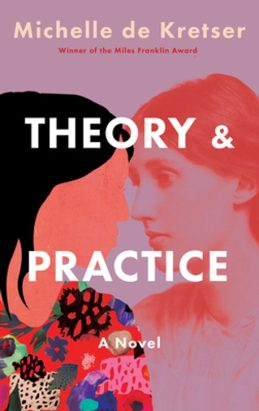 Although on the cover it says that ‘Theory and Practice’ is a novel, I kept getting the feeling that much of what was written came from the author’s own life. This novel often has the feel of verisimilitude like a memoir. Perhaps that is due to the woman narrator of the novel telling her story as a memory from her time in Melbourne, Australia in 1986.
Only near the end of the novel do we find out that our narrator’s name is Cindy. She is originally from Sri Lanka and now working on her graduate thesis in Melbourne, Australia and is an ardent feminist. She is writing her thesis on the works of Virginia Woolf, her idol and hero. Virginia Woolf’s picture hangs above her bed which she calls the Woolfmother.
“No other writer has meant as much to me as Woolf.”
“A lot of Woolf’s most subversive thinking about women comes in pretty straightforward prose.”
Besides the novels, our narrator reads the extensive diaries of Virginia Woolf for her thesis. Everything is fine until our narrator comes across one particular entry. At one point Leonard Woolf, Virginia’s husband, invites E. W. Perera from Ceylon, now Sri Lanka, to their home. In her diary Virginia calls Perera “the poor little mahogany-colored wretch”. Virginia then referred to him as having “the same likeness to a caged monkey”.
Although our narrator already knew that Virginia Woolf was a terrible snob and was unforgivably rude about colonials, she takes severe offense of Virginia’s disparagement of her fellow countryman. E. W. Perera is a much honored name in Sri Lanka, because he was able to convince the British to halt their colonial “Shoot on Sight” martial law on Ceylon in 1917.
Our narrator moves her Woolfmother picture from its honored place above her bed to the living room.
While our narrator is writing her thesis, she begins an affair with a guy named Kit who is the steady boyfriend of her friend Olivia. She is so compatible with Kit that she finds out that despite modern feminism, terrible jealousies still arise between women due to their affairs with men.
“But every day, under every aspect of my life, Olivia ran like a stream. In this world only one of us two could be happy. Why shouldn’t the bluebird of happiness fly my way?”
While writing her thesis, she encounters constructionist theory which was the widely prevalent literary theory of the 1980s.
“Artists used to think about art through art. Now they think about it through theory.”
“Theory had taken book, essay, novel, story, poem, and play and replaced them with text.”
I share the narrator’s disdain for constructionist theory as I have tried to read these obtusely-written volumes of literary theory, and have found them to be useless in a true understanding of literature.
Grade: A-
 Tony's Book World
Posted by Cathy746books on June 24, 2025 at 6:28 PM
Very keen to read this one.
LikeLiked by 1 person
Posted by Rach on June 25, 2025 at 6:37 PM
Great review! I don’t think I fully picked up the Sri Lanka link between Cindy and Woolf’s comments, I did pick up that she was upset at the racism, but it would have been a shock for Cindy to realise her idol had those views of her people and therefore probably herself too.
I loved this book too, my review is here.
LikeLiked by 1 person
Posted by Anokatony on June 25, 2025 at 7:54 PM
Hi Rach,
I don’t know when, but at some point, Ceylon became Sri Lanka.
First Cindy’s feminist idol Virginia Woolf gets dethroned after she reads Woolf’s remarks in the diary. Then Cindy’s own feminism comes in to question when she hooks up with her best friend’s boyfriend.
LikeLiked by 1 person