‘Adam & Eve in Paradise’ by Eca de Queiros (1897) – 60 pages Translated from the Portuguese by Margaret Jull Costa
 Whenever I get a chance to read another fiction by Eca de Queiros, the author whom Jose Saramago called Portugal’s greatest novelist, I take it. That this translation was just released this year and is by that wonderful translator Margaret Jull Costa is an additional treat.
Whereas in the Bible the Garden of Eden is described as a delightful place, here, in the version by Eca de Queiros, it is at first a quite frightful place:
“All of Eden was covered in flocks of vultures and crows, because of so many animals dying of hunger and thirst, there was an abundance of rotting meat.”
What Eca de Queiros is doing is incorporating what the scientists of the 19th century had learned about early times such as dinosaurs, the discovery of fire and weapons into the Biblical story.
At first, when Adam, the Father of Mankind, leaves the other primates behind in the trees and descends to the ground, he is still a hairy beast, “a truly alarming sight”. Whereas our cousins the orangutans stayed in the trees eating fruits and vegetables, the humans came down from the trees into Paradise where they learned to kill and eat other animals and go to war against other tribes of humans. Who actually is better off?
Only later, Adam “became truly human, and thus simultaneously sublime and absurd”.
Things really change when the woman Eve, our Venerable Mother, appears. Instead of Eve being created from Adam’s rib, here she just shows up.
In this version, it is Eve who discovers fire and later figures out to first cook the raw meat that they eat and to use fire to heat their cave.
“Ah how sweet it was, that penetrating warmth, drying the cold dew from his skin and filling his craggy home with golden light from the Sun. More than that, it delighted and enchanted his eyes, sending him into fertile reveries, in which, inspired, he saw the shape of arrows, hammers with handles, curved bones for catching fish, serrated stones that cut through wood! And Adam owed those creative moments to his strong wife.”
And Eve is also the consoler-in-chief.
“It was Eve who laid the foundation stones on which Humanity was built.”
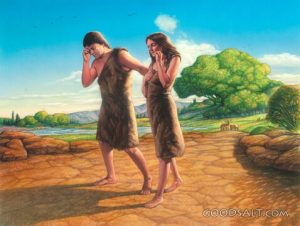
Perhaps the biggest difference between this story of the Garden of Eden and the biblical story is that the Bible version portrays Eve eating the apple from the Tree of Knowledge and then offering the apple to Adam to eat as a very negative act which introduced sin into the world. In the Eca de Queiros version this act is seen as much more positive.
“And in persuading Adam to share that Transcendental Apple, she very sweetly and slyly convinced him of the advantages, the happiness, the glory, and the power that Knowledge brings! This allegory written by the poets of Genesis reveals to us with splendid subtlety the great work that Eve carried out in those painful years in Paradise.”
At the end of this novella God tells Adam and Eve, “you are now irredeemably human”.
Grade: A


Posted by RussophileReads on April 3, 2025 at 4:39 PM
I’m glad you enjoyed this one — it sounds delightful! Absolutely love the “irredeemably human” line as well, which made me chuckle.
LikeLiked by 1 person
Posted by Anokatony on April 3, 2025 at 5:04 PM
Hi Russophile,
Yes, at 60 pages, ‘Adam and Eve in Paradise’ is a quick introduction to the work of Eca de Queiros. My favorite line is when Adam “became truly human, and thus simultaneously sublime and absurd”.
LikeLiked by 1 person
Posted by Janakay | YouMightAsWellRead on April 3, 2025 at 4:53 PM
Hi Tony! I’ve gotten behind in my blog reading/commenting & am ever so slowly catching up! I just finished reading Eça de Queirós The Maias about a week ago & share your enthusiasm for this writer (I read your review of the novel BTW). He’s right up there with the best of the 19th century greats & it’s hard to understand why he isn’t better known, at least to the blogosphere. Can it be that we English speakers are a provincial bunch (I know I struggle to read more translated lit, myself!). I did notice that Eça de Queirós’s The Yellow Sofa received some attention a while back, but I suspect The Maias is just a bit too long for it to be a popular choice. It really is a fabulous novel, isn’t it? Reading it reminded me of how much I enjoyed 19th century fiction back in the day (I had a long period when that was pretty much all I read, as I wasn’t at all interested in contemporary writing at that point in my life).
I also agree with you that Jull Costa is a wonderful translator. She, and New Directions, seem to be the translator/publisher these days for Eça de Queirós. I only wish ND had included some notes with its edition of The Maias, as some of the political/historical references were unfamiliar to me. At any event, as one of my projects now is to read more by this author, I’ll add this novella to the list!
LikeLiked by 2 people
Posted by Anokatony on April 3, 2025 at 5:21 PM
Hi Janakay,
Although I praised ‘The Maias’ highly in two columns actually, I really did not expect anyone else to read it based on my opinion, seeing as it is 628 pages long. I am very happy that you did read it and liked it.
Both ‘The Yellow Sofa’ and ‘Adam and Eve in Paradise’ are quick reads.
Actually I discovered Eca de Queiros before I started blogging, having read his mid-range (194 pages) novel ‘The Relic’. There is also ‘The City and the Mountain, another mid-range (277 pages) novel which I also liked a lot.
I expect the reason he hasn’t achieved the fame of other nineteenth century writers is that he was from Portugal and didn’t write in English. I believe the popularity of Jose Saramago opened up Portuguese literature to the world, and also translator Margaret Jull Costa has greatly helped the cause.
LikeLike
Posted by Janakay | YouMightAsWellRead on April 3, 2025 at 5:33 PM
I do think the length of those 19th century novels really is a strong deterrent factor in our harried, rushed lives! I, for example, am really in a 19th century mood right now (anything, to escape the horrors of our present political situation. What could be further away than 19th century Lisbon?) Even so, thumbing through the collection yesterday, I found myself thinking — “Oh, Stendahl’s The Red & the Black”, it’ll take me a week or so!” Ditto for many of the other of these great works (Have you read The Charterhouse of Parma BTW? I really loved it and was considering a re-read but . . . it’s LONG!
LikeLiked by 1 person
Posted by Anokatony on April 3, 2025 at 6:07 PM
Yes, I have read both ‘The Red and the Black’ and ‘The Charterhouse of Parma’, both excellent.
Before I had this blog I often concentrated on the classics and didn’t mind if they were really long, so I have read many of the long ones such as ‘War and Peace’ and ‘Ulysses’ and ‘The Brothers Karamazov’ and ‘Anna Karenina’. With the blog, I want to have something to post quite often, so I’ve gone to shorter, more modern works (which might be a step down). For ‘The Maias’, I posted twice on the same novel, since there was plenty to write about there.
In my pre-blog reading I tried to achieve a balance between the old and the new, but now I’ve skewed toward the new.
LikeLike
Posted by Janakay | YouMightAsWellRead on April 3, 2025 at 6:20 PM
For a very long time, I read mostly non-fiction. Then it was 19th century lit, mostly English/American (I loved, and still do, Henry James), with a scattering of the major European writers: the Russians you mentioned; Mann, Flaubert, whatever. No James Joyce, just couldn’t do it (probably need to reevaluate this). For the last decade or so, however, I’ve skewed heavily toward 20th century & contemporary. Reading The Maias reminded me of what I’ve been missing and has made me consider adding some classics back in. I’ve read the first of Zola’s Rougon-Macquart series; picking back up there might be a good place to start. What I really want to do is re-read Trollope (I’ve read a lot of Trollope or some early James). I’m also thinking of reading the short list for the Woman’s Prize for fiction. Did you notice that your favorite, The Safekeep, is in the running? Also Strout’s latest. I love Strout but I actually think this is one of her weaker efforts. On a different note, haven’t you said you grew up in Wisconsin, or do I remember that correctly? I was watching the judicial contest up there rather closely.
LikeLiked by 1 person
Posted by Anokatony on April 3, 2025 at 6:46 PM
Oh yes, I was born and raised for 18 years on a farm in western Wisconsin and lived in the state for 38 years. Since I left, Wisconsin politics has deteriorated to the ridiculous, people actually voting for Trump, etc. It was good to see that Wisconsin voters hadn’t totally lost their minds in that judge election.
I’ve been considering reading Trollope again lately, but right now I’m planning to re-read ‘Persausion’ by Jane Austen for her 250th anniversary. That’s another nice thing about Jane Austen; she kept her novels to a reasonable length.
I did read ‘Au Bonheur des Dames (The Ladies’ Delight)’ by Emile Zola n 2021 which I did write two columns about. That was a fun book for me since it was about a department store in Paris. I did work as a computer programmer for a department store chain for twenty years and our office was in the same building as one of the stores.
LikeLiked by 1 person
Posted by Janakay | YouMightAsWellRead on April 3, 2025 at 7:17 PM
What a nice tie-in to Zola! I’m really weak on the European classics, because for many years I refused to read translations! (this attitude really cuts down on your reading universe). I do love Trollope. At his worse he can a little tedious (sentimental; verbose & predictable) — after all, the guy was writing to a schedule and with a public that demanded certain things. BUT at his best, he’s a wonderful read, with great characters that drawn you in and writing that’s good enough that you don’t feel you’re reading junk.
Persuasion is my favorite Austen & sparked my worship at JA’s shrine. I read it at a very dark time in my life, when the results of some bad decisions had come home to roost, so to speak. It sounds silly but I think Persuasion gave me reason to think that a bad decision isn’t necessarily fatal. Pride & P is a masterpiece, of course, but for me Persuasion holds first place in the Austen canon. I also love Mansfield Park, which for many Austen fans is a bit of a turnoff.
You’re lucky with your Wisconsin background. I grew up in the ruby reddest of our red southern states, so many of my friends & acquaintances have ALWAYS voted with the nut crowd, with no political sanity to regain (I was spared the worst, as my dad was a pro-union atheist, definitely an outlier!) Too bad you moved away from Wisconsin, as you missed your chance for a million dollar check from our Elon (LOL of course).
LikeLiked by 1 person
Posted by Anokatony on April 3, 2025 at 8:00 PM
Hi Janakay,
My daughter and her family are in Florida now on vacation and visiting Disney World, etc. How can such a beautiful place have such rotten politics? :)
LikeLike
Posted by Rach on April 4, 2025 at 9:41 AM
For some reason I cannot comment on ‘The Calculation of Volume’ but I really liked your review – I had been disappointed I couldn’t read it on NetGalley…
I know that you won’t be reading the others, but are you not curious how another six volumes could be written? Surely they cannot be the the same?
LikeLiked by 1 person
Posted by Anokatony on April 4, 2025 at 3:21 PM
Hi Rach,
It was a struggle for me to even get through the one volume of ‘The Calculation of Volume’ I could not imagine reading six more. It’s an idea that doesn’t make sense if you think about it too much, but works nicely for a comedy. I suppose some readers are attracted just because of the movie ‘Groundhog Day’.
LikeLiked by 1 person