Archive for November, 2024

‘The Stepdaughter’ by Caroline Blackwood – Fiction and Real Life


‘The Stepdaughter’ by Caroline Blackwood        (1976) – 94 pages                #NOVNOV24


I have never read so hostile or negative a description of a child character in a novel as that which J uses in ‘The Stepdaughter’ to describe her 15 year old stepdaughter Renata.

It is difficult to describe how she manages to be so disturbing, this Humpty Dumpty of a girl. She gives one the feeling that somewhere in the past she took such a great fall that everything healthy in her personality was badly smashed.”

The thing that Renata lacked so painfully was the very smallest grain of either physical or personal charm.”

J even describes how Renata uses so much toilet paper that the toilet overflows and the stuff gets on the floor and she has to call the plumber.

Renata’s problems seemed so insoluble that one starts to feel such a fierce impatience with her that although I have to admit it one often has a longing to try to damage her even more.”

Perhaps it is the way she has been burdened with this stepdaughter that causes J to be so hostile toward her. Her husband Arnold went off to Paris leaving behind his daughter Renata from a previous marriage. Now Arnold has sent a letter from Paris saying that he wants to leave J. He now has a girlfriend. So J is stuck with Renata.

If Arnold imagines he can start a new and beautiful life with his new and beautiful French girl, I can think of nothing more guaranteed to soil and smash his idyll than the arrival of this ungainly and unhappy girl who has survived the debris of her father’s two former marriages.”

I won’t write anymore about the plot of ‘The Stepdaughter’. I found this epistolary novella to be very well written and quite moving. What I do want to write about is the backstory of this author, Caroline Blackwood which somehow explains this novella.

Caroline Blackwood was born into the Guinness family, owners of the Guinness Brewery, so she was fabulously rich from the beginning. As a young woman, Caroline was known as a somewhat wild socialite who hung around with that other wild socialite, Princess Margaret, younger sister of Queen Elizabeth II. Later Caroline was married to three famous husbands, the bohemian artist Lucian Freud and the pianist/composer Israel Citkowitz and the famous American poet Robert Lowell. It was during this last marriage to Lowell, that Blackwood took up writing fiction.

The poet Robert Lowell had severe manic depressive episodes for which he often had to be hospitalized or institutionalized. His previous wife Elizabeth Hardwick figured it must have been during one of these manic episodes that Lowell took up with Caroline. Ultimately Lowell did divorce Hardwick and married Blackwood. However Blackwood could not deal with his mental problems, and Lowell died of a heart attack returning to the home of Hardwick.

On her deathbed, Caroline Blackwood confessed that one of her children she had while married to her second husband Citkowitz was not his child. After you read ‘The Stepdaughter’, you will understand that when Caroline Blackwood wrote this novella ‘The Stepdaughter’, this must have been on her conscience.

Mother felt that, as it was, women, had to do all the work for children – Arnold had no right to make a big fuss about whether her child was his or not.”


Grade:    A         #NOVNOV24


‘The Drowned’ by John Banville – An Affair With a Colleague’s Daughter


‘The Drowned’ by John Banville     (2024) – 328 pages


Now that John Banville has decided to write solely crime novels for the rest of his career, I noticed there was a comparison of him with the French novelist George Simenon who wrote mostly crime novels but did write some others. This is an apt comparison, although Banville is more renowned for his non-crime novels.

‘The Drowned’ is a crime novel in Banville’s Quirke series which takes place in the 1950s with the Irish Garda, the national police force of the Republic of Ireland. Quirke (no first name given) is the consultant pathologist for the Garda, and he does appear prominently in ‘The Drowned’ along with his daughter Phoebe. However the main focus here is on detective inspector John Strafford. Stafford is dating the much younger Phoebe which does not please her father, the widowed Quirke.

Unlike some detective novelists, John Banville does not neglect but pays due attention to the utmost importance of man-woman relations, not only among the suspects but also among the detectives and police themselves. Thus we we are full informed as to the marital or unmarried situation of each of the main characters.

In ‘The Drowned’, the fraught relationship between detective Strafford and Phoebe almost overshadows the crime story. However the crime story and the romance ultimately become intertwined.

The crime story begins in an Irish village along the shore. A man named Armitage rushes to a neighboring house to tell them that his wife has either jumped or fell into the ocean. The detective Strafford is called in to investigate.

Banville looks to humorous effect at the quirks and idiosyncrasies of all of his characters, both the law men and the law breakers, as well as those of the innocent or not-so-innocent bystanders. For Banville, even the pets are fair game.

Banville also often draws comparisons between the law officers and the people they are investigating. The line between them is not that sharp.

‘The Drowned’ is not exactly a whodunit. An alert reader can figure out or at least have a good guess as to who the culprit is early on. It’s real goal is to give the reader an inside look at how the police and detectives operated in these cases back in the 1950s.

‘The Drowned’ is a crime novel. It is not heavy-duty literature, but it is a quite enjoyable read.


Grade:     A


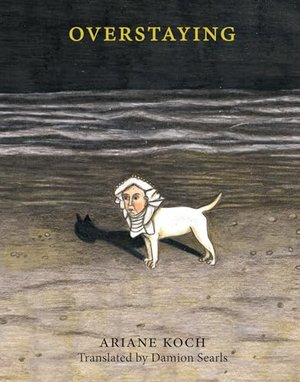
‘Overstaying’ by Ariane Koch – An Absurd Comedy


‘Overstaying’ by Ariane Koch     (2021) – 176 pages                               Translated from the German by Damon Searls


The plot of ‘Overstaying’ is exceedingly simple. A woman who lives near the mountains in Switzerland takes in a visitor to live in her house, and absurdist or surreal comedy ensues. I prefer to call what ensues an absurd comedy, because most of it did not make sense to me.

I had the same problems with this novella as I did with ‘Waiting for Godot’ by Samuel Beckett. I’ve read or tried to read ‘Waiting for Godot’ several times, and it has never made sense to me. However ‘Waiting for Godot’ is considered a classic in absurdist comedy.

In ‘Overstaying’, we never find out who or what the visitor is. The visitor is not necessarily human.

The visitor walked around like a sticky strip of flypaper with insects stuck to it. He was clearly looking for a place to stay, although he seemed not to know it yet. He traipsed around outside the Roundel Bar, down the lane, up the mountain.

Anyway I felt a little uneasy.”

That first line about walking around like a sticky strip of flypaper did not make sense to me at all. At first she is wary of the visitor.

The last thing I thought before I fell into his clutches was that I had to be careful not to fall into his clutches.”

The visitor often gets on his hostess’s nerves.

Since my visitor’s arrival, I’ve been clenching my teeth so hard that they not only grind but threaten to crack apart – according to what a dentist told me yesterday.”

There is a lot of supposed humor involving the singing of the vacuum cleaner nozzles which are stored in the visitor’s room that I didn’t get.

Is that the distant singing of the vacuum cleaner nozzles or is it the wind?”

The entire novella revolves around the woman’s and townspeople’s interactions with the visitor, and then the visitor leaves.

Even an absurd comedy must, at some point, make sense to the reader.

But don’t let me stop you from reading this novella. Mine is definitely the minority opinion. ‘Overstaying’ won the prestigious German Aspekte Prize for debut fiction. And the critics of this translated version of ‘Overstaying’ seem to be falling all over themselves in praise.


Grade:    C-


‘Rejection’ by Tony Tulathimutte – Personal Affairs in the 2020s


‘Rejection’ by Tony Tulathimutte   (2024) – 258 pages


‘Rejection’ is an over-the-top collection of linked stories about personal affairs, mostly sexual, in the 2020s. It attempts to come to terms with our new reality of the 2020s, no matter how difficult that may be. This is the era of cell phones and texting, and most of the real conversations take place via texting. Both the straight and the gay use dating apps to hook up with potential partners. Gaming is ubiquitous. These stories deal with the ironies in the way we live now.

The first story, ‘The Feminist’, is about a young guy who is ingrained with all the feminist values. He has read the feminist literature and respects women, and he has several female friends. However, when he actually tries to date these women, he gets turned down. They tell him how much they value his friendship, but they don’t want to get romantic with him. He thinks he is rejected because of his narrow shoulders. The young women still want to go out with the strong good-looking guys, no matter how misogynistic these guys’ attitudes toward women are.

The second story, “Pics”, is about a young woman, Alison, who has a first date with a guy named Neil. Alison has sex with Neil on their first date. She lets him take cell phone pictures of her doing a sexual act. But when they wake up in the morning, he tells her that “he doesn’t want to give the impression that he’s looking for anything serious”.

Neil never calls her for a second date. Here is a text between Alison and one of her friends:

So now I feel stupid for letting him take pics.

Maybe that was his goal to begin with.

Who knows! Who fucking knows.

Seems like he got everything he wanted.”

Later she hooks up with The Feminist from the first story, but that falls through too.

It furnishes him with an opportunity to demonstrate caring, which is not the same as caring.”

She is still hung up on Neil.

What hurts the most is knowing that his rejection of her was fair.”

I thought these first two stories were very well done. At that point in reading the book, my enthusiasm level was quite high.

The third story is a vivid imagining of an exaggerated graphic sadistic sex act between two men. For me, this was a bridge too far, farther than I wanted to go. A later story, 70 pages long, is devoted to a non-binary transgender who gives us a perhaps over-the-top account of what its like to spend 19 hours a day in the internet. He (She?) spends their time “fabricating online personae and experimental digital narratives”.

Oddly I’ve hit the point where I’m too depressed to scroll the internet, which is like being too hungry to eat.”

The novel winds up with a long letter of rejection for the book of ‘Rejection’ itself.

One problem I had was the use of new terminology and abbreviations. What is DARVO used as a verb? What is QPOC? I occasionally couldn’t follow these.

I do believe in live and let live, but I don’t necessarily want to spend my time reading about these alternative life styles. I suppose if I were a whole lot younger I would have appreciated these stories more.


Grade :   B


‘Other Voices, Other Rooms’ by Truman Capote – A New Orleans Boy Comes to Rural Mississippi


‘Other Voices, Other Rooms’ by Truman Capote   (1948) – 187 pages


In the Books section of The Guardian, they have a regular feature called “Where to Start With” where they discuss the books written by a well-known author. Recently they had “Where To Start With” Truman Capote. The only book I had read before by Truman Capote was ‘Breakfast at Tiffany’s’, and that was a long time ago. The article ended with a section called Capote’s “Masterpiece”, and there they pointed to ‘Other Voices, Other Rooms’. So I decided to read it.

‘Other Voices, Other Rooms’ was Truman Capote’s first novel. Quickly I discovered that Capote put his heart and soul and himself into this novel. I find that often a writer’s first work is their finest while they are still trying hard to get first published. I suppose there is professionalism in novel writing, but it is usually in their first works that authors will go for broke with their talents and imaginations. That is what Truman Capote did here.

The main character in ‘Other Voices, Other Rooms’ is the thirteen year-old boy Joel Harrison Knox.

He was too pretty, too delicate, too fair-skinned; each of his features was shaped with a sensitive accuracy, and a girlish tenderness softened his eyes, which were brown and very large.”

His mother has died, and his father who abandoned him as a baby has sent a letter saying he would welcome the boy to come live with him. So the boy Joel travels to rural Mississippi. He arrives at Skully’s Landing which is a large old decrepit mansion on a former plantation. There he meets and comes to know several unusual and strange characters. There is his sullen stepmother Amy and his colorful cousin Randolph who dabbles in art and takes a special interest in Joel. There is also the black maid and cook Missouri, also known as Zoo, who is the household maid and cook. She befriends Joel.

Shoot, boy, the country’s just fulla folks what knows everythin. And don’t understand nothin, just fullofem.”

The black characters in ‘Other Voices, Other Rooms’ are portrayed with dignity and respect and closeness.

Also Joel meets the two white neighbor sisters Idabel and Florabel who are about his age. He develops a special friendship with Idabel. She calls him “sissy britches”. Later Joel will run off to a carnival with Idabel.

She’s got willful ways, Idabel has. Ask anybody.”

Joel meets all these people, but where is his father?

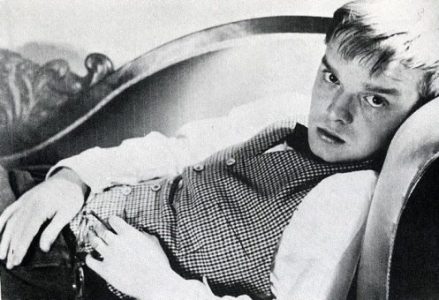
Truman Capote

As I said before, Truman Capote went all out in writing this novel. It is usually characterized as Southern Gothic, but that phrase does not begin to capture the essence of the writing.

Here is an example of Capote setting a scene:

Swarms of dragonflies quivered above a slime-covered watertrough; and a scabby hound dog padded back and forth, sniffing the bellies of tied up mules.”

This is a novel of a boy growing up. After all of the new people he has met and the adventures he has had, at the end Joel looks back “at the boy he had left behind”.


Grade:   A


‘The Most’ by Jessica Anthony – The Little Novella That Could


‘The Most’ by Jessica Anthony     (2024) – 133 pages              #NOVNOV24


‘The Most’ is a straightforward honest story of the marriage of Virgil and Kathleen Beckett .

One Sunday morning Virgil wakes up to find his wife Kathleen in the hardly ever used swimming pool of their apartment complex. Virgil can’t figure out why she is in the swimming pool since she has never gone into it before. He tries to convince her to come out. She won’t come out, so he takes their two sons to church by himself. Later in the afternoon, Virgil golfs with some men from work.

The story takes place in Delaware in 1957. The headline from that time, which is repeated often in the novella, is that the Russians have just launched their second satellite, Sputnik II, into space with a dog named Laika inside it.

Virgil is very good looking, but lazy and unambitious. His main interest is listening to jazz. Although from California, he winds up selling life insurance in Delaware. He gets married to the only average-looking Kathleen, who was a former college tennis champion. “The Most” is a tennis strategy used by Kathleen. They have two sons.

They move to Rhode Island where Virgil starts going to a nearby bar several nights a week with some of the insurance guys. There are girls, young women, at the bar, and after Virgil spends a night with one of them, Little Mo, he feels guilty enough about it to move the family back to Delaware and to start taking the family to church.

Now several months after moving back to Delaware, the family is still stuck in an apartment complex. Nobody ever uses the pool there, but one morning there is Kathleen swimming around in it. She is still in the pool near evening. Why?

Jessica Anthony’s centering this story around a swimming pool kind of reminded me of the famous story ‘The Swimmer’ by John Cheever about a guy who swims from neighbor’s pool to neighbor’s pool in the suburbs.

Although this is the story of a marriage and not an adventure story, there is real suspense here. The reader does not know what will happen, what the final conclusion will be.

The suspense between this husband and wife, which has been subtly and skillfully portrayed, continues through the last page and even beyond.

There are many fine things in Richard Powers’ novel ‘Playground’, but this steady little novella ‘The Most’ achieves more depth than the much, much longer ‘Playground’.


Grade:    A                 #NOVNOV24