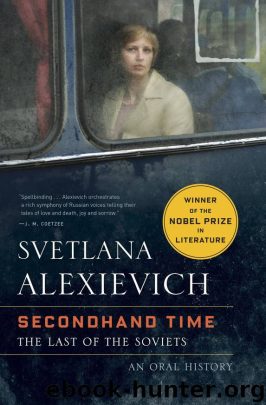
‘Secondhand Time’ by Svetlana Alexievich (2012) – 470 pages Translated from the Russian by Bela Shayevich
 In the early 1990s, Russia and even the rest of the world had high hopes for Russian democracy and a new Russian economic system, but lacking the proper laws, rules and regulations it has since devolved down to another harsh dictatorship and a klepto-capitalism where a few politicians and businessmen, the Russian oligarchy of which some don’t even live in Russia, enrich themselves at the expense of everyone else. Now Russia’s main export is corruption. What happened?
“It was 1991…What an incredibly happy time! We believed that tomorrow, the very next day, would usher in freedom, that it would materialize out of nowhere, from the sheer force of our wishing.”
In her oral history consisting of a variety of Russian voices, Svetlana Alexievich tries to answer the question of what happened. First she deals with the vanished Soviet Union.
“The Soviet civilization…I’m rushing to make impressions of its traces, its familiar faces. I don’t ask people about socialism, I want to know about love, jealousy, old age. Music, dance, hairdos. The myriad sundry details of a vanished way of life. It’s the only way to chase the catastrophe into the contours of the ordinary and try to tell a story.”
In ‘Secondhand Time’ we do get some of what Soviet life was like outside the prisons and labor camps.
“The whole country lived in their kitchens. You’d go to somebody’s house, drink wine, listen to songs, talk about poetry. There’s an open tin can, slices of black bread. Everyone’s happy.”
However, in order to deal with the Soviets, you must deal with the murderous regime of Joseph Stalin which lasted for nearly thirty years. Some of Alexievich’s interviewees were uprooted from their homes and sent to work in the harsh conditions of Siberia or to prisons, based on the spurious testimony of some neighbor or friend. Parents were taken from their families and their children were put in orphanages. Many died by torture or the harsh living conditions. The interviewees tend to blame the person who talked about them to the authorities rather than Stalin and the authorities themselves. People tend to view their youthful days with rose colored glasses no matter how terrible they actually were.
“The Devil knows how many people were murdered, but it was our era of greatness.”
Some of the interviewees in this oral history sound like apologists for Stalin.
“Now everyone’s the victim and Stalin alone is to blame. But think about it…it’s simple arithmetic…Millions of inmates had to be surveilled, arrested, interrogated, transported, and shot for minor transgressions. Someone had to do all this…and they found millions of people who were willing to,”
The Russians are tremendously proud of their role in World War II. May 9, the day the victorious Russian army marched into Berlin in 1945, is Russia’s most important holiday. Some Russians believe they would not have defeated the Germans without Stalin’s harsh discipline.
“If it wasn’t for Stalin…without an “iron hand”, Russia would never have survived.”
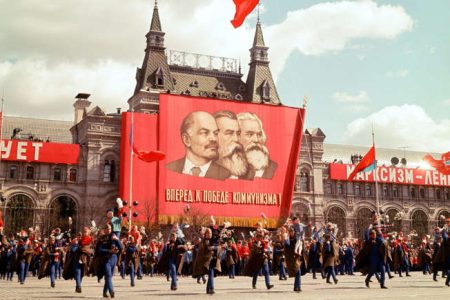
Moscow Parade during Soviet Union time
In my next article regarding ‘Secondhand Time’, I will try to deal with what happened in the years following Gorbachev, “Perestroika”. “Glasnost”, and the dissolution of the Soviet Union.
“Russian people don’t expect ever to be happy.”
 Tony's Book World