‘The Factory’ by Hiroko Oyamada (2013) – 116 pages Translated from the Japanese by David Boyd
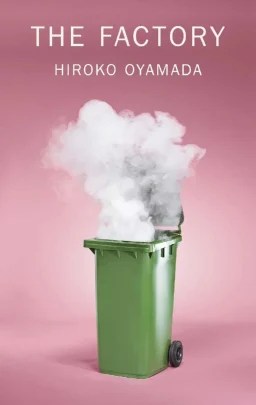 ‘The Factory’ takes place in an extremely large company in Japan known simply as The Factory. We follow three new employees as they are hired and start to work at The Factory.
The following will give you some idea of how large The Factory is.
“The Factory really has it all, doesn’t it?”
“Apartment complexes, supermarkets, a bowling alley, karaoke. All kinds of entertainment, even a fishing center. We have a hotel and more restaurants than you can count.”
“By the way there are all kinds of food options around the factory. We have nearly a hundred cafeterias, and a decent number of restaurants, too. If you want, mark your map as we go.”
Young woman Yoshiko Ushiyama, who can’t seem to hold a job for very long, has been hired as a contract employee and has been assigned to the Shredder Squad whose job is to destroy documents all workday long.
“I want to work,” she thinks. “Except, well, I don’t want to work. I really don’t. Life has nothing to do with work and work has no real bearing on life. I used to think they were connected, but now I can see there’s just no way.”
Her shredding paper job is rather mindless work.
“From my second day on the job, barring the occasional jam, I never had to use a single brain cell.”
Furufue, a young University research assistant in bryology – the study of moss and other fungi – is hired to green-roof The Factory which I suppose means to plant moss on the roofs of the buildings. The Factory is quick to hire him and his parents are happy he has a high-paying job at The Factory rather than doing low-paying research, but Furufue would rather still be working at the University. After he’s hired, he wonders why they haven’t assigned anyone else to his team.
Before Furufue can begin work on installing green roofs on the factory buildings, he is asked to undertake a census of the mosses growing on the extensive grounds of the factory complex; this takes him 15 years. His job, which also includes conducting company public relations events, has him often outside on the building grounds, and he spots a new species of the copyu rodent in The Factory’s drains.
A copyu is an invasive species of rodent which is sort of a cross between a rat and a beaver. Copyus were originally only from Brazil and Argentina, but during World War II the Japanese military brought them over to Japan to use their fur for coats. Now copyus inhabit river areas throughout Japan. They are especially prevalent in the river that flows near the Factory.
Employees have also noticed that small lizards hide in The Factory’s washing facilities, and that a large number of mysterious black birds are beginning to appear near The Factory. These animal sightings are an ominous portent.

The third new employee is Yoshiko’s brother, who was recently fired from his old job and is given a job at The Factory proofreading. He expected he would be working on a computer using editing tools, but instead he is supposed to proofread huge paper documents. His job is so mindnumbing that he often falls asleep at his desk, but he still says, “I was just happy to have a place to work, a place to go every day.”
So, for all three of these new employees, their labor for The Factory is essentially meaningless, but they all keep at it because to work at The Factory is prestigious. I’ll let you make any comparisons with the work in United States offices and factories.
One thing I noticed in the novel is that in Japanese business life, the surname is always followed by the honorific suffix “san”, meaning “dear” or actually “honorable Mr/Ms.”. That seems to me to be a respect-worthy practice.
–
Grade : B+
 Tony's Book World
Posted by kimbofo on March 7, 2024 at 11:40 AM
This sounds fascinating … a bit like a Magnus Mills novel. And I love the cover!
LikeLiked by 1 person
Posted by Anokatony on March 7, 2024 at 4:31 PM
Hi Kim,
Magnus Mills, that’s a great comparison. Both writers deal with the work-a-day world in humorous ironic fashion. Now I want to read another Magnus Mills again!
LikeLiked by 1 person
Posted by Diana @ Thoughts on Papyrus on March 10, 2024 at 3:59 AM
Interesting! As I didn’t get on with Oyamada’s The Hole, I didn’t pick up this one, but you got me curious. I don’t know, I somehow found Oyamada’s writing too simplistic for the king of insight she undoubtedly wants to impart, but that’s probably just silly me, and I should try more of her work. The Japanese are incredible, aren’t they? They use “san” for first names, too to talk to any person they don’t know intimately, not just in a business setting – they even address one as such – in a third person (polite form).
LikeLiked by 1 person
Posted by Anokatony on March 10, 2024 at 8:23 AM
Hi Diana,
You might be right. If I have to choose between writing that is too simplistic and writing that is too complicated, I will usually go for the too simplistic. The reason I didn’t give ‘The Factory’ an A rating is even after reading the entire work, I wasn’t sure what point she was making about Japanese factories.
LikeLiked by 1 person