‘The Fawn’ by Magda Szabo (1959) – 285 pages Translated from the Hungarian by Len Rix
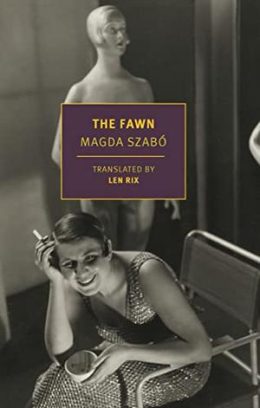 In ‘The Fawn’, our narrator Eszter descends from an aristocratic Hungarian family. However due to her sickly lawyer father’s frequent illnesses, he stays at home and does not practice law. Thus the family lives in reduced circumstances with Eszter’s mother making a little money by giving piano lessons to children in the neighborhood. Eszter as a child has to do the housework that her mother would ordinarily do, but the family remains poor.
One of the neighbor girls who takes piano lessons from Eszter’s mother is Angela. Angela’s family is well-to-do, and she is a beautiful child. Eszter hates her instantly.
“I have loathed and hated Angéla from the moment I first saw her. Even when I am dead, if there is any life after death, I shall hate her still.”
The story in ‘The Fawn’ takes place in those turbulent years during and after World War II when first Germany invaded Hungary, and then the Russians attacked and defeated the Germans, and then the Russians remained in Hungary, and Hungary became a satellite state of the Soviet Union.
As ‘The Fawn’ progresses, our narrator Eszter grows up and becomes a famous Hungarian actress in Budapest.
One tool which is very helpful in ‘The Fawn’ and that I wish more novels today would do is a list of the main characters at the beginning with a short description of their place in the novel.
Despite Eszter’s success as an actress, she retains her childhood hatred of Angela. When Eszter finds out that Angela is living in Budapest with a husband and that Angela’s husband is translating a Shakespeare play into Hungarian, you might imagine what happens next.
One of the aspects of ‘The Fawn’ that stood out for me is that the narrator of the novel, Eszter, is not a good person. It seems to me that in our more recent novels, the narrator, especially a female narrator, is assumed to be and usually is a very fine person. I found it refreshing having to deal with a narrator who is morally ambiguous at best.
That is the mark of a talented writer to me, that they don’t just try to get by with the good natures of their characters. The New York Review of Books must think the same way, since ‘The Fawn’ is the fourth Magda Szabo novel they have made available to us.
Grade : A-
 Tony's Book World
Posted by Janakay | YouMightAsWellRead on September 7, 2023 at 10:54 PM
Hi Tony! Hope all is going well (I haven’t been by for awhile). I enjoyed your review of The Fawn and agree with your assessment (I read it last spring, as it was the monthly selection of the NYRB Classics Club). Szabo is such a gifted writer that I’m ready to read anything of hers that’s been translated! Of the three novels I’ve read to date (The Door was fabulous and Katalin Street very, very good), I’d actually rank The Fawn last, as good as I thought it was! Although Eszter was definitely NOT a good person, she was definitely a fascinating narrator!
LikeLiked by 1 person
Posted by Anokatony on September 7, 2023 at 11:45 PM
Hi Janakay,
It’s funny that back in the 1960s, 1970s, and 1980s, while the literary reviews were building up a bunch of other European writers, there was no mention of Magda Szabo. It is only with the NYRB Classics that she is finally getting the recognition and fame she deserves.
This is becoming an eastern European year for me, what with Georgi Gospodinov from Bulgaria, Magda Szabo of course from Hungary, and soon Miroslav Krleža from Croatia.
LikeLiked by 1 person
Posted by Janakay | YouMightAsWellRead on September 8, 2023 at 4:20 AM
I’ve also been surprised that it’s taken so long for Szabo to be noticed, as she’s such a tremendous writer. Makes you wonder whether there are equally talented others out there, just waiting for NYRB to pick them up! Perhaps some writers are luckier in their translators than others? (although that begs the question of “why”) Do you remember that the New York Times picked The Door as one of its ten notable books of the year? This received quite a bit of attention and IMO really paved the way for Szabo’s other books to be made available for us English speakers.
I’ve come very late to translated literature (refused to read much of it for years and years). Reading the blogs and the NYRB Classics, however, have made me modify my ways. I’m very impressed with your eastern European year & look forward to reading your reactions.
LikeLike
Posted by Anokatony on September 8, 2023 at 5:08 AM
Yes, Janakay, I too avoided translated fiction for quite a while, concerned that something would be lost in the translation. Then I started reading Russian literature, the greats like Tolstoy, Doestoyevsky, Chekhov, Turgenev, etc. and found these translations better than most of the untranslated fiction I’d been reading. Now I find there are translators like Edith Grossman and Margaret Costa and Gregory Rabassa who might have even improved the work, and I’ve read a lot of translations since then.
LikeLiked by 1 person