Archive for January, 2023

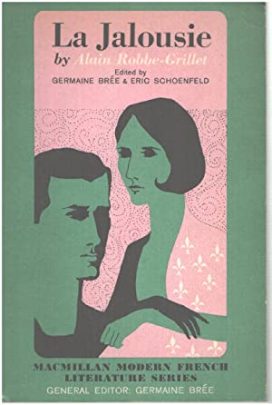
‘La Jalousie’ (Jealousy) by Alain Robbe-Grillet – A Suspicious Husband


‘La Jalousie’ (Jealousy) by Alain Robbe-Grillet     (1957) – 106 pages             Translated from the French by Richard Howard
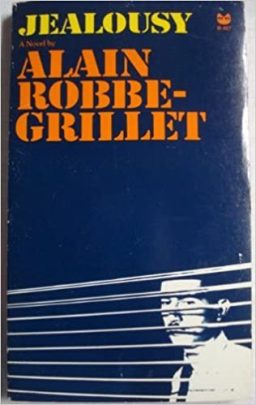
 

Alain Robbe-Grillet was a French author and film maker who was one of the main practitioners of the Nouveau Roman literary movement in the 1950s. The main purpose of the Nouveau Roman movement was to subvert the traditional narrative and plot structures of novels. It was a welcome bold experiment with the fundamentals of fiction.

The French title ‘La Jalousie’ is a play on words that can be translated as “jealousy” but also as “the jalousie window”. In the novel, the narrator is a jealous husband, a tropical planter on a banana plantation, who spies on his wife A… through the jalousie window of their house. He suspects his wife of having an affair with his neighbor Franck.

The bedroom window – the one nearest the hallway – opens outward. The upper part of A…’s body is framed within it. She says “Hello” in the playful tone of someone who has slept well and awakened in a good mood; or of someone who prefers not to show what she is thinking about – if anything – and always flashes the same smile, which can be interpreted as derision just as well as affection, or the total absence of any feeling whatever.”

What makes this novel different is that we see only what this obsessed jealous husband sees. Since he is so obsessed with his wife and his neighbor’s carrying ons, we never get an objective view of events.

He watches his wife and his neighbor interact through that jalousie window, and he becomes extremely jealous. He becomes obsessed with a squashed centipede that Franck had smashed with his hand and is still sticking to the wall. When the neighbor Franck drives our narrator’s wife in to town so she can do some shopping and the two stay overnight our husband’s suspicions know no bounds.

Franck has driven A… into town so she can run some errands. However Franck’s car, his new blue sedan has broken down. They must stay in town. The next afternoon when the three are having drinks, Franck said he was sorry he had given A… that night “in that miserable hotel”.

And now Franck and A… plan another trip into town. Will they return at a reasonable time this time or will they again be forced to stay overnight?
We get lengthy meticulously detailed descriptions of the house construction carpentry and appearance and the smashed centipede staining the carpentry. These lengthy descriptions are somewhat annoying and frustrating for the readers, but they are probably what this guy occupies his mind with as he waits for his wife A… and Franck to return.

These long stretches of less than scintillating prose are probably why the nouveau roman is not popular today. Let’s just say the nouveau roman is quite old now. Otherwise it is a quite captivating and moving scenario.


Grade:    B


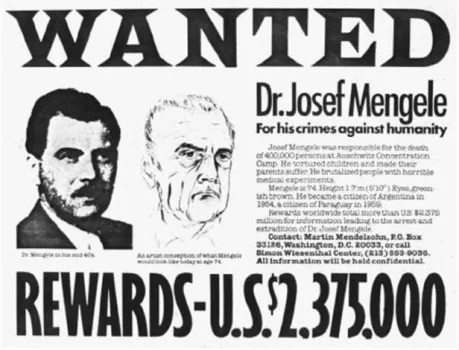
‘The Disappearance of Josef Mengele’ by Olivier Guez – “This is the story of an unscrupulous man…”


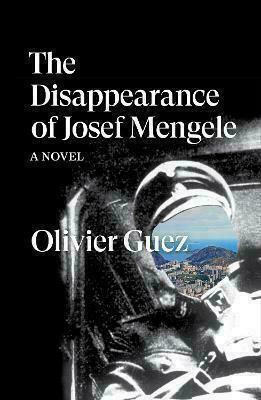
‘The Disappearance of Josef Mengele’ by Olivier Guez (2017) – 213 pages              Translated from the French by Georgia de Chambaret


Here is a novel that meticulously recreates the life of the most notorious one of all the Nazi war criminals who fled to South America after World War II, Josef Mengele. It is fiction because no one knows for sure what Mengele thought or said or did during those more than thirty years he escaped punishment for his crimes.

This is the story of an unscrupulous man with a small, hard soul struck down by a poisonous and deadly ideology that spread through a society weakened by the disruptions of modernity. The ambitious young doctor offered no resistance to the disease of Nazism.”

Mengele was a member of the team of doctors at the Auschwitz concentration camp who selected victims to be killed in the gas chambers and administered the killing gas. He performed deadly experiments on prisoners and was known as the Auschwitz Angel of Death.

He somehow escaped arrest after World War II, and in 1949 sailed to Argentina. Mengele’s father had founded a company that manufactured farming machinery, and the family was able to funnel Josef money throughout the rest of his life.

The leaders of Argentina at that time, Juan Peron and his wife Eva, welcomed these Nazi war criminals with open arms.

Peron opens the borders of his homeland and welcomes thousands upon thousands of Nazis, Fascists, and collaborators: soldiers, engineers, scientists, technicians, and doctors. War criminals are invited to build dams, missiles, and nuclear power plants, turning Argentina into a superpower.”

During the Peron years, Mengele adopts a new name, Helmut Gregor. Otherwise he can live pretty much out in the open with little fears of arrest. In 1956, he obtains a West German passport and goes back to Germany to visit his son Rolf. He starts a relationship with his widowed sister-in-law Martha. Mengele returns to Argentina and starts living under his real name. Martha and her son come to Argentina, and Mengele marries Martha.

Life in Argentina is relatively quiet for Mengele until 1959. In West Germany, Nazi hunters start collecting information on Mengele’s wartime activities and start extradition proceedings against Mengele. Mengele moves to Paraguay to avoid arrest, and his new wife and stepson move back to Germany.

Then in 1960, Nazi war criminal Adolf Eichmann is arrested in Buenas Aires by the Israeli intelligence agency Mossad. Eichmann was executed in Israel in 1962. To escape arrest in 1960, Mengele goes to Brazil.

He may have despised the Argentines, but he truly hates the Brazilians; half-breeds every one of them, mixing Indian, African, and European blood. To a fanatical race theorist who mourns the abolition of slavery, they are the Anti-Christ.”

At the end of this novel, the father Josef Mengele talks to his son whom he hasn’t seen for many years and tries to justify what he did at Auschwitz. Old Josef Mengele is unrepentant.

His son asks, “Have you never felt compassion for the children, the women, the old men you sent to the gas chamber? Do you have no remorse?” Mengele gives his son a filthy look.”

In 1976, Mengele suffered a stroke, and he drowned in the coastal Brazilian town of Bertioga on February 9, 1979 while suffering another stroke. He was 67 years old.

In the end, though, the novel portrays Mengele as a thoroughly despicable character, who came to a miserable — if not miserable enough — end.” – Julia M. Keith, The Forward.


Grade:    A


‘Blue Pages’ by Eleanor Perry – A Hollywood Roman a Clef


‘Blue Pages’ by Eleanor Perry    (1979) – 271 pages


In the 1960s, the husband and wife team of Frank and Eleanor Perry made several acclaimed movies. Eleanor was the scriptwriter, and Frank was the director. The movies they made together include “David and Lisa”, “The Swimmer”, and “Diary of a Mad Housewife”. However as such things go in Hollywood, they were divorced in the early 1970s and went their separate ways.

‘Blue Pages’ is Eleanor Perry’s thinly disguised roman a clef of her married partnership with Frank Perry and her screenwriting days. As a couple, the Perry’s went against the trend in Hollywood as Eleanor was 12 years older than Frank. In this novel, their names are Lucia and Vincent Wade. Both are nominated for Oscars for their first collaboration on a movie that was made on a shoestring budget.

The wife’s experiences have left her quite bitter, There are two reasons for her bitterness:

  1. The shabby way scriptwriters are treated in Hollywood.
  2. The shabby way women are treated in Hollywood.

Being both a woman and a writer, she had double reason to complain. She was “only the writer”, the lowly woman at the bottom of the Hollywood totem pole.

We were writers, despised menials.”

‘Blue Pages’ is about what goes on behind the scenes between the director, the producers, the stars, and the scriptwriters. The fact that it is a woman who wrote the original script makes it all the more subject to criticism by everyone else, even the actresses. The script is vulnerable.

It suffers from being filtered through a – feminine sensibility. Or should I say a feminist sensibility.”

The star of the movie is rewriting the script to make himself even more of a hero. The director is cutting out key scenes of character development.

Along the way, the author captures a Hollywood party at the time where even the old men and women at the party try to look and act like young hippies. When they find out that Lucia’s husband is a director, all the aspiring young actresses immediately surround him.

Eleanor Perry casts a wearily skeptical eye on all the outrageous doings at this typical Hollywood party. It is all quite droll and amusing.

Toward the end of the Sixties, Vincent comes up with a young girlfriend, and Lucia questions their relationship.

I should leave him, she thought. She’d thought it before – every time he cut her down, wiped out her confidence, drew blood when she was most undefended.”

This is an insider’s view of Hollywood, where every director, producer, and actor thinks they can re-write a better script than the scriptwriters.


Grade:   B+


‘One-Shot Harry’ by Gary Phillips – Photographs and Murder in Los Angeles in 1963


‘One-Shot Harry’ by Gary Phillips    (2022) – 274 pages


‘One-Shot Harry’ is a lively mystery about black free-lance photographer Harry Ingram investigating the death of his white friend in racist 1960s Los Angeles. It takes place in Los Angeles during the time of a visit to the city by Martin Luther King Jr. in 1963. Harry is called One-Shot because of his camera work. He is a veteran having served and fought in Korea.

When I came back from over there, I figured me and all them other negro troops bleeding for democracy and all that would be appreciated. How could Mr. Charley deny us our due on the home front?”

But then it was the same old, same old.”

What a surprise.”

Let’s get a drink.”

During the summer between my sophomore and junior years of college back in 1968, I read the book ‘Rivers of Blood, Years of Darkness’ by Robert Conot which was an exhaustive study of the Los Angeles Watts riots of 1965. It was an excellent balanced analysis of the causes of the riots and the situations that occurred during the riots with many first-hand accounts of witnesses and victims. In the book, Conot traces in detail how each of the 34 people who died in the riots was killed. It opened my eyes and gave me a much clearer picture of racial injustice in the United States than I had before. However for me, the very title ‘Rivers of Blood, Years of Darkness’ shows just how all-pervasive the problem of racism is in the United States, even in the very specific meaning of words in our English language.

‘One-Shot Harry’ takes place two years before the Watts riots and just months before King’s major March on Washington in 1963.

I think the March on Washington is going to be a watershed event, don’t you?”

Maybe, but crackers digging in their heels to preserve the way of life they like has usually been the response to any forward motion us colored folks have tried.”

That’s kind of cynical, isn’t it?”

Or just a realistic observation.”

One of the pleasures of reading is an opportunity to root for the underdogs who are being oppressed by others. In the Los Angeles of the 1960s, people who are black are certainly one of the large contingent who make up the underdogs, along with Latinos.

‘One-Shot Harry’ uses 1960s Los Angeles more as a backdrop for it’s mystery story rather than for any more political or instructional purposes, which is fine.


Grade:   B


‘Kick the Latch’ by Kathryn Scanlan – A Woman in a Horse Racing Community


‘Kick the Latch’ by Kathryn Scanlan   (2022)     129 pages


Almost everyone wants to be a part of at least one community. That community might be the people who work at your office or other job site; It might be the people who live in your neighborhood. It might be your fellow churchgoers, or the people who regularly go to the same bar where you go.

The woman who tells her story in ‘Kick the Latch’ is a member of a very tight community, the horse racing community.

The author has immersed herself completely in the life of this woman Sonia who is a race horse trainer. The author then tells Sonia’s life story as simply and clearly as possible, both the bad and the good. ‘Kick the Latch’ consists of many very short vignettes from her life as a horse trainer.

The New Yorker has published a long, long article by Leslie Jamison about ‘Kick the Latch’ which I have read. The New Yorker article is almost as long as the novella itself. The article is titled “Kathryn Scanlan’s Violent Compression”. In the article, Jamison posits that Kathryn Scanlan is using a radical new technique in presenting this woman horse trainer’s story which Jamison calls “violent compression”. I thought the story in ‘Kick the Latch’ was very well told, but I did not feel that the technique used was much different from effective story-writing in the past. I also disagreed with the byline to the article: “In her latest work of fiction, “Kick the Latch,” Scanlan continues to make art about ordinary life by distorting it.” I did not feel this story of the life of a horse trainer was distorted at all.

You get your triple-tie timothy hay bales, a hundred pounds each. Oats comes in ninety-six pound sacks. No one’s going to run up and say, Oh, Miss, let me get that for you! You carry your own. You lift them.”

I appreciated Scanlan’s minimalist approach to her subject; she doesn’t waste a word.

I was seven the first time I seen a horse break down on the racetrack.”

Of course there is the seamy side to horse racing, the betting, and many of the people involved are quite fly-by-night. In one of the early vignettes, she starts out by saying “I got raped”. The man who did it was a jockey she knew. It was devastating for her, but she then takes extra precautions, she gets her hair cut short, and she continues on with her horse training. She doesn’t report it because then her parents would never let her keep working as a horse trainer after that.

Also working with horses is often dangerous, and the people who do it are subject to severe injuries. I guess there are down sides to every occupation.

There’s always puzzlers. Just when you think you know a lot about a horse he’ll show you how stupid you really are.”

‘Kick the Latch’ is a very effective minimalist novella that presents both the up and down sides of the horse racing life.


Grade:    A


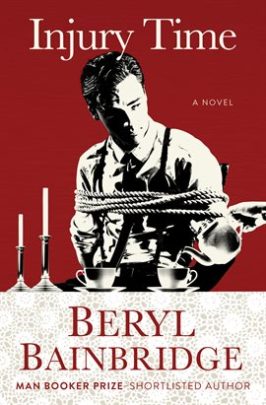
‘Injury Time’ by Beryl Bainbridge – A Demented Dinner Party


‘Injury Time’ by Beryl Bainbridge    (1977) – 203 pages


‘Injury Time’ starts out sanely enough. Edward is a married tax accountant. Binny is a hapless divorcee with three children. Edward and Binny are having an affair. It is the 1970s after all.

Edward feels guilty about Binny.

He gave her so little; he denied her the simple pleasures a wife took for granted – that business of cooking his meals, remembering his sister’s birthday, putting intricate little bundles of socks into his drawer.’”

Binny wonders why Edward couldn’t “pretend that he longed to leave his wife, so that she in return could pretend she wished he would.”

In order for Binny to feel more involved with his life, Edward decides to arrange a dinner party at Binny’s house with his friend Simpson and Simpson’s wife Muriel. Edward must get home by 11:00 PM so his wife does not get suspicious.

So Simpson and his wife arrive that evening at Binny’s house for the dinner party.

As for Simpson, he was just another Edward – too pompous for words. Men were all alike. It was not being involved with children every hour of the day that made them appear to be superior.”

And then everything goes crazy.

First Binny’s woman friend Alma shows up…drunk, and Alma proceeds to vomit all over the floor and pass out.

Then some even more unexpected guests arrive, bank robbers with sawed-off shotguns. ‘Injury Time’ turns from a social comedy of middle-aged passion into a surreal comedic hostage drama with a baby carriage full of cash. When all hell breaks loose, Edward is still worried about getting home to his wife in time.

‘Injury Time’ captures that wildest of times, the 1970s, when things between men and women seemed to go to ridiculous extremes. I do think that Beryl Bainbridge could have better prepared us early on for the unhinged conclusion. However I admire Bainbridge’s willingness to go the dark comedy route rather than settling for a straightforward story.


Grade:   B+


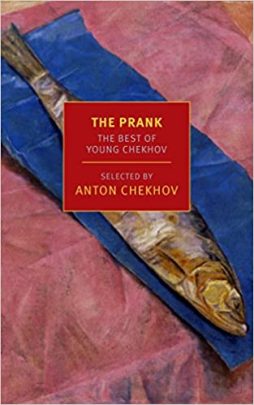
‘The Prank’ – The Best of Young Chekhov


‘The Prank’ The Best of Young Anton Chekhov (1882)

114 pages, Translated from the Russian by Maria Bloshteyn, Illustrated by Nikolay Chekhov


‘The Prank’ is an early collection of stories written by Anton Chekhov as a teenager and in his early twenties and illustrated by his older brother Nikolay Chekhov. At this beginning point in his career Anton saw his writing self mainly as a humorist and wrote these light sketches and stories for various magazines. At the same time Chekhov was training to be a doctor. Chekhov famously wrote,

Medicine is my lawful wife, and literature is my mistress. When I get [fed up with] one, I spend the night with the other. “

In 1882 when Chekhov was only twenty-two, Chekhov put together a group of his sketches and stories to be published as a book. However a stern Moscow censor blocked it from being published. Checkhov would submit his later collections of stories to publishers in St. Petersburg who would print them.

The first sentence from the first story, “Artists’ Wives” (which Chekhov playfully subtitles “Translated….from the Portuguese”) sets the comical good-natured tone for the rest of the collection:

Alphonso Zinzaga, a free, utterly free citizen of the capital city of Lisbon, a young novelist, very famous (only to himself), showing signs of great promise (only to himself), was returning home exhausted and as hungry as the hungriest dog after a whole day of trudging the boulevards and making the rounds of editorial offices.”

In this story, Chekhov laments the plight of the artist’s (literary or otherwise) poor wife who has to put up with him.

You know what, single girls and young widows? Don’t you go and marry an artist!”

The next story, ‘Papa’, also starts out to very humorous effect:

Mama, lean as a Holland herring, walked into the study of Papa, fat and round as a beetle, and gave a little cough. As she entered, the maid jumped off Papa’s lap, darting behind the curtains; Mama paid no attention. She was used to Papa’s little weaknesses. She was the intelligent wife of a civilized husband. She understood.”

In the third story, ‘St Peter’s Day’, this is the day all the men in the village get together with their guns to go hunting. Everything is fine until Mikkei Egorovich, brother of one of the hunters and “the world’s most insufferable man” shows up.

The secret to the success of Anton Chekhov as a fiction writer and as a playwright is so obvious it is a wonder more writers haven’t followed his path. It is Chekhov’s good-natured empathy for all of his characters from the generals, and doctors and lawyers to the ne’r-do-well layabouts and drunks who make up a good part of a village’s population. Of course the generals, doctors, etc. are likely to get pretty drunk too. This all encompassing good-natured empathy of Chekhov’s also extends to the society matrons and housewives of the village to the lowliest servant girls.

At this early point in Chekhov’s writing career, he was most interested in finding the humor in various human situations; later, his writing would become more poignant.

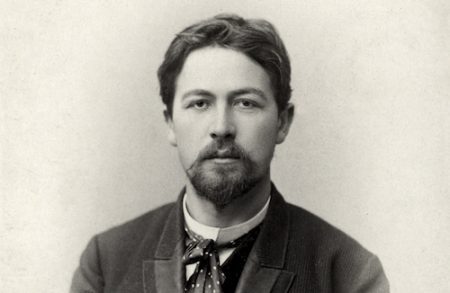
Young Chekhov

This is quite a fun collection to read, but if you have not read Anton Chekhov before, I would recommend you read a collection of his later stories before reading ‘The Prank’. After you have read his greatest stories, turn to his plays which are more dramatic, ironic, and subtle.

No writer has a higher standing in my literary world than Anton Chekhov.


Grade:   A