‘Stone Mattress’ by Margaret Atwood (2014) – 268 pages
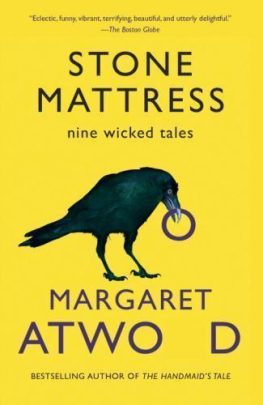 What is the difference between a tale and a story? According to Margaret Atwood, a woman whose penetrating wisdom I treasure from many of her quotes, it is the following:
“Calling a piece of short fiction a “tale” removes it at least slightly from the realm of mundane works and days, as it evokes the world of the folk tale, the wonder tale, and the long ago teller of tales. We may safely assume all tales are fiction, whereas a “story” might be a true story about what we usually agree to call “real life”, as well as a short story that keeps within the bounds of social realism.”
Margaret Atwood calls the fictions in ‘Stone Mattress’ tales rather than stories for a good reason. Tales are wilder than stories and are not limited by what actually could happen to real people.
Alice Munro, another famous Canadian fiction writer, is a wonderful writer of stories that do not veer far or at all from real life as we know it. On the other hand, Margaret Atwood excels at going beyond the everyday world as we have seen from ‘The Handmaid’s Tale’ and other of her works.
These tales in ‘Stone Mattress’ are wild and strange, living up to Atwood’s definition of a tale. In the title story, an old woman on a guided tour spots a man who mistreated her cruelly back in high school. He doesn’t recognize her, and she decides to get her revenge using a billions-year old rock.
In the tale ‘The Freeze Dried Groom’ Atwood writes about a slimeball husband. Instead of being angry about this scuzzbag, Atwood writes a humorous story from his point of view but with him getting his comeuppance in the end.
In the tale, “The Dead Hand Loves You”, the narrator Jack says to his old girlfriend Irena:
“I wouldn’t have forgotten you. I can never forget you.” Is this bullshit, or does he really mean it? He’s been in the bullshit world for so long it’s hard to distinguish.
I couldn’t imagine Alice Munro writing a sentence like the following about Jack:
“Their view of him was that he was a fuck-up and a jinx from whom stray dogs fled because they could smell failure on him like catshit.”
Both the tales and language of Margaret Atwood are wilder and looser than those of Alice Munro. I really liked the imaginative flourishes and un-restraint of all these tales in ‘Stone Mattress’.
Sometimes it’s good for the imagination to go beyond realism.
Grade: A
 Tony's Book World
Posted by Janakay | YouMightAsWellRead on December 26, 2022 at 10:47 PM
Hi Tony — I see we totally agree on this one, i.e., it’s great! I’m generally a big fan of Atwood’s (she’s one of my favorite writers) but, even so, for me this collection stood out. Although all the stories/tales are strong, like you, I particularly enjoyed the title story and it’s revenge theme (no one does revenge better than Atwood!)
LikeLiked by 1 person
Posted by Anokatony on December 27, 2022 at 2:46 AM
Hi Janakay,
I remember, back in the 1980s, I went to a poetry reading of Margaret Atwood and bought a signed copy of one of her books of poems (which I can’t find now).
However when it came to fiction my Canadian favorite was Alice Munro, and I kind of neglected the fiction of Margaret Atwood. Lately I have enjoyed reading some of the criticism writings about fiction and life by Margaret Atwood, and decided I should read more of her fiction work. I really enjoyed ‘Stone Matress’, so I probably will be reading more of Atwood’s work.
LikeLike