‘Black Cloud Rising’ by David Wright Falade (2022) – 290 pages
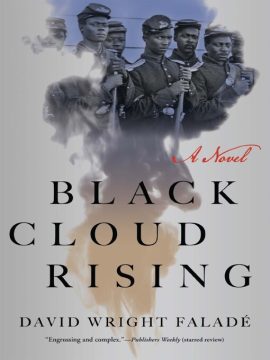 Imagine a troop of black soldiers marching in the South of the United States in 1863, freeing the slaves on the farms and plantations there.
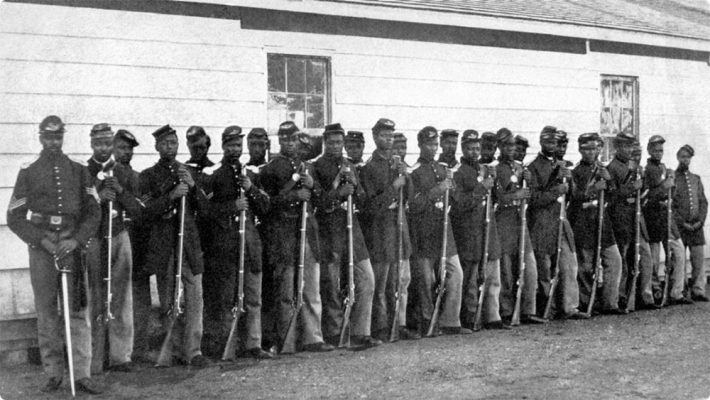
‘Black Cloud Rising’ tells a fictionalized account of the experiences of the real person Richard Etheridge. Richard was born a slave in 1842 on one of the islands of the Outer Banks near Virginia. When the Civil War started, these islands were among the first to be recaptured by the forces of the Union. In 1863, Richard became a Sergeant in the African Brigade, a recently-formed black troop. One of the first duties of the African Brigade was to go around to the various farms in rural Virginia and actually emancipate the slaves living on these farms. As the slaves were being freed, many of the men would then enlist in the African Brigade.
‘Black Cloud Rising’ takes off to a rousing start when the slaves on one farm tell the troops how their owner used to beat them using a whipping post. The troops then subject the owner to a beating using his own equipment.
Later the African Brigade moves into North Carolina. There they had to deal with the bushwhackers, loosely formed Rebel guerrilla groups who would be particularly cruel to these ex-slaves if they could get away with it. Some of the white slave owners took off to Texas keeping their slaves.
“We will be in the enemy’s country, men, so look sharp and bring pride to the African Brigade.”
Some of the white officers expressed surprise at how fiercely the black troops fought. But black soldiers were fighting for much more than restoring the Union. They were fighting to liberate their people.
Since, in the days of slavery, the slave owners themselves often took on the task of impregnating the young female slaves in order to replenish their slave supply, you had situations where the white and black children on the farm or plantation were nearly all half-brothers or half-sisters, and they would play together as little kids. Later the black kids would be put to work from sunup to sundown, while the owners would tell their white kids not to associate with the black kids, their half-brothers and half-sisters, anymore.
Thus in some cases, the Civil War was a family feud, with half-brother fighting his half-brother.
Richard’s half-brother Patrick uses the N-word, and Richard calls him on it. Then Patrick says, “It’s different with you, we come up together. You’re like family”.
“Like family? Patrick, you and I are family.”
The upper echelon of officers in the African Brigade were white. Some of these white officers were better than others.
As I said before, ‘Black Cloud Rising’ is a rousing lively novel dealing with a little-mentioned aspect of the Civil War. This is a dramatic stirring historical novel.
At one point, we get a first-hand account of the public hanging of a bushwhacker.
How well did the members of the African Brigade perform as soldiers? One of the white officers of the African Brigade, Colonel Draper, said:
“It seems to me that what makes you and your lot good soldiers has to do with what was beaten into you to make you learn to submit. Soldiers and slaves, their daily surrender to authority was similar.”
As for me, I expect they performed as well as many of the black players in the major sports leagues of football, baseball, and basketball today. In other words, I have no doubt that they probably excelled as soldiers.
Grade: A
 Tony's Book World
Posted by Janakay | YouMightAsWellRead on March 24, 2022 at 7:16 PM
It’s interesting (and encouraging) to see more & more fiction written about a past that has been largely ignored until now. I can’t remember if you read much non-fiction, or are interested in the visual arts, but the history of the 54th Massachusetts is incredibly moving; a civil war unit composed of Black soldiers, it suffered enormous casualties on the assault on Fort Wagner. The actual monument’s in Boston, but Washington’s National Gallery has several plastere casts and a bronze of a slightly different version. I look at it most times when I visit the museum. https://www.nga.gov/collection/art-object-page.102494.html
The Black soldiers serving in the Union army were incredibly brave, particularly as they were treated horrifically by Confederate forces. If captured, many were returned to slavery or slaughtered. Nathan Bedford Forest, the darling of 19th (and some 20th) century Southern historians (and an ex-slave trader before the war) mae a point of this; he was responsible for massacring Black Union troops stationed at Fort Pillow, Tennessee. Forest later capped his career by founding the Ku Klux Klan and serving as its first grand wizard.
I grew up BTW in a deeply southern state. The history I learned before the tides of revisionism set in characterized the KKK as a group of southern patriots who, while they may have gone a bit overboard at times, were essentially fighting to protect their home & rights, both taken away by Union forces. It’s so encouraging to see the historical record set straight and to also see this reflected in popular fiction.
LikeLiked by 1 person
Posted by Anokatony on March 24, 2022 at 8:50 PM
Hi JanaKay,
How could anyone who has watched US professional sports not figure out that black men and women would be exceptionally good soldiers?
I did watch the movie Glory about the 54th Massachusetts, a very fine movie.
I was born on a Wisconsin farm, so we did not see many black people. I think my family, neighbors, and I suffered from the severe racism of the ignorant. I still find myself having to revise some of those earlier insidious attitudes.
Nathan Bedford Forest is one of those villains of US history. At least in my neighborhood we didn’t have the KKK, but attitudes were still pretty bad.
LikeLiked by 1 person
Posted by Lisa Hill on March 25, 2022 at 3:03 AM
“It’s so encouraging to see the historical record set straight and to also see this reflected in popular fiction.” Well said, JanaKay. If it is well done, and it sounds as if this is, historical fiction is a powerful educational tool. Conversely, if it is romanticised nostalgia as Gone With the Wind is, it can be harmful. I still cringe at my teenage self chuckling at Mammy’s red petticoat and worrying about the ‘uppity freed slaves’ menacing Scarlett; I hadn’t realised what a vile film GWTW was until I saw it again in 2015 on a long-haul flight. (I wrote to Singapore Airlines telling them not to screen it again and why, but I don’t suppose they took any notice).
The parallel to be wary of is what is being called the ‘pyjamasisation’ of the Holocaust, novels which popularise a Lite version of it, with romance, sentimentality and an improbable surfeit of ‘good’ Germans. .
I don’t think it’s an exaggeration to say that blog reviews like this one are a good way of publicising the good ones.
LikeLiked by 2 people
Posted by Anokatony on March 25, 2022 at 4:08 AM
Hi Lisa,
Even though I consider both Clark Gable and Vivien Leigh very fine actors, somehow I have avoided ‘Gone With the Wind’ all these years.I probably will continue to avoid it, since there are a lot of good movies with these stars.
What I have been considering is that slavery and the Holocaust took place in so-called “civilized” white countries. Once again with the Ukraine war, we are seeing that these so-called white civilized countries are the most brutal. Maybe we should reconsider what the word “savages” means.
LikeLike
Posted by Lisa Hill on March 25, 2022 at 4:36 AM
But what we are also seeing is that nobody cared much about wars involving people of colour in other countries. Nobody cared about Syria or Yemen and the West abandoned Afghanistan and Iraq because democracies were tired of it.
Our tolerance for when it’s ok/not ok to invade a sovereign country is pretty elastic too. Global politics is *always* about self-interest, it is never about moral principles.
LikeLiked by 1 person
Posted by Anokatony on March 25, 2022 at 5:31 AM
This is all true. No one in the US or in Europe seems to care about what happens to the Yemenites
LikeLiked by 1 person
Posted by kimbofo on March 25, 2022 at 8:04 AM
And don’t forget the Rwandan Genocide and the Khymer Rouge in Cambodia. War and genocide and murder doesn’t have a colour… it’s humans doing unspeakable things to their fellow humans
LikeLiked by 1 person
Posted by kimbofo on March 25, 2022 at 8:07 AM
Oops. Rogue “or” in there.
LikeLiked by 1 person
Posted by Anokatony on March 25, 2022 at 9:13 AM
I believe Khmer Rouge is correct. I took out the ‘or’.
LikeLike
Posted by kimbofo on March 25, 2022 at 10:00 AM
Thanks 🙏
LikeLike
Posted by Lisa Hill on March 25, 2022 at 3:05 AM
Oops, typo: *are* a good way….
LikeLike
Posted by Lisa Hill on March 25, 2022 at 3:19 AM
PS I’ve just done a search for this: in Australia prices range from $36 to $50 + delivery costs, and even if I abandon my principles about Amazon, it’s not available on Kindle. I’ll have to see if I can persuade my library to get a copy…
LikeLike
Posted by kimbofo on March 25, 2022 at 8:07 AM
Thanks for doing the research Lisa. I have an Amazon UK account (because I still have a UK bank account) but even on there it’s very pricey.
LikeLike
Posted by Lisa Hill on March 25, 2022 at 10:13 AM
Hmm, yes, it’s a pity. Because otherwise I wouldn’t have hesitated.
LikeLike