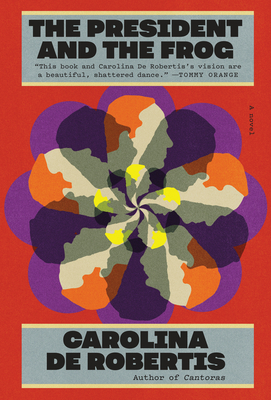
 To fully appreciate this simple novel ‘The President and the Frog’, you first must know a few facts about the real person who is this fiction’s main character, José Mujica.
José Mujica was President of the South American country of Uruguay from 2010 to 2015. What makes his story unique is that in his younger days Mujica was a leader of the left-wing urban guerrilla movement the Tupamaros. The Tupamaros were responsible for political kidnappings and assassinations during the time of Uruguay’s right-wing dictatorship. In 1970, the Tupamaros kidnapped and killed United States CIA torture instructor Dan Mitrione. During the years that Uruguay was ruled by the US-backed military junta, Mujica was imprisoned in squalid conditions, locked in a cell by himself in a hole in the ground. In all Mujica spent 13 years in prison and was subjected to frequent torture.
“Once upon a time there was a group of revolutionaries who’d dreamed of changing the world for the better by fighting the forces of repression, but the forces of repression were a monster that grew new tentacles with every battle they fought.”
The military dictatorship of Uruguay ended in 1984 with democratic elections, and Mujica was finally released from prison. Later Mujica would become Uruguay’s Minister of Agriculture and later was elected President of Uruguay in 2009.
‘The President and the Frog’ celebrates the breaking away of Uruguay from the evil influence of the United States government which supported and aided severe dictatorships across South America which tortured and murdered many of their own people for opposing their tyranny.
A Norwegian TV reporter has come to interview Mujica now that he is President.
“You have many admirers in Norway.”
“That’s very kind.”
“It’s quite true. You’re a beacon of hope, giving the world a different view of leadership, showing us that it’s possible for a president to truly serve the people.”
During the interview Mujica recalls his prison days.
As you can tell from the title ‘The President and the Frog’, it is written as a fable. When Mujica is imprisoned in a hole in the ground, only the frog is there for him to talk to. The frog is kind of a wise guy, but sometimes he has some good advice.
You don’t want to be broken. Don’t be broken.
“You’re a frog. You don’t know what humans do to each other – what they’ve done to us.”
And what they haven’t done.
“There’s nothing they haven’t done. Just look at me. They’ve starved me, beaten me, tortured me with their fancy imported torture machines, put me here alone, and done it not just to me but to the lot of us, the resistance lost, we’re lost, we’re all done for. “
Ho-de-hum, co-co-comes a sto-rm.
“Have you even been listening?”
Silly man.
This is a simple inspiring story about a remarkable leader we here in the United States have not heard much about.
Grade: A
 Tony's Book World
Posted by Lisa Hill on February 26, 2022 at 1:20 AM
I just looked up José Mujica at Wikipedia. What a remarkable man!
I wonder if many Americans know much about their interference in South America? People like us, politically aware, in the 1970s knew about it, but it seems to have faded from view. (I remember a colleague at work (from Chile, younger than me) being very surprised that I knew anything about it).
LikeLiked by 1 person
Posted by Anokatony on February 26, 2022 at 1:41 AM
Hi Lisa,
Uruguay has become the most advanced country in the Americas in terms of respect for “fundamental labor rights, in particular freedom of association, the right to collective bargaining and the right to strike”. I see that José Mujica has been called “the last hero of politics”. That seems about right considering the way things are going. I search out articles and novels about that terrible time in South America during the 1970s and 1980s caused by United States interference. I expect most US people know about some of the atrocities but avoid digging too deeply.
LikeLike
Posted by Lisa Hill on February 27, 2022 at 4:56 AM
It seems to me that there is a fundamental disconnect between the way the global economy works and the wellbeing of most people on the planet. It’s mostly ok for people in western economies, but mostly not ok for anybody else. And if they try to challenge that, they are very quickly stopped by either overt or covert means.
LikeLiked by 1 person
Posted by Anokatony on February 27, 2022 at 6:18 AM
Do you consider Australia a western economy? Just wondering.
Some countries are able to have a strong economy without exploiting different peoples and races, but the United States isn’t one of them.
LikeLike
Posted by Lisa Hill on February 27, 2022 at 7:20 AM
I use ‘western’ in a political-economic sense, not a geographic one, so, yes, we are… we are part of the OECD, and the G20, and we play by those economic rules…
Any country that imports stuff at very cheap prices, is complicit in the underpayment and exploitation of people in poor countries. We pay lip service about not buying stuff from countries with slave or indentured labour, but hey, when an Aussie is in the supermarket, s/he buys all the cheap imported produce from Asia and SE Asia, and we don’t have local manufacturing of shoes, crockery, cars, most clothing etc because we import from (mostly) China where labour conditions are atrocious. We do grandstanding about the Uyghurs but we don’t say a word about people injured in Chinese factories who make the things we buy.
And anyone who does, such as I have just done, is automatically labelled a Leftie, possibly even a covert communist!
LikeLike
Posted by Janakay | YouMightAsWellRead on March 1, 2022 at 6:06 AM
Fascinating review Tony! I also enjoyed the dialogue between you and Lisa. I’m afraid it’s all too true, that most of us in the U.S. really know very little about Latin America. I don’t consider myself an exception to this sad truth. I only became interested in the region long after the horrors of the 1970s, when I actually started visiting some of the South & Central Ameican countries as an eco-tourist. It’s one of the reasons I started reading some of the Spanish language authors, as there’s no better way IMO to learn about a country than to sample its literature & art. Thankfully, there seems to be an ever increasing amount of translations available.
LikeLike