Whoever came up with monotheism – the idea that there is only one God – suffered from a severe lack of imagination. Yet millions of people today are stuck with this notion of an all-knowing, all-seeing, all-good “Big Man in the Sky”. And why would God be a man when the woman is much more integral to the birth process?
The ancient Greeks had it right, gods and goddesses for every occasion. We have Zeus and Athena and Apollo and Aphrodite. We have Ares, the god of war, but we also have Eris, the goddess of strife and chaos. We have a god or goddess for every facet of existence.
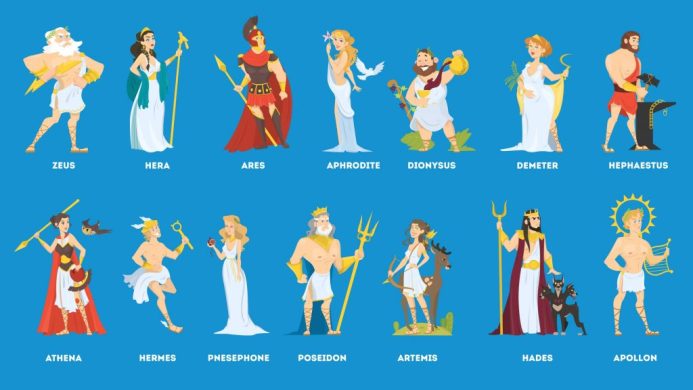
The Greeks also had it right that the gods and goddesses were not too good to be true. Their gods and goddesses had the same faults and weaknesses that we humans do. However there is one critical difference, the gods and goddesses are immortal; they do not die.
The Greek gods and goddesses intermingle with the humans too. The gods and goddesses have all the human faults. They are vain and selfish. Zeus has slept with many of the women in the kingdom, much to the displeasure of his goddess sister Hera to whom he is also married. Demigods – half god and half human – are popping up all over the place. And there are many, many other examples of gods or goddesses and human hook-ups.

‘Thetis Dipping Achilles in the Styx’ by Honoré Daumier
To take one famous example, Achilles was the son of the Nereid goddess Thetis and Peleus, the mortal king of the Myrmidons. Thetis loved her shining son Achilles, so she dipped his entire body in the holy river Styx in the hope that Achilles would then be immortal. However she held the baby boy by his heel which did not get submerged. Later Achilles would have many successes on the battlefield to become known as the Greeks’ greatest warrior. Finally Achilles would die on the battlefield after he is stabbed in the heel by a spear wielded by the Trojan warrior Paris.
These are the kind of stories that monotheism does not have due to its lack of imagination and of diversity. There are hundreds of these stories in the Greek myths about the interplay of the gods and goddesses with the humans, and then the resulting demigods.
Stay tuned for my next post in regard to ‘A Thousand Ships’, a re-telling of the stories of the Trojan War, by Natalie Haynes.
 Tony's Book World
Posted by Janakay | YouMightAsWellRead on February 8, 2022 at 5:54 PM
Hi Tony — looks like you’re on a classical kick here! I, too, have always enjoyed mythology (mostly western classical) and retellings of the myths. Have you read anything by Madeline Miller? I know you read the Anne Carson thing but can’t remember if you mentioned Pat Barker’s trilogy on the Trojan war.
It’s really interesting to see the numerous modern treatments of these classical stories. Some readers don’t like them; to me they’re evidence of the vitality of the source material.
Aside from the religious angle, I do think you’re shortchanging just a little bit the biblical stories as sources of creativity and imagination. Just think of all that early modern art with religious subjects . . .
LikeLiked by 1 person
Posted by Anokatony on February 8, 2022 at 6:17 PM
Hi Janakay,
Over the years, I have read and enjoyed many novels and stories based on the ancient Greek myths including ‘The Song of Achilles’ by Madeline Miller. I have also read a number of the ancient Greek plays by Euripedes, etc. Still I needed a refresher course on my Clytemnestra, my Odysseus and Penelope, my Andromache and Astyanax, etc. I might as well say it now. ‘A Thousand Ships’ is a delight.
I was brought up a Lutheran, and our mother made sure we attended our small rural church, so I’m familiar with the bible stories. The Lutheran minister there wanted to show off how well his parochial students performed, so us non-parochial students were treated as the poor unkempt stepchildren. Maybe that’s why I’m a bit skeptical of monotheism today. :)
LikeLiked by 1 person
Posted by Janakay | YouMightAsWellRead on February 8, 2022 at 6:28 PM
Tony — my comment didn’t really relate to monotheism or religion as such; it was directed to the creative and artistic use of biblical mythology (that’s pretty much how I think of the bible) in the visual arts (literature too, probably. Didn’t Thomas Mann do some huge novel on Joseph & His Brothers?). I totally agree that the classic/pagan myths have been incredibly rich sources for creativity & art, I was merely trying to point out that artists, at least until fairly recently, looked to biblical mythology just as much.
I was lucky enough to have a wonderful Latin teacher in high school who took a broad view of her subject & included mythology and classical history along with the language. Many of her students continued this in college, to some extent. Like you, I have a real fondness for the subject.
The rural Lutheran thing sounds rough. From personal experience, I can assure you that Southern Baptist churches, at least back in the day, were certainly not much better!
LikeLiked by 1 person
Posted by Anokatony on February 8, 2022 at 6:45 PM
I have not read ‘Joseph and his Brothers’, but I have read ‘The Gospel According to Jesus Christ’ and ‘Cain’ by Jose Saramago, both of them superb. Another excellent novel based on the Bible is ‘The Four Wisemen’ by the French writer Michel Tournier, a writer I would put up there next to Saramago.
My first encounter with the ancient Greek myths was in college with ‘Mythology’ by Edith Hamilton, a fine book but not fictionalized.
There is a quote about surviving childhood that I can’t come up with now, but I suppose most kids have a wonderful/awful time of it.
LikeLiked by 1 person
Posted by Janakay | YouMightAsWellRead on February 8, 2022 at 11:09 PM
I have Cain on my list (in fact, already have a copy) and I do believe I read (or skimmed) The Fourth Wise Man many, many years ago. Like you, I loved Edith Hamilton’s Mythology, almost as much as her Greek Way (The Roman Way wasn’t as good, but still worth reading).
There are so many talented classical scholars now, many of them women (Mary Beard springs to mind); I also noted a couple of recent books focused on reinterpreting the myths from a feminist perspective. All wonderful to see, as they’re living proof that the old stories retain their vitality.
LikeLiked by 1 person
Posted by Annabel (AnnaBookBel) on February 8, 2022 at 9:01 PM
I love all the retellings of ancient myths and legends, gods and goddesses wherever they come from, and the Old testament did have loads of really good stories. Haynes is super, but Ive not read 1000 ships yet.
LikeLiked by 1 person
Posted by Anokatony on February 8, 2022 at 9:09 PM
HI Annabel,
It’s surprising that Shakespeare didn’t get into using some of the Old or New Testament stories in some of his plays, but I guess that wasn’t his thing. Now there is a lot of fiction based on Shakespeare plays which is another rich source for material.
LikeLiked by 1 person
Posted by Lisa Hill on February 9, 2022 at 11:32 AM
Yes, I love ’em too.
I really liked John Banville’s The Infinities, where a family reunion because the patriarch is dying, is subjected to the whims of some vengeful Greek gods. They watch the vigil with cynical amusement and mild jealousy; they interfere out of malice and selfishness. They are petty and vindictive; they are sensual and spiteful. Humans are their playthings, an amusing diversion. It causes chaos…
LikeLiked by 2 people
Posted by Anokatony on February 9, 2022 at 6:13 PM
Hi Lisa,
“Humans are the gods’ playthings”; that’s about right. Maybe that’s where Christianity gets it wrong, god or the gods can misbehave.
Yesterday I was trying to figure out a list of novels based on Greek myths. Since I wasn’t familiar with ‘The Infinities’ by John Banville, I didn’t think of that one.
LikeLike
Posted by Lisa Hill on February 10, 2022 at 3:21 AM
Oh, it’s wonderful. Banville is a bit hit and miss for me, but I really liked that one.
LikeLiked by 1 person
Posted by Janakay | YouMightAsWellRead on February 9, 2022 at 2:51 PM
Hi Tony — I don’t want to hi-jack your blog but I did want to respond to Lisa’s comment regarding Banville’s Infinities (which is now on my TBR). A few years ago I took a class in “Mythology in Renaissance Art” or something like that (text was Ovid’s Metamorphosis) where this was precisely the point the instructor made: the best thing for humans was simply to avoid notice or contact with immortals; attracting their notice, particularly for women, was dangerous (think Callisto, Io, Semele and so on). Even when things start off well, they don’t end that way . . .
LikeLiked by 1 person
Posted by Anokatony on February 9, 2022 at 6:08 PM
Going unnoticed by the gods. What fun would that be? :)
LikeLiked by 1 person
Posted by Janakay | YouMightAsWellRead on February 9, 2022 at 7:29 PM
Probably more fun than being turned into a tree, or a bear (subsequently hunted by your son), or a cow, or consumed by fire or . . . (LOL)
LikeLiked by 1 person
Posted by Charles Behlen on February 11, 2022 at 7:22 PM
There is but one God, and she is Scarlet Johansson
LikeLiked by 1 person
Posted by Anokatony on February 11, 2022 at 7:57 PM
Scarlett Johansson? I would have thought Lily James or Anya Taylor-Joy.
LikeLike
Posted by Tales from the Greek, by John Hughes with artwork by Marco Luccio | ANZ LitLovers LitBlog on March 6, 2022 at 12:07 PM
[…] Tony from Tony’s Book World so recently pointed out in his post ‘Why I Enjoy the Greek Myths, Greek myths and legends have a universal, enduring appeal. Unlike monotheistic gods, Greek gods […]
LikeLike