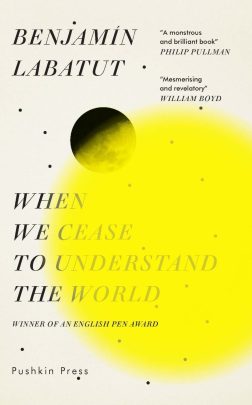
‘When We Cease to Understand the World’ by Benjamin Labatut (2020) – 188 pages Translated from the Spanish by Adrian Nathan West
 I try to keep up with the major happenings in this world of ours. Yet until I read ‘When We Cease to Understand the World’ I had not ever or even heard of the Haber-Bosch process, the process developed in 1907 used to extract nitrogen directly from the air.
“The Haber-Bosch process is the most important chemical discovery of the twentieth century. By doubling the amount of disposable nitrogen, it provoked the demographic explosion that took the human population from 1.6 billion to 7 billion in fewer than a hundred years. Today nearly fifty percent of the nitrogen atoms in our bodies are artificially created, and more than half the world population depends on foodstuffs fertilized thanks to Haber’s invention. The modern world could not exist without “the man who pulled bread from air”, in the words of the present day.”
And I thought I was well-read.
Fritz Haber, the German Jewish scientist who invented this process, somehow escaped Nazi Germany in 1933 only to die shortly thereafter. The cyanide poison gas Zyklon which the Germans used during World War I was also produced by Haber and his team. After World War I, Zyklon was banned for use in warfare. However the Germans modified Zyklon into Zyklon B and used it in gas chambers to poison the Jewish concentration camp inmates. Many of Haber’s relatives were murdered by the Nazis in this fashion.
‘When We Cease to Understand the World’ is about those scientists and mathematicians who have shaped our modern world for better or worse. The Heisenberg Uncertainty Principle, the name, has always intrigued me although I still do not understand it. In this book we meet the odd eccentric man who developed this principle, Werner Karl Heisenberg.
In a feverish fit of delirium which lasted for days on the island of Heligoland in 1925, Heisenberg shaped his strange revelations into a publishable article.
After Niels Bohr read Heisenberg’s paper, Bohr wrote to Albert Einstein.
“Heisenberg’s latest paper, soon to be published, appears rather mystifying but is certainly true and profound and will have enormous implications.”
“And spare us any resort to the repulsive algebra of that cursed Wunderkind, Werner Heisenberg!” Erwin Schrödinger said to them provoking a fit of laughter among his colleagues.”
The Heisenberg Uncertainty Principle is the entire basis of quantum theory which explains how everything works at the sub-atomic level as both wave and particle. That is as much as I know.
However the stories of these strange brilliant scientists and mathematicians are intriguing. Fritz Haber, Karl Schwarzschild, Alexander Grothendieck, Werner Karl Heisenberg, Erwin Schrödinger, Albert Einstein. These are the individuals who have created our modern world.
But is this book fiction or non-fiction?
Although all of the persons in this book are real people, and their circumstances have been well-documented, there are fictional flourishes in describing some of the incidents in the lives of these physics and chemistry geniuses that go beyond what the author could possibly know and thus violate the standards of non-fiction. The book starts out almost totally factual with its portrayal of the German chemist Fritz Haber, but it uses more fictional devices as it goes along. For example, how does our author know there was a tingle running down Schrödinger’s spine?
The author himself states in the Acknowledgments that “This is a work of fiction based on real events.”
Fiction or non-fiction, it makes for fascinating reading.
Grade: A
 Tony's Book World