‘The Trojan Women’ by Euripides via Rosanna Bruno, Text by Anne Carson (2021) – 78 pages
 I have no qualms about reading a comic or graphic version of Euripides’ play ‘The Trojan Women’, especially when it is scripted by the world-renowned classicist of Ancient Greece and one of my personal favorites Anne Carson.
Troy has been defeated in war by the Greeks, and all of its men are dead in battle. The women and children of Troy have been rounded up and will be carried off on ship by the Greeks to serve as the Greeks’ concubines or slaves.
“We can’t go on. We go on.”
‘The Trojan Women’ focuses on four of these women:
Hecabe (often spelled as Hecuba) – Wife of King Priam who is of course dead now
Helen – The most beautiful woman who some say started the war by leaving her husband Menelaus to join King Priam’s son Paris in Troy. Paris is of course dead now too.
Kassandra – daughter of King Priam. Some say she’s a prophetess, some say she’s crazy.
Andromache – another daughter of King Priam, married to the brave warrior Hector who is also dead. Much of the play ‘The Trojan Women’ centers around the murder of her young son Astyanax by the Greeks
 The artist of this comic book, Rosanna Bruno, takes great liberties in depicting these characters as well as all of the other characters in the play. Hecabe is depicted as a dog, Helen as a sable fox, Andromache as a poplar tree. Only the psycho Kassandra is depicted as a human woman. The god of the sea Poseidon is depicted as a giant ocean wave. The goddess Athena is depicted as an owl wearing overalls.
These depictions do take a bit of getting accustomed to, especially that of Andromache as a poplar tree, but ultimately I did not have a problem with them.
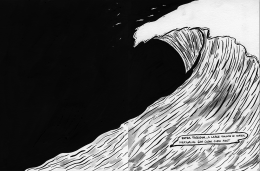 All of these Trojan women are bemoaning the fate of Troy and their own fates as they are forced on to ships to be taken away by the Greeks. Troy has been burned to the ground. The Greeks murder the child Astyanax for fear he will become a brave warrior like his father Hector.
“That man is a fool who counts on success lasting, it leaps around like a lunatic. And no one makes their own luck.”
Reading this comic proved to be a mainly painless way to become familiar with this ancient Greek play.
Grade: A
 Tony's Book World
Posted by Janakay | YouMightAsWellRead on December 27, 2021 at 6:13 PM
Hi Tony! I loved this particular play, which I read in translation during my semi-classical days. I was interested to see your take on graphic version, particularly as I decided to pass. I love modern treatments of the ancient classics; after all, what greater proof is there that such works continue to speak to us across the centuries? I decided to pass on this particular treatment of the play, however, when I read a description of the artwork, as I just couldn’t “see” Hecuba as a dog. I think, however, that on second thought, I’m going to give this a try.
Have you read Carson’s Autobiography of Red? I’ve been meaning to get to it for years!
LikeLiked by 1 person
Posted by Anokatony on December 27, 2021 at 6:35 PM
Hi Janakay,
Since verse novels are one of my favorite genres, I have read ‘Autobiography of Red’. I believe that was the novel that started my admiration for Anne Carson. I have also much enjoyed her ‘The Beauty of the Husband’ and her translations of some of the ancient Greek plays.
Yes, the depictions of the characters in ‘The Trojan Women’ as a dog or a tree or an ocean wave or a fox or a owl takes a lot of getting used to. I guess my admiration for Anne Carson circumvented that problem for me.
LikeLiked by 1 person
Posted by Lisa Hill on December 28, 2021 at 2:07 AM
Do you think the comic treatment conveys Euripedes theme of the senselessness of war?
LikeLiked by 1 person
Posted by Anokatony on December 28, 2021 at 2:35 AM
Hi Lisa,
I did not get much insight into the senselessness of war from this comic treatment of ‘The Trojan Women’.
LikeLike
Posted by Lisa Hill on December 28, 2021 at 5:20 AM
Ah… I’m remembering seeing it on stage, and it was heart-rending.
LikeLike
Posted by Kat on December 29, 2021 at 11:04 AM
Sounds strange and charming. I like Ann Carson, so if she’s involved, it will be fascinating! IT is now on my wish list, as they say.
LikeLiked by 1 person
Posted by Anokatony on December 29, 2021 at 5:39 PM
Hi Kat,
Yes, it was the prestige of Anne Carson that saved this graphic novel for me. Now that I think about it, the outlandishness of these characters’ artistic depictions kind of detracts from the overall theme of the senselessness of war.
LikeLike