Archive for May, 2021

‘Hold’ by Bob Hicok – “Who can explain lonely to ants?”


‘Hold’, poems by Bob Hicok (2019) – 104 pages

 

Words are Bob Hicok’s playthings, and he loves to play. This is the second of Hicok’s lively poetry collections which I have read.

Will you appreciate Hicok’s humor? I suppose it depends if you think the following lines are funny.

“My Way” should only be sung underwater,

so the narcissism is softened a bit by drowning.”

I am going to quote you the first sentence of the poem “Waiting is the Hardest Part of Waiting” which is in this ‘Hold’ collection, and it will give you some more indication whether or not you will like these poems:

“I like the way your nose wrinkles

when you confuse a coping saw

for a coping mechanism and cut a duck

out of balsa to float on the lake and keep

the mallard with one wing company

badly, in that your duck has the shape

and soul of a potato.”

And then there is this great line in the poem “Baby Steps” about Bob Hicok’s father:

Joy isn’t a hat I ever saw him wear”

Hicok’s mind moves so fast from one thing to another it is difficult to keep up with him. Many of the poems I did not fully appreciate until multiple readings. However then I really did appreciate them, and that is saying a lot for any poems.

Sometimes he goes completely off the rails, but that is partly the fun of this poem collection.

In a few of his more political poems, I missed some of his usual whimsy and they seem somewhat pedestrian and overly polemic although I agree with most of his positions. Hicok is plenty aware of the problems of putting politics into poems:

Now I’m stuck, as politics

and poetry get along about as well as lips

and soldering irons, hawks and wet cement;”

Sometimes the playfulness of the words doesn’t match the seriousness of the poem’s intent, but that’s OK. Bob Hicok takes chances.

What is it about poetry that it refuses to die no matter how often TV shoots it in the head?”


Grade:    A-
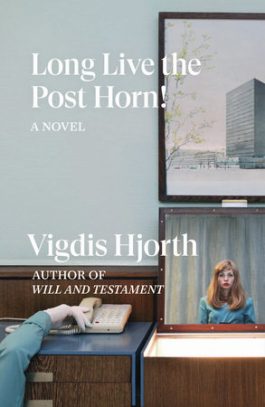


‘Long Live the Post Horn!’ By Vigdis Hjorth – Introspection at Its Most Nordic Miserable


‘Long Live the Post Horn!’ By Vigdis Hjorth (2013)  196 pages              Translated from the Norwegian by Charlotte Barsland


Much of  ‘Long Live the Post Horn!’ transpires in Oslo, Norway, home of our first person narrator, Ellinor:

Saturday morning in Oslo in late November. Morose people with their heads bowed against the cold. Slush under neath my feet and oppressive sky above my head. My chest felt tight and there was a blinding, enervating light in the shops mixed with Hammond organ music everywhere. Rushing people, their eyes frantic, humiliated, and wounded.”

The inner thoughts of our first person narrator Ellinor are often as gloomy as the Oslo weather, but sometimes we are all beset with such doubts. The usual fiction process is to remove any self-doubts from the main characters to achieve a more sprightly and lively read. Instead Vigdis Hjorth has loaded up young woman Ellinor, with misgivings about her approach to life.

I hadn’t made much progress, I was just as inadequate as I always had been.”

Ellinor is one of three members of a public relations team for Kraft-Com. The team’s new task is to convince the Norwegian public that a postal directive from the European Union should be rejected. This new postal directive would allow competition in postal service, the downside being that competitors would try to cut costs by cutting wages and services and thus ultimately reduce the mail service, especially for remote northern areas of Norway.

This novel was published in English recently, soon after Donald Trump and his Postmaster General Louis DeJoy deliberately damaged the United States Postal Service in order to interfere with the mail-in voting process. Now that was really dismal.

The Post Horn

Ellinor does have a boyfriend Stein to whom she composes the following letter:

I feel my life is too banal for despair. That our relationship is too trivial and not passionate enough for our despair. What do we do with our despair if our lives are too small to contain it?”

She tears up the letter and doesn’t send it.

Very little actually happens, and everything that does happen is filtered through this depressed woman Ellinor’s reverie. For the first three quarters of ‘Long Live the Post Horn!, we have a woman lost in self doubt. But then the novel finally does build to a somewhat jubilant climax.

This is Nordic literature with a vengeance.


Grade:    C+


‘The Bottle Factory Outing’ by Beryl Bainbridge – “an outrageously funny and horrifying novel” – Graham Greene

‘The Bottle Factory Outing’ by Beryl Bainbridge    (1974)  –  219 pages


So much of literature today seems designed to placate everyone who reads it. ‘The Bottle Factory Outing’ will placate no one; it is uncompromising in its starkness and its gallows humor. It’s sheer originality is amazing; I doubt that there would be anyone else who could write a novel quite like ‘The Bottle Factory Outing’.

It is the story of two women, Freda and Brenda, who room together and work together in the same wine bottle factory in London. I picture the two women as both in their late twenties or early thirties. Freda is big, blonde, and aggressive while Brenda is more hapless and self-effacing, yet it is Brenda who was previously married.

They are the only women who work in the bottle factory besides an older Italian woman Maria. The factory is owned by Paganotti, an Italian entrepreneur transplanted to England, and most of the other employees are Italian men. Freda has her eyes and her heart set on fellow worker Vittorio.

It’s not so much that I want him, she thought, but I would like him to want me.”

Beryl Bainbridge

Meanwhile Brenda is beset by the unwanted fumbling attentions of the plant manager Rossi or what we would call sexual harassment today.

She couldn’t think how to discourage him – she didn’t want to lose her job and she hated giving offense. He had a funny way of pinching her all over, as if she was a mattress whose stuffing needed distributing more evenly.”

The novel centers around a Sunday outing for the workers in the bottling plant. I won’t go into any of the details of the shocking plot so that you can discover it for yourself.

‘The Bottle Factory Outing’ is a deadpan comedy like nothing you have ever read before. Somehow Beryl Bainbridge manages to keep a straight face while telling us this outrageous story.


Grade:    A


‘The Book of Embraces’ by Eduardo Galeano – Imprisoned for Writing in Support of the Downtrodden


‘The Book of Embraces’ by Eduardo Galeano (1989) – 272 pages          Translated from the Spanish by Cedric Befrage


‘The Book of Embraces’ is a collection of short passionate vignettes or word pictures. Most of the items are about people who actually lived and events that really happened. It is a collection of short scenes or ideas for us to contemplate. Here are parables, paradoxes, dreams, anecdotes, and fragments of autobiography. I would classify this book as an enlightened journalism. These brief texts are illustrated with line drawings by Galeano himself.

Galeano had started out writing more traditional history, fiction, and analyses of Latin America with his ‘Open Veins of Latin America’ and his ‘Memory of Fire’ trilogy. However later he decided the more fragmentary style of writing was more effective in getting his messages across. I found this method quite compelling; for me, it does qualify as literature of a high order.

I write for those who cannot read me: the downtrodden, the ones who have been waiting on line for centuries to get into history, who cannot read a book or afford to buy one.”

In the 1970s Chile, Argentina, Uruguay, and Peru were all ruled by United States-sponsored dictatorships. These dictators ran roughshod over the people they were supposed to be governing. Many of the people who opposed these dictators were “disappeared”, in many cases taken up in airplanes and dumped into the ocean. Eduardo Galeano was imprisoned for his writing in Uruguay, and when he was released he fled for exile in Argentina in 1976. However in that same year there was a bloody military coup in Argentina and Galeano’s name was added to the list of those condemned by the death squads. Galeano escaped again, this time to Spain.

Yes. Yes, finally, I fled away from Argentina also, because—I couldn’t stay in Uruguay, because I don’t like to be in jail, and I didn’t stay in Argentina. I could not, because I didn’t want to lay in a cemetery, because, as I told you before, death is very boring.”

Eduardo Galeano, who died in 2015, was known for the courage of his directness and outspokenness in defying repressive Latin American regimes. He was also known for his love of and his writings about soccer.

Here is a fine example of one of these vignettes called “System/1” which also could be used to describe the Trump years in the US:

Functionaries don’t function,

Politicians speak but say nothing,

Voters vote but don’t elect,

The information media disinform,

Schools teach ignorance,

Judges punish the victims,

The military makes war against its compatriots,

The police don’t fight crime because they are too busy committing it,

Bankruptcies are socialized while profits are privatized,

Money is freer than people are,

People are at the service of things.”

In one short section called “Paradoxes”, Galeano writes, “North American blacks, the most oppressed of peoples, created jazz, the freest of all music”.

Finally, in 1984, Galeano was able to return to Uruguay.

The human murder by poverty in Latin America is secret: every year, without making a sound, three Hiroshima bombs explode over communities that have become accustomed to suffering with clenched teeth.”

Eduardo Galeano is a good place to begin to understand Latin America and its history of brutal repression.


Grade:    A


‘The Perfect Nine’ by Ngugi Wa Thiong’o – The Eternal Verities


‘The Perfect Nine’ – The epic of Gikuyu and Mumbi by Ngugi Wa Thiong’o (2021) – 227 pages


I’m going to start with some lines from ‘The Perfect Nine’:

The trinity appears in many states of being.

Father,

Mother,

Child.

The trinity of Birth.

Birth,

Life,

Death.

The trinity of Life.

Morning,

Noon,

Evening.

The trinity of Day.

Yesterday,

Today,

Tomorrow.

The trinity of Time.”

This is brilliant. I have never encountered such a profound meditation on the number three before. This is religion without the excess baggage. Kenyan writer Ngugi Wa Thiong’o reaches for the eternal truths that all religions share.

The words seem etched in stone rather than written.

‘The Perfect Nine’ is an epic that deals with the timeless verities, the continuation of life from generation to generation. It is based on the lore of the Gikuyu people of Kenya. These are the origin stories that have been told and retold from the early days.

One unusual feature of this saga is that the women are at least as heroic as the men.

It is an ancient tale of Gikuyu and Mumbi.

They faced hazards big enough to shatter the hearts of many.

Their bodies trembled, but their hearts remained unshaken,

For Gikuyu and Mumbi had robed themselves with hope

And fastened themselves with courage and had moved on.”

They now have ten daughters. The youngest Warigia is born with crippled legs.

When the daughters get to be of marrying age, 99 male suitors arrive. Each daughter must select the suitor who is right for her.

The birds hopped up and down in their nests, letting forth their rapturous song,

As if whistling advice to the man and woman that

They too should set up their own nest there, under the trees.”

As a test, the daughters and their suitors must go on a hazardous journey to the Mountain of the Moon. They must contend with several ogres that threaten their existence. Several of the suitors are lost along the way.

This primitive heroic poem is by turns joyful and elegiac.


Grade:    A


‘The Mystery of Henri Pick’ by David Foenkinos – “Merely Pleasant”


‘The Mystery of Henri Pick’ by David Foenkinos (2016) – 281 pages           Translated from the French by Sam Taylor


‘The Mystery of Henri Pick’ is a playful French literary mystery. It is not a world-changer but instead an amusing interlude. After reading the intense stories in James Baldwin’s ‘Going to Meet the Man’ which were passionate and insightful and angry, I was ready for something that was “merely pleasant”.

In the town of Crozon in Brittany there is a library where would-be authors can take their manuscripts that have been rejected by one or many publishers and have never been accepted. Somehow Delphine who is a literary agent for a publishing house comes across one of these rejects, ‘The Last Hours of a Love Affair’ by one Henri Pick, and believes she has found a best-seller. Henri Pick is the owner of a pizza shop in Crozon who has died a couple of years ago, and his wife and daughter are quite shocked that he had literary ambitions.

The story in the rejected manuscript blends the last moments of a love affair with the death throes of Russian writer Alexander Pushkin after he had been shot in a duel. Delphine believes this is a surefire hit if handled the correct way.

Delphine had realized that the best way to publicize the novel was to talk about it as little as possible, to let a feeling of mystery surround it, perhaps even a few false rumors.”

‘The Mystery of Henri Pick’ makes good-natured fun of the world of books and writers. There is much tongue-in-cheek literary humor here about publishing or not publishing books, marketing books, and writing fiction itself. There are even subtle mischievous jokes about famous French authors including Michel Houllebecq and Laurent Binet. This novel is too light and fluffy to be called satire.

We are introduced to a merry-go-round of characters. We get to know these characters superficially, all on the surface. Although there are break-ups of old romances and the beginnings of new romances, none of these are at all intense. In ‘The Mystery of Henri Pick’, David Foenkinos views the lives of his multitude of characters through rose-colored glasses. This is a lighthearted novel.

I enjoyed it. Just as with all of those paintings of the French Impressionists, one can never underestimate the power of the “merely pleasant”.


Grade:    B+


‘Going to Meet the Man’ by James Baldwin – A Fearless Artist


‘Going to Meet the Man’, stories by James Baldwin (1965) – 249 pages


I wanted to read more James Baldwin, and I had read a lot of good things about his collection of stories, ‘Going to Meet the Man’. It did not disappoint.

These are deep stories with an acute and often angry understanding of the predicaments of his characters. One theme in each of these powerful stories is our refusal to really know other humans and to accept our differences.

The subjects of these eight stories are wide-ranging, and whatever the subject that James Baldwin takes on, he approaches it with an insightful humane intelligence.

It’s always been like that, people always try to destroy what they don’t understand – and they hate almost everything because they understand so little.”

The early story ‘The Outing’ is about a church outing when the members of the church and a few others take a boat trip up to Bear Mountain where they would spend the day. Since it is a church outing the pastor Father James preaches to those who came along.  Johnnie, the son of the Deacon of the church, is attracted to his male friend David. David is more interested in the girl Sylvia who is an upstanding member of the church than in Johnnie. Neither Johnnie nor David has committed to the church, thus they are both unsaved. Can this almighty God forgive Johnnie’s “sin”?

I found this story to be powerful and caused me to eagerly read the following stories.

These lines from the story “Previous Condition” resonated with me:

Acting’s a rough life, even if you’re white. I’m not tall and I’m not good looking and I can’t sing or dance, and I’m not white; so even at the best of times I wasn’t in much demand.”

Many of the stories confront the racial prejudice which the characters must contend with, being a black person in the United States. There is justifiable anger in the shabby and sometimes much worse treatment these characters face every day. However in the story “This Morning, This Evening, So Soon”, our main protagonist escapes to Paris where racial attitudes are different.


In “Sonny’s Blues”, one man finds his escape through music:

For, while the tale of how we suffer, and how we are delighted, and how we may triumph is never new, it always must be heard. There isn’t any other tale to tell, it’s the only light we’ve got in all this darkness.”

‘Going to Meet the Man’ finishes with the devastating title story depicting the lynching of a black man in a small southern US town, told from the harsh view of the white deputy sheriff who is overseeing the proceedings.

There has been a James Baldwin revival lately, and the compelling stories in ‘Going To Meet the Man’ are strong examples of his eloquent insight into daily life.


Grade:    A