Archive for March, 2021

“That Old Country Music” by Kevin Barry – Amusing and Poignant Irish Stories


That Old Country Music”, stories, by Kevin Barry (2021) – 191 pages
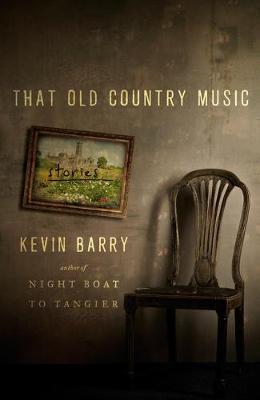
 

It is still March and still Reading Ireland Month (barely), so here is Kevin Barry. In ‘That Old Country Music’, he writes stories about the Irish people as we have always heard them to be and as I expect they really are.

There are certain writers who just happen to be virtuosos of the short story. Anton Chekhov, Elizabeth Taylor, John Cheever, William Trevor, Alice Munro, George Saunders, etc. When you read a collection of their stories, you know that nearly every one of those stories is going to move you in some way. I believe it is now time to add Kevin Barry to this list.

In the humorous story ‘Who’s-Dead McCarthy’, the main character is always the first to tell everyone about the ones who have recently died. No matter where we are from, I’m sure most of us have known a guy who is all too willing and pleased to report the misfortunes of someone else to those who are around him.

He shook his head with a blend that spoke curiously of tragic fate and happy awe.”

As is often the case in short story collections, my favorite story is the first one, ‘The Coast of Leitrim’. Seamus Ferris has fallen hard for a Polish girl, Katherine Zeilinski, who works in the cafe down in Carrick. However when she falls for him and they become a couple, he is tormented by his own happiness.

Seamus Ferris could bear a lot. In fact already in his life he had borne plenty. He could handle just about anything, he felt, shy of a happy outcome.”

Lines like this show an acute awareness which puts you on this writer’s side no matter where he decides to take the story.

He had refused happiness when it was presented to him in the haughty form that he had always craved.”

Of course Kevin Barry is a strong novelist as well. He is a writer who recognizes that life isn’t always or often straight lines. Even though I have no Irish ancestors and have never been to Ireland, I could relate to every one of the stories in this collection. It helps that most are amusing as well as poignant.

The bottom line is that in capturing Irish human nature, Kevin Barry captures our human nature, wherever we are from.


Grade:   A


‘Klara and the Sun’ by Kazuo Ishiguro – A Solar-Powered Artificial Friend


‘Klara and the Sun’ by Kazuo Ishiguro (2021) – 303 pages


It’s the not-so-distant future, and artificial friends (AFs) for children are for sale. Klara is one of these AFs in the store waiting to be sold. She has been in the store awhile, and there are already newer B3 models of artificial friends with more advanced features. One day the store manager puts Klara in the sunny storefront window, and Klara, being solar-powered, really brightens up. Young girl Josie who is walking by with her mother has gotta have this Klara for her own friend.

Josie is a rather sickly girl, but she has been “lifted” by artificial genetic editing, so she is eligible for college. However the boy she plays with, Rick, has not been “lifted”. Klara tries her best to be a good friend to both of them.

At Josie and her mother’s home, Klara must also contend with Melania Housekeeper who apparently is a Slovenian machine.

And AF. Your big plan. If it make Miss Josie worse I come dismantle you. Shove you in the garbage.”

Since the story in ‘Klara and the Sun’ is told in the first person by Klara, it is a fine balancing act for Kazuo Ishiguro to make Klara not sound too stilted or mechanical, yet not altogether human.

In ‘Klara and the Sun’ all of the people carry around an “oblong” which apparently is a well-advanced version of the cell phone. This got me to thinking about the next generation of cell phones today. For these next cell phones, the default for all phone calls will probably be to film all participants on the call. If you don’t want your live picture shown to the other participants, you must figure out the setting for not filming yourself. There may be plenty of times you may not want to have other people watching you while you are on the phone.

Who knows what other changes, probably not all of them good, await us in the future generations of our machines?

Ishiguro pays attention to the musical quality of all of his writing, the rhythms of his words and sentences as well as the silences between them. More writers should pay attention to these properties.


Grade:   A-


‘The Glorious Heresies’ by Lisa McInerney – A Blunt and Sleazy View of the Irish Crime Scene


‘The Glorious Heresies’ by Lisa McInerney   (2015) – 389 pages


I am fond of Irish novels with a shaggy plot. When I read Irish fictions, I like them wild and crazy and funny and poignant; ‘The Glorious Heresies’ sure fits all those categories. It is a wonder, a glorious wicked novel, a wild Irish crime story written from the point of view of the criminals. It was about time I read this novel from the “arse end of Ireland”.

I’ve read other wild Irish fiction, dark comedies with brutal honesty about sex and drugs and crime, but ‘The Glorious Heresies’ is the first that I’ve read that was written by a woman. It is refreshing to get a woman’s angle on some of these demented matters.

You get the full impact of this crazy stuff with the criminals, the drunks, the drugs, the prostitutes, and the church on the women folk. For the male writers, the whole scene is more or less just a black comedy. With Lisa McInerney it’s more poignant and dramatic, and she accomplishes this without sacrificing the humor. ‘The Glorious Heresies’ tells the blunt candid truth without sentimentality.

Jimmy shook his head. Cowardice is nobody’s darling. So much of a man was stripped away when notice was given of his demise; it was no surprise to see them cry and beg and empty their bladder all over their shoes, but it was an ugly thing. What use was a man who couldn’t stand up straight to face his mortality?”

Jimmy Phelan is the brutal crime boss. He has set up his long lost mother Maureen with an apartment which is in what used to be one Jimmy’s houses of prostitution. She has just killed an intruder, a guy who was still expecting to find prostitutes there.

Jimmy liked to allow room for maneuver in his daily schedule, but “Clean up after your mother offs someone” was a much more significant task than he’d ever have thought to factor in.”

The prostitute that the guy was looking for, Georgie, no longer has a house but must fend for herself out on the street.

Jimmy hires the hapless drunk Tony Cusack to clean up his mother’s apartment. Tony’s fifteen year old son Ryan sells drugs for a dealer who gets his drug supply from Jimmy. Ryan has a girlfriend Karine D’Arcy whose parents are totally disgusted with Ryan and his family.

And then there is the talk.

Who told you I was the sentimental type? Said J.P., mildly.

Yeah, that’s a mistake I made, for thinking there was still a man in there underneath the bullshit.”

Phelan turned. He backed Tony up against the wall.

No one talks to me like that.”

Of course, it being an Irish novel, there must always be The Church.

It’s just, you know, the Christians might be daft but they’re trying to do the right thing.”

‘The Glorious Heresies’ is actually the first book of a trilogy; the second novel titled ‘The Blood Miracles’ has already been published, and the third titled ‘Rules of Revelation’ is due to be published this coming May.

This is probably my favorite kind of novel, so merciless it’s humorous. It is filled with uproarious cynicism.


Grade:    A


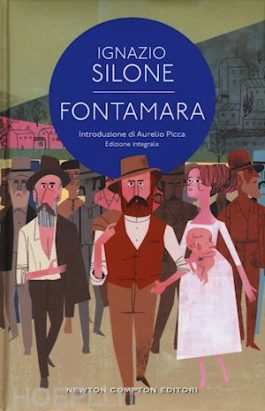
‘Fontamara’ by Ignazio Silone – A Powerful Anti-Fascist Italian Novel


‘Fontamara’ by Ignazio Silone   (1934) – 240 pages            Translated from the Italian by Harvey Ferguson II


‘Fontamara’ holds important lessons for today since fascism is more of a threat today than at any time since World War II. ‘Fontamara’ brings to light the rise of fascism in Italy during the late 1920s and early 1930s.

The fame of Ignazio Silone rests mainly on his two early novels ‘Fontamara’ and ‘Bread and Wine’. These two novels were among the first anti-Fascist novels and were hugely popular, influential, and well-lauded. His later works never achieved the acclaim of these earlier works. However, based mainly on these two novels, he was nominated for the Nobel Prize ten times although he never won the prize.

In ‘Fontamara’, the wealthy landlords are in league with the politicians and the banks and the lawyers to make the lives of the poor farmers a living Hell.

The new government is in the hands of a gang of bandits. They call themselves bankers and patriots, but they’re bandits without any respect for the old-time small landowner.”

In the area in southern Italy known as Fontamara, there is a stream that provides the water for irrigation which sustains all the poor farm families who have worked this land for centuries. The current government of the area then passes a law to divert this stream to the estate of a local rich landowner Don Carlo Magna.

At least one thing was clear: new laws were coming out every day in favor of the rich landowners. But only the old laws that were in favor of the peasants were being abolished. The ones that were unfavorable remained.”

The poor farmers knew from experience they could get no help or advice from the Church which would deliver them from the wickedness of the rich and imperious.

The local government always takes the side of the rich landowners against the poor farmers. The land in the Fucino basin which the poor farmers have worked for centuries is redistributed to the rich landowners who have the necessary capital to develop it.

Every word and gesture from these gentlemen reeked of trickery.”

However there were also poor people who backed this criminal autocratic government of the rich.

Men in black shirts…They were poor people too. But they formed a special class of poor people…Too weak and cowardly to stand up to the rich and the authorities, they preferred to serve them so they could rob and oppress the others – the peasants, tenants, and small landowners. They have always been in service of whoever gives the orders, and they always will be…They were the so-called Fascists.”

Once again we are faced with too many nations where their governments have been taken over by criminals who are working on behalf of the rich. The last rise of fascism resulted in World War II. Who knows what will happen this time?


Grade:    A


Playful and Astute Words about Life and Literature from Margaret Atwood


I just happened to stumble onto all these fascinating quotes from Margaret Atwood. It’s been awhile since I have found such meaningful yet often humorous words, and I want to share them with you. If the quote is from one of her books, I indicate the source.


About Life in General

“If you’re not annoying somebody, you’re not alive.”

“How could I be sleeping with this particular man…. Surely only true love could justify my lack of taste.”

“I’m not sure which is worse: intense feeling, or the absence of it.”

“Stupidity is the same as evil if you judge by the results.” – ‘Surfacing’

“And yet it disturbs me to learn I have hurt someone unintentionally. I want all my hurts to be intentional.” – ‘Cat’s Eye’

“There’s more than one way to skin a cat, my father used to say; it bothered me, I didn’t see why they would want to skin a cat even one way.” – ‘Surfacing’

“The facts of this world seen clearly are seen through tears.”

“If we were all on trial for our thoughts, we would all be hanged.” – ‘Alias Grace: A Novel’

“Oppression involves a failure of the imagination: the failure to imagine the full humanity of other human beings.” – ‘Second Words: Selected Critical Prose’

“I’ve never understood why people consider youth a time of freedom and joy. It’s probably because they have forgotten their own.” – ‘Dancing Girls’

“Men and women are not “equal” if “equal” means “exactly the same.” Our many puzzlements and indeed unhappinesses come from trying to figure out what the differences really mean, or should mean, or should not mean.”

“You can think clearly only with your clothes on.” – ‘The Handmaid’s Tale’

“Forgiving men is so much easier than forgiving women.” – ‘Cat’s Eye’

“If he wants to be an asshole, it’s a free country. Millions before him have made the same life choice.”

“I hope that people will finally come to realize that there is only one ‘race’ – the human race – and that we are all members of it.”

“The desire to be loved is the last illusion. Give it up and you will be free.” – ‘Selected Poems II (1976-1986)’

“Men are afraid that women will laugh at them. Women are afraid that men will kill them.”

“The fabric of democracy is always fragile everywhere because it depends on the will of citizens to protect it, and when they become scared, when it becomes dangerous for them to defend it, it can go very quickly.”

“Better never means better for everyone… It always means worse, for some.” – ‘A Handmaid’s Tale’

“Don’t let the bastards grind you down.” – ‘A Handmaid’s Tale’

About Literature

“A word after a word after a word is power.” – ‘Spelling’, a poem

“In the end, we’ll all become stories.” – ‘Moral Disorder’

“Show me a character totally without anxieties and I will show you a boring book.” – ‘Margaret Atwood: Conversations’

“Poetry is where the language is renewed.”

“It’s a feature of our age that if you write a work of fiction, everyone assumes that the people and events in it are disguised biography — but if you write your biography, it’s equally assumed you’re lying your head off.”

“I read for pleasure and that is the moment I learn the most.”

“Everyone thinks writers must know more about the inside of the human head, but that’s wrong. They know less, that’s why they write. Trying to find out what everyone else takes for granted.”

“Once you publish a book, it is out of your control. You cannot dictate how people read it.”

“More of your brain is involved when reading than it is when you watch television… because you are supplying just about everything… you’re a creator.”

“You need a certain amount of nerve to be a writer.” – ‘Writing with Intent: Essays, Reviews, Personal Prose: 1983-2005’,


There are hundreds more, but it’s time to move on.


‘Tamburlaine Must Die’ by Louise Welsh – The Other Elizabethan Playwright


‘Tamburlaine Must Die’ by Louise Welsh  (2004)  – 140 pages


‘Tamburlaine Must Die’ is the English playwright Christopher Marlowe’s own fictional account of his last days up until the day he was killed in an ale house in Deptford on May 30, 1593. He was 29 years old.

The novella starts at the home of Marlowe’s patron Thomas Walsingham who allows Marlowe to stay at his home outside London to work on his plays. Then Marlowe travels to London where events get quite hectic for him

The era of Queen Elizabeth I was a time when religious crimes such as heresy and blasphemy were treated as civil crimes with exceedingly harsh punishments including torture and death. Christopher Marlowe was not one who was shy or careful about what he said or even wrote especially during and after one of his trips to one of the many London ale-houses. He frequently was in trouble with the authorities.

Christopher Marlowe has an “adventurous nature”.

Now Marlowe is in trouble with the Privy Council of Queen Elizabeth. He is accused of committing heresy, of being an avowed atheist who caused others to convert to his beliefs, and of posting a scurrilous threatening bill on the door of the Dutch church signed “Tamburlaine” which happens to be the name of one of his plays.

I found some of the scenes in this novella quite well done, especially when Marlowe talks over his plight with the old gaoler in Newgate prison he knew from the first time Marlowe was locked up. Another scene has the following sharp dialogue:

You seem to find yourself in some small difficulty, Master Marlowe.”

It is a fact of my profession. Theatre is built on difficulties.”

The theatre of life also?”

It is so for all men.”

Perhaps,” he smiled, a brotherly smile, sympathetic yet with no illusions about my character, “but most men’s troubles are of a mundane nature. They lack money or have upset their wife. You are in danger of losing your life.”

However ‘Tamburlaine Must Die’ is too often too sensational and way over the top. We go from bloody incident to bloody incident with few quiet moments in between them. There is scarcely little about how Christopher Marlowe came to write those plays which are still performed over 400 years later – ‘Doctor Faustus’, ‘Tamburlaine’, and ‘Edward II’ among others.

It is difficult to keep track of all the side characters that are introduced too quickly and then are gone from the novella.

There is more sword play than word play in ‘Tamburlaine Must Die’.


Grade:   C


‘One Hand Clapping’ by Anthony Burgess – Used Car Salesman to Quiz Show Champion


‘One Hand Clapping’ by Anthony Burgess (1961) – 218 pages

My reason for reading ‘One Hand Clapping’ is fairly subtle. I saw that it had been turned into a failed play in 2017, and I figured if someone would go to all the trouble of turning a 1961 novel into a play 56 years later, that novel must be pretty good. I was looking for an excuse to read Anthony Burgess again anyhow. It turned out that I was correct in my reasoning.

‘One Hand Clapping’, written in 1961, gets the 1960s off to an uproarious and provocative start.

‘One Hand Clapping’ takes place in 1961, back in the Dark Ages when you could only see TV shows in black-and-white and all TV programming came to your home over the air through the antenna on top of your house. This was the era of the quiz shows Twenty-One and The $64,000 Question, both of which we later found out were rigged.

In ‘One Hand Clapping’, out 23 year-old narrator Janet works shelving and price marking goods in a grocery store. Her 27 year-old husband Howard is a used-car salesman. They are a quite ordinary couple who live in Bradcaster (Manchester, England) until one day Howard is selected to appear on the TV quiz show ‘Over and Over’. Howard does have one skill that is useful for a quiz show contestant, a photographic memory.

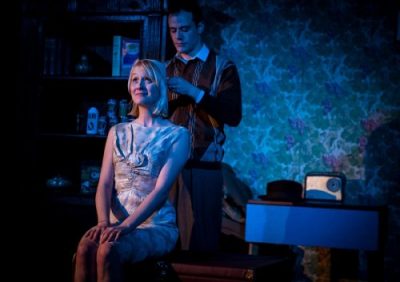
A scene from the play ‘One Hand Clapping’

Janet is a down-to-earth young woman with a lot of practical and intuitive sense. Howard is a far bit impulsive. On his first night after his resounding victory on the quiz show, he has an accident with one of his boss’s cars, a Bentley, from the used car lot. Of course his boss is angry with him, and Howard tells him off and gets fired.

With his quiz show winnings, Howard has grand pretensions and becomes a patron of the arts by funding aspiring poet Redvers Glass. When Howard asks the poet to recite a few of his poetic lines, Glass replies with some lines that Howard, with his photographic memory, immediately recognizes are from the classic poem ‘To His Coy Mistress’ by Andrew Marvell.

Here are a few lines the poet writes for Howard:

But we saw England delivered over to the hands of

the sneerers and sniggerers, the thugs and grinners,

England became a feeble-lighted moon of America“

The Americanization of England was feared by the English in the early 1960s. But of course the British Invasion a few years later led by the music of the Beatles as well as many other groups flipped everything around, and the United States teenagers were imitating everything English.

‘One Hand Clapping’ takes some sharp, crazy turns, some of them gruesome, but all in good fun. It takes an adept writer to pull this off, and Anthony Burgess does.


Grade:    A


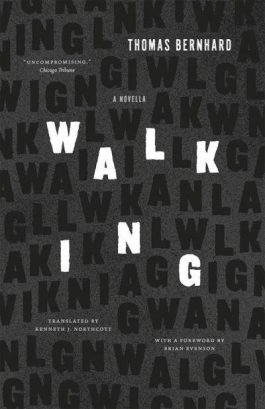
‘Walking’ by Thomas Bernhard – Walking and Talking and Thinking


‘Walking’ by Thomas Bernhard (1971) – 86 pages              Translated from the German by Kenneth J. Northcott

Yes, ‘Walking’ is a novel about walking. Our narrator used to go out walking with his friend Karrer on Mondays and walking with his friend Oehler on Wednesdays. However now that Karrer went mad and is confined in the Steinhof asylum, our narrator goes out walking with Oehler on both Mondays and Wednesdays.

Oehler is the ultimate depressive and a depressing companion.

The whole process of life is a process of deterioration in which everything – and this is the most cruel law – continually gets worse, says Oehler.”

Not only is Oehler forever gloomy, but also he has some quite obnoxious opinions and attitudes.

Anyone who makes a child, says Oehler, deserves to be punished with the most extreme possible punishment and not to be subsidized.”

The centerpiece of ‘Walking’ is when Oehler relates the incident where Oehler and Karrer are out walking together and go to the Rustenschacher’s store. Karrer has his ”terrible collapse” at the store.

While in the store, Karrer complains about the shoddy merchandise calling some pairs of trousers on display “Czechoslovakian rejects”. Of course the sales clerk who happens to be the store owner’s nephew defends their merchandise, and they get into a loud argument.

This scene at the store is so outrageous it is almost comic as Oehler relates it, if it wasn’t for the fact that this is when Karrer gets carted off to the psychiatric ward. This is a frequent technique of Bernhard’s, to make a scene so outrageous and gruesome, it becomes almost comic to picture these people doing these things.

So now our narrator is stuck walking with the depressing Oehler twice a week who keeps saying these grim things.

All people fill their heads without thinking and without concern for others and they empty them where they like, says Oehler. It is this idea that I find the cruelest of all ideas.”

Not much else happens in this novella.

I have read a lot of Bernhard, and I find in much of his work, gloomy as it may be, that there is ultimately a sense of redemption. In fact he has over time become one of my favorite authors. Novels of his that I especially like are ‘Extinction’, ‘Woodcutters’, ‘The Loser’, and ‘Wittgenstein’s Nephew’.

However I did not get much of this sense of redemption in ‘Walking’ which is an early work of Bernhard.


Grade:    B


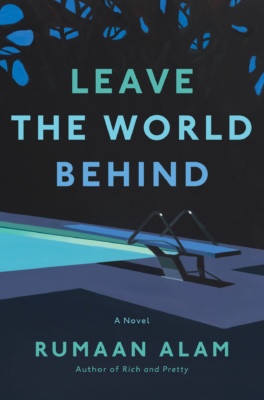
‘Leave the World Behind’ by Rumaan Alam – The Four Scariest Words


‘Leave the World Behind’ by Rumaan Alam (2020) – 256 pages


Here is my candidate for the scariest sentence, the four scariest words, in the English language: “The future is uncertain”.

I would feel better if I just knew what was happening.” Amanda looked toward the hall, could hear the plash of water in the bathtub. These words were not true, but she did not know that.

‘Leave the World Behind’ starts out with a family traveling from New York City to the outer reaches of Long Island looking for a week long escape from the city. The family is made up of father Clay who is a professor, mother Amanda who is an office manager, and their 16 year old son Archie and 13 year old daughter Rose. The family has rented a beautiful house with pool in a near-deserted part of Long Island just for a week.

Everything is fine at first, but the family’s situation soon turns from idyllic to ominous. Daughter Rose spots a herd of thousands of deer congregating in the woods. A flock of pink flamingos land in the swimming pool. All of the other birds are unnaturally quiet.

The animals,” Danny continued. “They know something. They’re spooked.”

The couple who are the actual owners of the vacation house, G. H. and Ruth, show up bringing word of a massive blackout across Manhattan from which they are escaping by going to their house. Clay and Amanda are of course reluctant to have them stay, since they paid to have the house all to themselves for a week.

Whenever the focus shifts to one or another member of the family or one of the house owners, the author lets us know what they are really thinking which is often cynical or disparaging of one of the others.

And then all of them are shaken by the Big Noise.

Not a bang, not a clap. More than thunder, more than an explosion…It was noise big enough to alter forever their working definitions of noise. You’d cry if you weren’t so scared.”

The atmosphere of impending doom looms closer and more oppressive, but we don’t know what it is. ‘Leave the World Behind’ provokes that feeling that one must have the second he or she is the victim of a fatal accident. “Why did this happen to me? Why did I let this happen to me?”

Ruth did understand. Everyone understood. This was what everyone wanted, to be safe. This was the thing that eluded every single one of them.”

Or maybe the four scariest words are “The future is certain”, since we all know what is going to ultimately happen to each of us.


Grade:   A-