‘Transcendent Kingdom’ by Yaa Gyasi (2020) – 364 pages

First, a few facts. Yaa Gyasi was born in Ghana in 1989. She and her family moved to the United States in 1991. From the age of ten, she was raised in Huntsville, Alabama. She received her Bachelors’ degree from Stanford University and her Masters degree from the Iowa Writers’ Workshop. She completed her first novel in 2015. After initial readings from publishers, she received several offers for the novel. She accepted a million dollar advance for the novel from Knopf. That novel, ‘Homecoming’, won several major awards including the PEN/Hemingway Award for best first novel. ‘Transcendent Kingdom’ is her second novel.
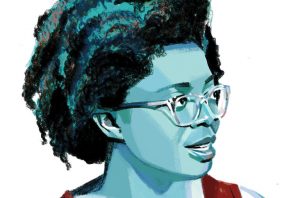 When the New York Times has an artist draw a picture of you, you know you have arrived.
So why all this excitement over Yaa Gyasi?
The writing of Yaa Gyasi is cerebral and thoughtful yet vivid and passionate. She brings an intensity to her character portrayals that makes you care about what happens to them.
Our female narrator here, Gifty, is a Stanford neuroscientist. Her research involves modifying the behavior of mice by altering their brain activity. If the behavior modification techniques are successful for mice, similar techniques could be applied to humans in the hope of controlling addictive or other abnormal behavior patterns. Gifty has a special family interest in addictive behavior, because her brother Nana died of a heroin overdose before he became 20 after becoming addicted to Oxycontin prescribed for a basketball injury. Then Gifty’s grief-stricken mother took to her bed and did not get up. Eighteen years later Gifty’s mother has a recurrence of her sleeping mental sickness, and Gifty who is now a graduate student at Harvard brings her mother to her campus apartment.
While reading ‘Transcendent Kingdom’, I learned a new word for Gifty’s mother’s ailment, anhedonia:
Anhedonia – lack of pleasure or the capacity to experience it
Gifty’s father came over to the US from Ghana with the family, but was unhappy living in Alabama where his family are treated worse than second class citizens because they are black:
“In my country (Ghana) neighbors will greet you instead of turning their heads away like they don’t know you.”
He returns to Ghana leaving his wife working two jobs and raising the two children.
“It’s those who stay who are judged the harshest, simply by virtue of being around to be judged.”
Gifty’s mother works hard to hold the family together under difficult circumstances.
“She was a matter-of-fact kind of woman, not a cruel woman exactly, but something quite close to cruel.”
The familiar, perhaps over-familiar, plot of Oxycontin addiction is offset by a spirited portrayal of living in Alabama and then on to Harvard and Stanford.
“Do we have control over our thoughts? When I was a child this was a religious question,” she says, “but it is also, of course, a neuroscientific question.”
Grade: A-
 Tony's Book World
Posted by Lisa Hill on November 6, 2020 at 7:40 AM
Have you read Homegoing? I bought a copy of it when it was being hyped here, but I’ve never got round to reading it and wonder sometimes if it should be recycled.
LikeLiked by 1 person
Posted by Anokatony on November 6, 2020 at 8:06 AM
Hi Lisa,
I have NOT read Homecoming. I feel like I’m sated with the new stuff and may go back to reading classics for awhile. Tonight I was researching that, and I was looking at ‘Life A Users Manual’ by Georges Perec on Goodreads which you have marked as wanting to read. That might be my next read, and I will probably write a couple of articles on it since it is over 500 pages.
LikeLike
Posted by Lisa Hill on November 6, 2020 at 10:20 AM
Ah, I’m not one for readalongs, but I reckon that’s one where I’d like to share the journey. But having promised myself that this *will* be the year that I read David Mann’s bio of Patrick White and not left myself much time to do it, I shall have to be an appreciative bystander:)
LikeLike