‘Mauprat’ by George Sand (1837) – 384 pages Translated from the French by Mary W. Artois
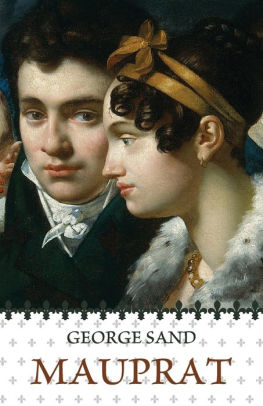
‘Mauprat’ takes place just before the French Revolution when the landed nobility still lorded over the peasants. Wealthy land barons terrorized their poorer neighbors. Many of these landed gentry oppressed the peasants by imposing heavy duties on them while avoiding taxes themselves.
“The poor have suffered enough; they will turn upon the rich, and their castles will fail and their lands be carved up. I shall not see it; but you will. There will be ten cottages in the place of this park, and ten families will live on its revenue. There will no longer be servants or masters, or villein or lord.”
This situation was made worse because certain orders of the Catholic Church were in league with the landed gentry to oppress the peasants.
“It is the indelible characteristic of the Catholic priesthood,” he said. “It cannot live without making war upon families and ferreting out every means by which it can get money from them….gentle robbery.”
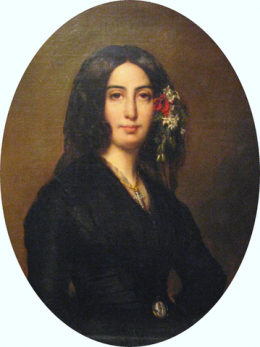
George Sand
The La Roche-Mauprats are a particularly cruel and rapacious family of the nobility. The Mauprat father is “a man who had a genius for wickedness, and his sons, lacking the affection they were incapable of feeling, submitted to the ascendancy of his detestable superiority and obeyed him with a precision and promptitude almost fanatical.” Sound familiar? ‘Mauprat’ is a novel for today.
The father La Roche-Mauprat and his seven sons intimidate and frighten their neighborhood. Of course no woman would go near the estate fearing for their honor.
“Bernard, do you wish me to tell you why they thought all women are liars?”
“Yes.”
“It was because they were violent and tyrannical with beings weaker than themselves. Whenever one makes one’s self feared, one runs the risk of being deceived.”
However there are two sides to the Mauprat family. The other side of the family is also well-to-do, but they are pillars of the community. Our hero Bernard was born into the good side of the family, but his mother died when he was five, and he was adopted by the cruel Mauprats. Of course one of his uncles, Jean, hates the kid for being there, and Bernard later relates that “For ten years I suffered from cold, hunger, and insult; from confinement in the dungeon and from blows, according to the more or less ferocious caprices of this monster”.
 Later Bernard finally escapes the clutches of the cruel Mauprats and is taken up by the honorable side of the family where he meets his second-cousin Edmee who turns out to be the love of his life. However Bernard has learned some nasty habits during his sojourn with the cruel Mauprats, and he must make amends before Edmee can like him at all. Bernard has overpowering feelings for Edmee.
“Edmee never knew in what peril her honor was in that agonizing moment; I remember it with eternal remorse; but God alone will be my judge, for I triumphed, and this evil thought was the last I have felt during my life.”
Later hiding behind a bush, Bernard overhears a conversation between Edmee and the abbe:
“Now I realized fully the odious part I was playing, and I had just read in the depths of Edmee’s heart, the fear and disgust I inspired in her.”
 So in ‘Mauprat’, we have a devastating romance as well as an acute depiction of the social situation in France just before the Revolution.
“It was the first time that I had heard of a peasant being spoken of as a man.”
As now even the United States has lost its way and fallen into a corrupt autocracy, perhaps it is time for a second French Revolution?
Stay tuned for my second article about this novel in which I will deal with the more literary qualities of George Sand and ‘Mauprat’.
Grade: A
 Tony's Book World
Posted by Guy Savage on September 14, 2020 at 6:04 PM
Thanks. I’ve been meaning to get to George Sand and this may be the best place to start
LikeLiked by 1 person
Posted by Anokatony on September 14, 2020 at 6:10 PM
Hi Guy,
I like to compare George Sand to Charles Dickens, since they were both producing a lot of novels in the same time period. Both the hearts of Charles Dickens and George Sand were in the right place, but, George Sand, her mind was a little sharper than Dickens.
LikeLike
Posted by Mike Walmer on September 14, 2020 at 6:35 PM
Great to read this, Tony, look forward to the next bit. And thanks for covering it.
LikeLiked by 1 person
Posted by Anokatony on September 14, 2020 at 6:40 PM
Hi Mike,
My pleasure, ‘Mauprat’ is a fine novel.
LikeLike
Posted by kaggsysbookishramblings on September 14, 2020 at 10:44 PM
Great post! I have this one lurking too – it’s very appealing!
LikeLiked by 1 person
Posted by Anokatony on September 15, 2020 at 12:05 AM
Hi kaggsy,
I had read only one George Sand novel before – ‘Marianne’ – and had no idea she was so prolific, a real rival to Dickens in productivity.
LikeLiked by 1 person
Posted by Lisa Hill on September 15, 2020 at 5:13 AM
Hello Tony, I’ve taken the liberty of adding this review to the fledgling Sensational Sand site, see https://sensationalsands.wordpress.com/index-of-works/
I really must make more of an effort to work on this site, and also the Maupassant one… TBH I set them up when I did just to ensure that we had bagged the names as sister sites to our collaborative Zola and Balzac sites, but I’ve never had time to work on them properly.
LikeLiked by 1 person
Posted by Anokatony on September 15, 2020 at 6:27 AM
Hi Lisa,
Thank You! That’s one thing about George Sand, there is nearly an infinite number of novels and plays to read. She was very prolific. According to Wikipedia, she was widely popular during her lifetime even more popular than Balzac or Hugo. From my reading of ‘Mauprat’, I believe more of her novels should be rescued from obscurity. And then there was her romantic affair with Frederic Chopin. She was an enterprising woman.
LikeLike
Posted by Lisa Hill on September 15, 2020 at 7:43 AM
I’ve liked the couple I’ve read, and one of them was in French so one way or another if I can track them down I should be able to read more of them:)
LikeLiked by 1 person
Posted by Anokatony on September 15, 2020 at 7:56 AM
I suppose a number of them are untranslated.
LikeLike