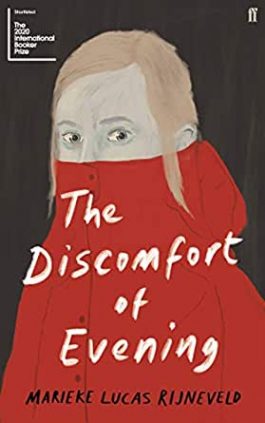
‘The Discomfort of Evening’ by Marieke Lucas Rijneveld (2018) – 282 pages Translated from the Dutch by Michele Hutchison

I suppose your reaction to ‘The Discomfort of Evening’ will depend on whether or not you like the following typical sentence from the novel:
“I watched as the diarrhea splattered on to the grass like the caramel sauce my granny poured on to the rice pudding.”
I did not like it.
Some readers may see this analogy as clever, but I saw it as obtuse and gross. This awkward disturbing simile is probably most representative of the novel as there is a lot to do with bum holes and poo throughout “Discomfort of the Evening”. The author throws hundreds of such analogies or similes against the wall, but only a few of them stick.
I was definitely motivated to read ‘The Discomfort of Evening’ since I had just heard that it had won the International Booker prize for 2020, yet I struggled and struggled to keep my interest in the novel. I was severely disappointed. Let me explain.
‘The Discomfort of Evening’ is narrated by a 12 year old girl, Jas, as she tries to cope with the severe dysfunction of herself and her entire farm family after the death of her older brother Matthies in a skating accident.
After a major tragedy like this, there is always guilt. Guilt prevents one from feeling the honest pain of bereavement, thus the pain manifests itself in other bizarre forms. This is especially true for children.
There is a lot of self-mutilation with pins, etc. This is a novel of a family’s severe abnormal behavior, but the excesses in the writing here kind of diminished my trust in the author.
After her brother’s death, Jas has a problem with constipation and she has an epiphany when she finally does have a poo, and we get a sticky detailed description of the results.
“Granny once said that poo is healthiest when it looks like the greasy veal sausages she sometimes makes. My poo looks anything but that.”
Even when the similes aren’t coarse, they didn’t make very much sense to me.
“In the light of my globe, her nose looks like a capsized sailing boat.”
What is that supposed to mean?
 The family is very religious, and there is a lot of quoting of the Bible. The Bible passages are not there to uplift but more often used to explain some aberrant act by one of the family members, especially the other brother Obbe.
Things go from bad to worse on the farm when the family’s entire dairy herd has to be killed due to foot-and-mouth disease. Of course we get graphic descriptions of this event. It makes for a grim read, and there is no humor or redemption.
I suppose since the narrator is only 12 years old we must forgive the clumsy syntax of many of her sentences, but these sentences do make it difficult to read and stay interested in the story.
Perhaps some readers are so moved by the dire circumstances of this farm family that they leave their critical faculties behind at the door.
Since it won that major prize, maybe you should read it anyhow regardless of my opinion. Decide for yourself.
Grade: C-


Posted by fulcherkim on September 1, 2020 at 6:03 PM
Interesting. I think my countertake would be that some readers are so grossed out by this moving portrayal of farm family that they leave their critical faculties behind at the door! A deserving winner of the Prize, having read all of the longlist.
LikeLiked by 1 person
Posted by Anokatony on September 1, 2020 at 6:08 PM
Hi fulcherkim,
Of the shortlist, I have only read ‘Tyll’ besides ‘The Discomfort of Evening’, and I can’t imagine how anyone would consider ‘The Discomfort of Evening’ more well-written than ‘Tyll’. But to each their own.
LikeLike
Posted by kimbofo on September 1, 2020 at 6:38 PM
Having grown up surrounded by dairy farms, it sounds fairly authentic as far as all that excrement goes! LOL. This is the first review of this book I’ve seen… I’m in two minds as to whether I want to read it. Perhaps I’ll see if I can borrow it from the library.
LikeLiked by 1 person
Posted by Anokatony on September 1, 2020 at 6:51 PM
Hi Kim,
I grew up on a dairy farm and we had family tragedies too which I won’t go into. I do believe that Rijneveld’s topic, the severe family dysfunction that can occur in these circumstances, is important. I just thought the novel was over-written, clumsy, and sensationalized and offered no redemption. Life does go on after tragedies.
LikeLiked by 1 person
Posted by fulcherkim on September 1, 2020 at 7:07 PM
Much my least favourite of the shortlist – rather unambitious I thought versus the other 5
LikeLiked by 1 person
Posted by Anokatony on September 1, 2020 at 7:25 PM
I forgot that I also read ‘Hurricane Season’ by Fernanda Melchor which I also thought was excellent.
LikeLike
Posted by kaggsysbookishramblings on September 1, 2020 at 10:44 PM
Um no. Definitely not for me (and I know HeavenAli abandoned it…)
LikeLiked by 2 people
Posted by Anokatony on September 1, 2020 at 11:21 PM
Hi kaggsy,
I’m pleased to find out that others share my opinion of ‘The Discomfort of Evening’. By the way ‘The Discomfort of Evening’ is an excellent title for a novel, but just not this one.
LikeLiked by 1 person
Posted by Lisa Hill on September 2, 2020 at 3:52 AM
Two things put me off this novel even before I saw your review: a description of it, and hearing the author talk about it at the Edinburgh Festival.
No… I lie…I listened to about 15 minutes of her talk and then turned it off. I’m no Pollyanne but am not in the mood for dreariness. (And that’s not Covid, that’s a general weariness about the diet of misery that’s constantly being published and fêted.)
LikeLiked by 1 person
Posted by Anokatony on September 2, 2020 at 7:18 AM
Hi Lisa,
Misery in novels is OK as long as it is artfully presented, which I don’t think it was here. Although I suppose I am not a big fan of unrelieved misery either. I’m still trying to figure out the mystery of how this novel got such an inflated status in the first place.
LikeLiked by 1 person
Posted by heavenali on September 2, 2020 at 10:35 AM
I tried and failed. I ploughed through 50% of this on my kindle, and gave up. I didn’t want to read it and found I didn’t care enough about it to carry on.
LikeLiked by 1 person
Posted by Anokatony on September 2, 2020 at 5:16 PM
Hi heavenali,
I understand exactly what you mean. I wanted to give up early, but kept reminding myself that this novel is the Booker International winner for 2020.
LikeLike