Archive for October, 2019

‘Welcome to America’ by Linda Boström Knausgård – Unspeakable Family Life


‘Welcome to America’ by Linda Boström Knausgård (2016) – 124 pages              Translated from the Swedish by Martin Aitkin

In ‘Welcome to America’, eleven year-old narrator Ellen has stopped talking. Her father has recently died, and Ellen is living with her stage actress mother and Ellen’s older brother.

Ellen believes she killed her father because she wished him dead, and then he died. Her father had severe mental problems, and he was a danger to people around him, especially his wife, so he was locked up in an institution.

The ambulance that pulled up slowly outside, and me trying not to draw his attention to it, so he wouldn’t run away. I’d dreamt about them coming to get him. Men in white coats who took him away and locked him up for good.”

Now the father has died, and daughter Ellen lives in nearly unrelieved misery and has stopped talking.

The backstory is that the father was relatively stable up in northern rural Sweden. Then he married his wife who soon became an acclaimed stage actress and in order to advance her career the family had to move to the city. The father couldn’t stand complicated city life and went bonkers, and died in the asylum.

A broken man. Mom had chewed him up and spit him out. She’d lived their life as if it were the most natural thing in the world, only then to shut him out.”

This entire novel is overwrought, and the young girl Ellen is a case study in severe depression. It has the cold sad disquiet of one of Ingmar Bergman’s darker movies, but even Bergman would have put in a few lighter scenes for contrast. ‘Welcome to America’ would have been more convincing if there had been a couple of happy moments for variation from all of the despair.

I also don’t like the proposition that the mother’s stage success and vivacity naturally led to the father’s craziness, but that is probably just the kid’s projection anyway.

The novel is written in short staccato sentences and in many cases mere short phrases. Despite the short sentences, I wasn’t entirely convinced this was a young girl speaking. It is difficult for me to believe that an eleven year old girl could be this clinically depressed. In any case I’m not sure the story should have been told entirely from a depressive’s point of view, even if she is only eleven.

Also the title is misleading, because ‘Welcome to America’ has absolutely nothing to do with the story, except that Ellen is in a play at school about the Statue of Liberty. This play is barely mentioned.


Grade:   C+
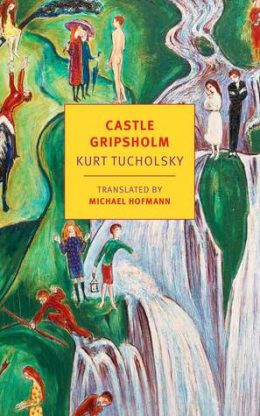


‘Castle Gripsholm’ by Kurt Tucholsky – An Idyllic Summer Vacation in Sweden


‘Castle Gripsholm’ by Kurt Tucholsky   (1931) – 127 pages         Translated from the German by Michael Hoffman

The New York Review Books Classics series has done a remarkable job of rescuing neglected wonderful fiction from the past. Whenever I get fed up with the over-hyped novels of today, I read one of these classics in order to restore my faith in fiction. ‘Castle Gripsholm’ is another fine novel by a writer I had never heard of before.

I probably should have heard of Kurt Tucholsky before. There are two literary prizes, one in Sweden and one in Germany, named after him. He was perhaps Germany’s finest journalist in the 1920s but his work was banned, declared un-German, and burned in bonfires when the Nazis came to power in 1933. He left for Sweden then. ‘Castle Gripsholm’ was his only novel.

‘Castle Gripsholm’ is a fictional playful, lighthearted account of a five-week vacation trip to Sweden.

Our narrator Kurt travels by train with his girlfriend Lydia (called the Princess) from Berlin to Copenhagen, then up to Sweden by ship. They stay in the Swedish countryside near a lake at an annex to the Castle Gripsholm. There the two have a restful vacation.

Swimming in the lake; lying naked on the shore, in a sheltered spot; soaking in the sun so you rolled home at noon, wonderfully dozy, and drunk on the light, the air and the water; quiet; eating; drinking; sleeping; resting – holiday.”

Later Kurt’s good friend Karlchen arrives and stays a few days. The Princess and Karlchen immediately hit it off well, and Kurt is happy to have his two great friends there.

To have someone to trust! To be with someone for a change who doesn’t eye you suspiciously when you use a phrase that might perhaps offend his vanity, someone who isn’t prepared at any moment to lower his visor and do battle to you to the death…Friendship is like one’s homeland. We never talked about it, and whenever there was any slight surge of emotion unless it happened in a serious late-night talk – it would be quenched in a bucketful of colorful abuse. It was marvelous.”

After Karlchen leaves, a friend of the Princess, Billie, arrives for a few days, and the idyll continues.

Much of the fun of ‘Castle Gripsholm’ is in the playful witty repartee between these friends. However there are also the quiet times.

How wonderful it is to be silent with someone.”

Of course even a charming novel must have some dramatic tension to sustain interest, so there is a side story about a young girl Ada who they discover is being terribly abused by the cruel headmistress of a children’s home, Frau Adriani.

I have always tried to maintain certain balances in my reading between male and female writers, between authors from various parts of the world, and between new novels and the classic old novels. The New York Review Books Classics series helps me maintain all these balances. The one constant is that I look for novels that are meaningful and that I will enjoy.


Grade:    A


‘Klotsvog’ by Margarita Khemlin – A Vivacious Self-Justifying Russian Woman


‘Klotsvog’ by Margarita Khemlin (2009) – 245 pages                         Translated from the Russian by Lisa C. Hayden

‘Klotsvog’ is by far the liveliest Russian novel I have read that takes place during Communist times. This is thanks to our vivacious first-person narrator Maya. People find a way to live their lives as they want to in almost any circumstances.

‘Klotsvog’ takes the form of a fictional memoir of Maya who was born in Kiev, Ukraine in 1930 to a Jewish family. She was on a trip with her mother out of town when her village was destroyed and the rest of her family as well as the rest of the community were murdered by the Nazis.

However Maya’s memoir begins in 1950. Jewish people then still had to worry, because Stalin still had a scheme to murder all the survivors of the Holocaust. Fortunately Stalin died in 1953 which was a great burden removed from the surviving Jewish people in Russia. Maya shares this insight into Communism:

The house is burning but the clock still keeps time.”

In 1950, Maya is a beautiful young woman, and she enters into an affair with her older instructor who is married. Another man named Fima is also interested in her. When she finds out she is pregnant by her instructor, she agrees to marry Fima and attempts to have sex with him so he will believe the baby will be his. She is only partially successful. This sets the pattern for the entire rest of the memoir. By the end Maya has had three husbands, two children, and four other intimate boyfriends, occasionally while she was still married. Of course in one case the husband was fooling around too. When she finds out that her husband is having an affair with his mother’s live-in nurse, she reacts thus:

Of course there could be no talk of love here. This was the usual male impermanence. Romance based on a fresh outward appearance and a young woman’s affected good-naturedness.”

Throughout I admired the honesty and insight of Maya.

Maya is honest in her memoir throughout, but the memoir is an exercise in self-justification as most memoirs are. Maya comes from a Ukrainian Yiddish background, but she does not want her children to speak Yiddish under any circumstances. Her mother and the few other family survivors criticize her mothering of her kids. The boy who is the older child spends much time with the grandmother in Kiev while Maya and one of her husbands move to Moscow. The grandmother instills the boy with some of the old family values, and Maya becomes estranged from the boy. Maya criticizes her daughter severely for being overweight, and the daughter becomes a severe behavior problem. Neither child likes their mother Maya much. In this memoir, Maya attempts to justify her parenting throughout, but is only partially successful.

I liked ‘Klotsvog’ a lot because Maya is an astute woman. But towards the end it does get somewhat discursive or repetitive or ambiguous. But as Maya would say:

But that’s not my point.”

Life is ambiguous.


Grade:    A-


‘Night Boat to Tangier’ by Kevin Barry – A Funny Sad Elegy for Two Aging Irish Criminals.


‘Night Boat to Tangier’ by Kevin Barry   (2019) – 255 pages

‘Night Boat to Tangier’ is the story of two fading Irish gangsters, best friends, in their early fifties, Maurice and Charlie. Charlie has a severe limp; Maurice has lost one of his eyes. Maurice and Charlie started dealing dope in high school.

Money accrued; ambition was fed. Dope brought girls and money. There was langour by day and violence in the night.”

Since then, they had devoted their entire adult life to smuggling drugs. They have made huge amounts of money at times, nearly all of which has somehow flown away, mostly on bad investments and illegal drugs for their own personal use.

They are at the waiting room of the ferry terminal in Algeciras on the southern coast of Spain expecting Maurice’s 23 year old daughter Dilly to show up. Dilly left Ireland three years ago and has not returned, but Maurice has heard rumors that she might be coming in on the ferry from Tangier today. Early on they encounter a dreadlocked young guy Ben who looks like he might know Dilly, so Maurice and Charlie manhandle him to find out more of Dilly:

I don’t know if you’re getting the sense of this yet, Ben. But you’re dealing with truly dreadful fucken men here.”

As they wait, Maurice and Charlie talk about the old days. Scenes from the past are juxtaposed with scenes of the two waiting, and we readers get nearly their entire life story.

‘Night Boat to Tangier’ doesn’t glorify these hardened Irish criminals but it surely humanizes them. What we are dealing with here is a novel in the Loveable Irish Criminal genre times two. Many of us readers have been here a thousand and one times before.

Of course at times Maurice gets soppy sentimental about his daughter Dilly even though he was not around most of the time when she was growing up.

Twenty years ago I was so sick of cuteness in Irish fiction that I made it a point to avoid it at all costs. However Kevin Barry is so good at Irish cute that I can’t resist.

The scenes in this novel are supremely constructed. There is one brazen incident from the past when Maurice confronts Charlie in a bar. Kevin Barry heightens the menace of this cofrontation by having it told by the bar owner who wishes to maintain order in his bar at all costs.

The scenes are highly climactic and cinematic. I believe there is a strong possiblility that ‘Night Boat to Tangier’ will be turned into a movie, something along the lines of ‘In Bruges’ starring Colin Farrell and Brendan Gleeson.

Along the way in ‘Night Boat to Tangier’, Maurice and Charlie give us the “Seven True Distractions in Life” which I think are quite good. The “Seven True Distractions in Life” are want-of-death, lust, love, sentimentality, grief, pain, and avarice.


Grade:    A


‘Drive Your Plow Over the Bones of the Dead’ by Olga Tokarczuk – Astrology and the Plight of the Animals

‘Drive Your Plow Over the Bones of the Dead’ by Olga Tokarczuk (2009) – 274 pages                                                      Translated from the Polish by Antonia Lloyd-Jones


I decided to re-post this article on this day since Olga Tokarczuk won the Nobel Prize for Literature today.

‘Drive Your Plow Over the Bones of the Dead’ begins with alarming but fascinating stark intensity:

We left the house and were instantly engulfed by the familiar cold, wet air that reminds us every winter that the world was not created for Mankind, and for at least half the year it shows us how very hostile it is to us. The frost brutally assailed our cheeks, and clouds of white steam came streaming from our mouths.”

The old woman who lives in a rural forest area, Janina Duszejko, and her neighbor Oddball find the newly dead body of their other neighbor Bigfoot lying on his kitchen floor. He appears to have choked to death on the bone of a deer. Nearly everyone here has a nickname. The old woman’s reaction is severe:

I disliked him. To say I disliked him might be putting it too mildly. Instead I should say I found him repulsive, horrible. In fact I didn’t even regard him as a human Being. Now he was lying on the stained floor in his dirty underwear, small and skinny, limp and harmless…for someone as foul as he was did not deserve death. Who on earth does?”

I can think of no other novel in which the main character’s reaction to events is so fierce and sharp.

The old woman has two strong beliefs. One is a belief in astrology. There is much talk of which planet or moon is ascendant or in opposition. I usually avoid like the plague books that go too heavily into astrology, but I am happy I stuck with this one.

Her second belief is a love of and a passion for justice for animals. She absolutely detests the killing of animals, especially by hunters. Here is her justification:

“They were more human than people in every possible way. More affectionate, wiser, more joyful… And people think they can do whatever they want to Animals, as if they are just things. I think my dogs were shot by the hunters.”

She becomes livid when she finds the hunters near her home have set up salt licks to attract deer.

And when the Animals come to feed, they shoot at them. It’s like inviting someone to dinner and murdering them.”

She is fanatic about all animals, even the lowliest:

It occurred to me that every unjustly inflicted death deserved public exposure. Even an Insect’s. A death that nobody noticed was twice as scandalous.”

When the old woman reports cases of animal cruelty to the authorities, they see her as “a tedious madwoman who is hopeless at everything, pathetic and laughable”. However in her younger days, she worked as a bridge construction engineer and then a grade school teacher.

At one point the irate old woman tells us of the value of anger:

“Sometimes when a Person feels Anger, everything seems simple and obvious. Anger puts things in order and shows you the world in a nutshell. Anger restores the gift of Clarity of Vision, which is hard to attain in any other state.”

All I can say is that despite the old woman’s beliefs in things I don’t necessarily agree with, she states her views in such a clear straightforward fashion that she won me over as a fictional character.

‘Drive Your Plow Over the Bones of the Dead’ is a powerful passionate intense novel, and I strongly recommend it.


Grade:    A


‘Cantoras’ by Carolina de Robertis – Five Women Around a Campfire


‘Cantoras’ by Carolina de Robertis   (2019) –  317 pages

The small country of Uruguay was supposed to be immune from collapsing into a dictatorship. It was supposed to be a tiny oasis of calm. The country prided itself on being a progressive democracy, a role model. However on June 27, 1973 it fell into the throes of a severely repressive military dictatorship. Citizens were arrested and disappeared for no reason. Many of these were tortured and/or murdered it was found out later. Large numbers of people left the country, escaped as exiles. Not until 1984 was Uruguay returned to civilian rule.

‘Cantoras’ is the story of that appalling time in Uruguay told from the perspective of five women who had thought they had found refuge on a remote beach on the Atlantic Ocean. These women all have a special reason to be concerned about the alarming events in their country because they are women who are attracted to other women. They call themselves “Cantoras” which is the Portuguese word for female singers or songstresses.

There was no future for women in this godforsaken country, must less for women like her.”

We readers are there when one or more of these women fall in love or fall apart or bring in another woman from outside the group.

She had never seduced a woman who was so much older than her before; the thrill of it helped her survive the terror of her days. She was only seventeen years old but she’d been watching men for a long time, the way they acted as if they knew the answers to questions before they were asked, as if they carried the answers in their mouths and trousers.”

We are there when one of this female group is arrested.

There she was, a prisoner flanked by soldiers in plain clothes, and yet she looked as free and normal as anyone else. The essence of dictatorship, she thought. On the bus, on the street, at home; no matter where you are or how ordinary you seem, you’re in a cage.”

I have previously read the novel ‘Perla’ by Carolina de Robertis which is also about the military dictatorship in Uruguay. After reading ‘Perla’ I was already sure that I had discovered a new major world-class novelist in Carolina de Robertis, and ‘Cantoras’ reinforces that view. ‘Cantoras’ is a moving blend of the political and the personal, how these women start, continue, and end their romantic relationships under difficult conditions.

…at twenty-eight, she would never know how much of who she was was deformed by dictatorship, like a plant twisting its shape to find light. That so much had been lost or broken.”

We do not realize how important freedom is to living our lives until it disappears. The significance of living freely and the destruction of lives caused by the loss of freedom are conditions too many South Americans know all too well.

We don’t appreciate what we have until it’s gone. Freedom is like that. It’s like air. When you have it, you don’t notice it.” – Boris Yeltsin


Grade :    A-