Archive for April, 2019

‘Spring’ by David Szalay – A Would-Be Romance


Spring’ by David Szalay (2011) – 259 pages
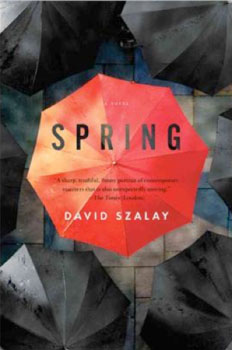
David Szalay has a new novel, ‘Turbulence’, coming out in June, but I was so impressed with his previous collection of stories, ‘All That Man Is’, that I couldn’t wait and decided to read his novel from 2011, ‘Spring’, right now.

All of the stories in ‘All That Man Is’ centered around young men making or not making their way in this modern world, and I found each story engaging, insightful, and eloquent.

There are writers of historical fiction, romance, science fiction, and mystery, but there are few writers who can articulate this maddening modern world we now live in. David Szalay is one who can take on modern life today, and I value him for that.

‘Spring’ is about a would-be romance between a young man and a young woman, James and Katherine, in London, but outside factors like Katherine’s ex-lover Fraser keep getting in the way. James had made a fortune in the dot.com boom of the late nineties but has lost it in the bust, and now he’s working on a shady horse racing scheme with his pals in order to recoup a little of the money. Katherine works in a reception desk in a hotel where she earlier had met her ex, Fraser, who makes a living as a photographer taking pictures of celebrities on the sly.

In ‘Spring’, Szalay captures nearly every nuance of the interaction between James and Katherine from a nice outing in Morroco to Katherine’s indifference when she starts things back up with her old boyfriend. One time James calls Katherine and he can hear noises that makes him suspect there’s a man in her room. Sadly that reminded me of an episode in my own past.

I suppose ‘Spring’ could be described as an anti-romcom as James presses forward to get closer to Katherine but is met by her seeming lack of enthusiasm. ‘Spring’ is more realistic than a romance by capturing every twist and turn of this harrowing relationship or non-relationship between these two.

We also get the spurious results of the whole horse racing scheme which adds some light humor to this entertainment. Szalay captures what it must be like for young guys and gals to live in London now and how they get together or don’t get together.

England is quite far along in recognizing David Szalay as a perceptive writer, but the United States has not really discovered him yet. I will be waiting for ‘Turbulence’ to arrive in June.


Grade:    A-


‘Arturo’s Island’ by Elsa Morante – A Masterpiece Only a Female Could Have Written


‘Arturo’s Island’ by Elsa Morante (1957) – 370 pages                    Translated from the Italian by Ann Goldstein

Once in a great while I stumble upon a unique masterpiece, and this time it is ‘Arturo’s Island’. It is a beautifully-written moving one-of-a-kind novel. Although there are clues that ‘Arturo’s Island’ takes place after World War II, the story seems to occur outside of time in a place of legend, of myth.

The story begins with the stark simplicity of a fairy tale. It takes place on the remote island of Procida in the Bay of Naples near Italy. As you can see from the picture below, the actual Procida Island is built up with a multitude of structures. However in the novel you get the impression that it is nearly deserted. Arturo is born in the castle called Casa de Guagliano which for centuries had been a monastery but has recently been occupied by a woman-hating old man named the Amalfitano. Arturo’s mother died the night he was born. Arturo’s main caregiver as a baby is Silvestro, a male servant. There are no women living in the castle. Arturo grows up quite wild and free on the island, worshiping his father Wilhelm who goes off on his own on mysterious trips and comes back only occasionally. Arturo’s best friend is his dog Imacolatella.

When Arturo is fourteen, his father brings back a wife called Nunziata. Nunziata is only sixteen, and she acts more like a big sister to Arturo than a mother. Nunziata does her best to be a good mother, but Arturo resents her for intruding on his man’s world. He has had little or no interaction with females up until then.

It is in depicting this teenage girl Nunziata that the writer Elsa Morante really shines. Nunziata arrives like a breath of fresh air into Arturo’s all-male world, although he doesn’t appreciate her at the time. Nunziata is charming, beguiling, enchanting, appealing. ‘Arturo’s Island’ is special because it is written from a female’s point of view. Thus it captures the inherent qualities of a female and how a female views men.

Procida Island Marina

There are types of stories which women excel in because women are more observant of other people than men are. Whereas men are more action oriented and stay on the surface, women can go deeper and capture the nuances of human relationships.

But above all, I was impressed with the graceful elegance of Morante’s writing in ‘Arturo’s Island’. Elsa Morante has captured an isolated world on this remote island of Procida and she brings back meanings that apply to us all. I won’t forget this one.

‘Arturo’s Island’ is a must-read that only a female could have written


Grade:   A+


‘The Traitors Niche’ by Ismail Kadare – A Comedy of Beheadings


‘The Traitors Niche’ by Ismail Kadare (1978)  – 200 pages      Translated from the Albanian by John Hodgson

Ismail Kadare of Albania is one of those writers I keep coming back to because I get a lot out of his novels. ‘The Traitor’s Niche’ is no exception.

‘The Traitor’s Niche’ is a historical novel and a laugh riot that takes place in the early nineteenth century when Albania was still part of the brutal Ottoman Empire. The Ottoman rule was harsh to say the least, and in the main square of Constantinople they kept what was called a Traitor’s Niche where just the head of a leader who had rebelled against the empire was displayed to the public. Whenever a new rebellion was quashed the head of its leader would replace the head that was currently displayed. ‘The Traitor’s Niche’ is the story of the beheading of one such rebel leader Black Ali, the transfer of his head to the square in Constantinople, and the care and grooming of the head to keep it in shape for public display.

The blade of destiny had harvested its crop, and it was there on the table, this white cabbage from the gardens of Hell.”

Not only were the Ottoman rulers constantly quashing uprisings; they also made harsh attempts to strip or erase their conquered people of their national identities. Kadare calls this stripping of identity Caw-caw, and the Ottomans used several methods to achieve this goal. Weddings are one occasion where communities celebrate their roots, so the Ottoman rulers would come up with diabolical ways to debase, distort, or entirely eliminate the wedding rites of these subjugated people.

Another Ottoman goal was to reduce their various conquered peoples’ languages down to what Kadare calls Nonspeak:

Words had been expunged from dictionaries, rules of grammar and syntax had gradually been erased until they vanished from use, and finally the letters of the alphabet were rubbed out.”

So among all the fun and mischief of the beheadings and the care and grooming and display of these severed heads, Kadare makes some serious points about the destruction of a people’s culture and language by a conquering empire.

That is what I like most about Ismail Kadare, his mixture of the profane and the sacred. Not many writers have the ambition or the wherewithal to deal with an entire nation’s identity and still be humorous.


Grade:   A


‘Instructions for a Funeral’, Stories by David Means


‘Instructions for a Funeral’ stories, by David Means   (2019) – 189 pages

There are two ways to look at the title ‘Instructions for a Funeral’. One way is to say ‘What a sad gloomy title’. The other way is to remark that David Means is so assured of his skills to interest and entertain us with his stories he can even stick his collection with this dismal title. I will let you know later which of these ways applies to me.

Except for ‘Fistfight, Sacramento; August, 1950’ which is an absolute gem of a story, I preferred the stories in this collection which were less dense and overcrowded. These less dense stories were in the last half of the collection starting with ‘Instructions for a Funeral’ which is another superb story.

Perhaps the most applicable example of a story in the first half of the collection which I feel is over-written is ‘The Chair’, the third story in the collection. In this story, an at-home caregiver father reflects on his wife and on his son whom he is watching as the five year old boy heads toward a dangerous retaining wall. In this story the sentences are long and the paragraphs are long and it was difficult for me to maintain interest.

But overall I felt these stories were well done, fine examples of what can be done with a story today. A few of the stories share themes. Some are stories about men who are stuck in halfway houses or mental hospitals or mission houses, down-and-out men. Also there is a recurring theme of an older man watching a younger man make his own earlier mistakes.

I probably would have left out the two entries that were fragments or not-stories, one which contains three separate reflections on fatherhood in four pages, and one which contemplates Raymond Carver and Kurt Cobain. I would also have lost the five-page introduction called ‘Confessions’.

As far as the gloomy title goes, I think that David Means is just carrying on the time-honored tradition of titling the book after the best story in the collection which happens to be ‘Instructions for a Funeral’. In this story a man realizes his own position in this world is quite precarious and so he writes down detailed instructions for his own funeral. Since the story contains instructions rather than reflections it avoids the pitfalls of being too self-reflective. The story is humorous in its own way.

When I first approached this collection, the stories seemed to be overcrowded and exhausting, the writing seemed to be over the top, overwritten. However by the last story, I felt that perhaps other writers’ stories might be too sparse. A lot goes on in these stories; that’s a good thing.


Grade:    B+


‘Antigo Nick’ by Sophokles – A Spiky Irreverent Translation of the Ancient Greek Tragedy Antigone


‘Antigo Nick’ by Sophokles (441 BC) – 44 pages Translated by Anne Carson

This is not you grandma’s translation of Antigone.

Anne Carson does not approach this ancient drama with undue reverence. King Kreon arrives on the scene riding in his powerboat, his ship of state. The translation of the ancient play alludes to Samuel Becket, Berthold Brecht, Virginia Woolf and others. And the words of the play are turned into spiky even whimsical mostly unpuncuated modern prose.

but of course there is hope look here comes hope

wandering in

to tickle your feet

then you notice your soles are on fire

a wise word

if evil looks good to you

some god is heading you on the high road to ruin”

But I’ve learned to trust the Canadian Anne Carson.

Words bounce. Words, if you let them will do what they want to do and what they have to do.” – Anne Carson

Carson knows what she is doing, especially with these ancient plays. I have read a lot of her poems and other stuff, most of it unclassifiable and brilliant.

For someone who is just beginning to discover Anne Carson, I would recommend two of her works, ‘Autobiography in Red: A Novel in Verse’ and ‘The Beauty of the Husband: A Fictional Essay in 29 Tangos’.

I watched a performance of ‘Antigo Nick’ with Anne Carson playing the role of ‘Chorus’ on You Tube as well as read the play. ‘Antigo Nick’ is probably not the first place to begin to discover Anne Carson, but even with the translation’s quirkiness it captures the spirit of the play.

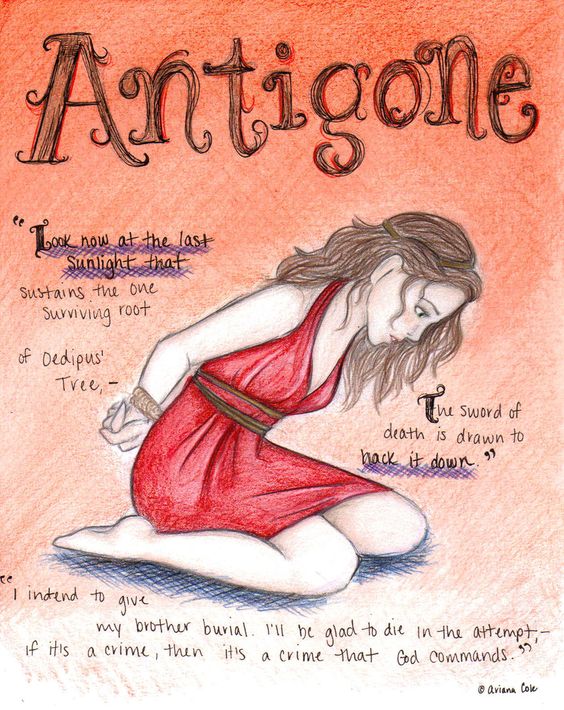
Here is the set-up of the play. The two brothers of Antigone and Ismenes have fought on opposite sides in the Thebes civil war and now both are dead. King Kreon has ruled that one brother Eteokles will be honored and given a full burial; the other brother Polyneikes will lie unburied on the battlefield and be prey to scavenging birds and worms. Antigone on her own decides to bury Polyneikes against the King’s wishes. The King finds out about it and decides that Antigone must be buried alive as punishment for her disobedience.

It’s Friday afternoon

there goes Antigone to be buried alive

is there

any way

we can say

this is normal

rational

forgivable

or even in the widest definition just

no not really

If I can convince even one person to investigate the work of Anne Carson, I will feel I have accomplished a great deal.

I write to find out what I think about something.” – Anne Carson

Not knowing what one is doing is no prohibition on doing it. We all grope ahead.” – Anne Carson


Grade: A-