Archive for August, 2018

‘My Year of Rest and Relaxation’ by Ottessa Moshfegh – Sleeping for a Year


‘My Year of Rest and Relaxation’ by Ottessa Moshfegh (2018) – 289 pages

Ottessa Moshfegh. I can’t imagine any writer voluntarily choosing this name as their pseudonym, but I also can’t imagine this being someone’s real name either. I keep trying to unscramble the letters ‘O t t e s s a   M o s h f e g h’ to come up with the real author’s name.

But Ottessa sure can write. Formerly I called her the Queen of Dirty Realism. Perhaps a more fitting name is the Queen of Ugly Realism. Not that her characters are ugly, far from it. It is just their behavior that is ugly. After our nameless young woman narrator loses her job at a realistic but ridiculous modern art gallery, all she wants to do is sleep. Anyone who can have their main character sleep for a year and still keep the story moving and interesting has got to be a good writer. Of course our nameless heroine does lots of subliminal activities while she is asleep.

Sleep walking, sleep talking, sleep-online-chatting, sleepeating, that was to be expected, especially on Ambien. I’d already done a fair amount of sleep-shopping on the computer and at the bodega. I’d sleep-ordered Chinese delivery. I’d sleepsmoked. I’d sleeptexted and sleeptelephoned. This was nothing new.”

Her psychiatrist the lady Dr. Tuttle prescribes nearly every kind of downer drug and rest medication there is to help our girl sleep, and the ones she doesn’t prescribe she hands out as free samples. Our girl winds up taking one drug called Infermiterol which knocks her out for two days straight but causes her to do a lot of crazy things in her sleep.

Our girl’s best friend Reva comes over once in a while and tries real hard mostly unsuccessfully to cheer our girl up and get her to go out and about. Our girl nearly always snubs Reva and has only contempt for her best friend’s efforts to be friends and to interfere with her sleep.

This novel captures our girl’s darkly comic mood and is filled with caustic black humor. It could have been a tragic story of a young woman withdrawing from the world, but here it is played for mostly laughs. Despite our heroine’s depressive attitude, the humor here keeps us reading.


Grade :    B
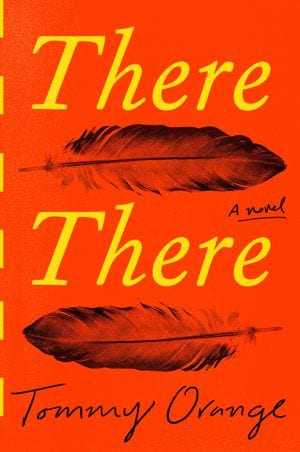
 

‘There There’ by Tommy Orange – Being Indian Today


‘There There’ by Tommy Orange (2018) – 290 pages

If you are expecting a nostalgic look at Native American life from the past, don’t read this novel. ‘There There’ is an enlightening, sometimes endearing and humorous, sometimes brutal and heartbreaking take on modern urban Indian life. This does not take place on the reservation but rather in the apartments and on the streets of Oakland, California today.


“We know the smell of gas and freshly wet concrete and burned rubber better than we do the smell of cedar or sage or even fry bread—which isn’t traditional, like reservations aren’t traditional, but nothing is original, everything comes from something that came before, which was once nothing.”

We have all heard the legend of the first Thanksgiving of the white settlers and the Native Americans sitting down together to a Thanksgiving feast. Here is an account of a more typical Thanksgiving in American history:

In 1637 near present day  Groton, Connecticut, over 700 men, women and children of the Pequot Tribe had gathered for their annual Green Corn Festival which is our Thanksgiving celebration. In the predawn hours the sleeping Indians were surrounded by English and Dutch mercenaries who ordered them to come outside.  Those who came out were shot or clubbed to death while the terrified women and children who huddled inside the longhouse were burned alive. The next day the governor of the Massachusetts Bay Colony declared “A Day Of Thanksgiving” because 700 unarmed men, women and children had been murdered. – ‘The Real Story of Thanksgiving’, Susan Bates, Manataka American Indian Council

Today Native Americans are still struggling to survive in our cities and on reservations. It is a story of low pay, inadequate employment, excessive alcohol drinking, broken homes, drug use, suicides. Even if you have Fetal Alcohol Syndrome because your mother drank to much when she was pregnant with you, life goes on for you. Some of the men leave their wives and small children to fend for themselves.

But ‘There There’ is enlivened by Tommy Orange’s all-encompassing empathy for these people, his people. The stories of twelve people are interspersed in short chapters until the conclusion where all the characters come together at the Big Oakland Powwow. Powwows may seem like an anachronism today, but they draw thousands of dancers from hundreds of tribes and tens of thousands of visitors to watch.

The eleven year old boy Orvil Red Feather wished his mother had taught him something about being Indian, but she was too busy. Instead he tries to learn it on the Internet, by “watching hours and hours of powwow footage, documentaries on YouTube, by reading all that there was to read on sites like Wikipedia, PowWows.com, and Indian Country Today.” His stolen Indian regalia is ready for the big day and he worries that he might look ridiculous. He teaches his two younger brothers Loother and Lony what it means to be Indian.

The Bay Area American Indian Two Spirits Powwow

Two of the main characters are the half-sisters Opal Viola Victoria Bear Shield and Jacquie Red Feather. They shared a tough childhood with a mother who was often beaten. “Home for Jacquie and her sister was a locked station wagon in an empty parking lot. Home was a long ride on a bus.”

This is a powerful debut novel by Tommy Orange which is sure to move you.


Grade :     A


‘Kudos’ by Rachel Cusk – Where’s Faye?


‘Kudos’ by Rachel Cusk (2018) – 232 pages

My enthusiasm for the Outline Trilogy, or as I call it the Faye Trilogy, peaked with the second novel ‘Transit’. Even though most of the stories people told to Faye in ‘Transit’ were not concerning Faye at all, it felt like Faye and her situation were front and center in that novel. However, in ‘Kudos’, it seems like the stories that the people tell Faye aren’t related to her at all, and Faye is barely there. Faye is for the most part missing in action in ‘Kudos’.

Also I searched for one really nice sentence in ‘Kudos’ that I could use in my review and didn’t find even one, except maybe this one.

A degree of self-deception was an essential part of the talent for living.”

‘Kudos’ begins with our novelist Faye traveling on an airplane to another literary conference in an unspecified European city when the guy sitting next to her tells her the story of his life in a long monologue. As with the previous novels in the trilogy, ‘Kudos’ consists almost entirely of these long monologues from near strangers. These monologues tend to be more philosophical than conversations we have in real life, filtered through Faye’s perspective. They usually are about literature or family life, and especially about marriage and divorce.

Although each of these monologues is quite interesting in itself, there is little to give them any lasting significance. Since each of these characters come on the scene only to tell their story and then are promptly dropped, the only character that is sustained throughout the novel is Faye. And with Faye barely there, there is nothing for the reader to hold on to. The monologues begin to sound very similar to each other. Of course there is no plot in ‘Kudos’ beyond attending this literary festival or conference.

One of the writers at the festival resembles what we know of Karl Ove Knausgaard, but Cusk does not use this resemblance in much of any way to enliven the proceedings.

Two of the bellwethers I use to determine the popularity of a novel are the number of copies and the number of holds on a book at the Hennepin County Library. Hennepin County is the county that contains Minneapolis so it is a big library system. Popularity is usually not a positive characteristic for me, but sometimes it is instructive. I would like to compare ‘Kudos’ with my previous novel ‘Dear Mrs. Bird’ by A. J. Pearce. Both novels received almost universally positive reviews. ‘Dear Mrs. Bird’ was published on April 5, and there are currently 287 holds on 81 copies of the novel at the library. ‘Kudos’ was published on May 18, and there are currently 9 holds on 18 copies of the novel. ‘Dear Mrs. Bird’ is admittedly a crowd-pleaser, but I was struck by how little reader interest there is in ‘Kudos’ for such a well-reviewed novel.

Ordinarily I would take the side of the little-read but uniquely literary novel like ‘Kudos’, but I can’t help feeling that there is something or someone missing from the novel. Perhaps Faye?


Grade :   B


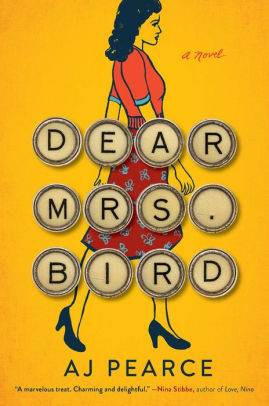
‘Dear Mrs. Bird’ by A. J. Pearce – Advice to Londoners During The Blitz

‘Dear Mrs. Bird’ by A. J. Pearce (2018) – 276 pages

‘Dear Mrs. Bird’ tells the moving story of young 23 year-old Emmeline Lake (‘Emmy’) during the time of The Blitz in London in 1940. The Blitz was Germany and Hitler’s all-out air bombing campaign against England. The German bombing campaign started out to be the bombing of only strategic targets but the bomb dropping was inaccurate, and civilian areas accidentally were bombed. By 1940 the deranged madman Hitler had decided that the terror bombing of London civilians might be useful for his goal of getting England to surrender.

Emmy has two jobs. During the day she works as an assistant to Mrs. Bird who writes a women’s advice column for the Woman’s Friend Magazine. At night she works at the fire station taking calls for the Fire Brigade which must deal with the on-ground devastation of Germany’s bombs.

There are obviously times when ‘Dear Mrs. Bird’ is necessarily heartbreaking but with all the death and destruction around them, living well is even more precious for these young people like Emmy and her friend Bunty. We have the camaraderie, the dances, the boyfriends, the weddings. ‘Dear Mrs. Bird’ is a surprisingly high-spirited read.

The advice columnist Emmy works for during the day, Mrs. Bird, is definitely old school. She will allow nothing concerning “intimate relations” or any other “unpleasantness” in her column. Emmy is supposed to cut up and throw away any letters that contain any mention of these things. As Emmy reads these plaintive letters about the real problems these women are facing in their personal lives, she decides to write to these women herself giving advice, and she signs them “Mrs. Bird”.

I could see people were ever so frank when they wrote in, which I thought really quite brave. Some of them sounded in a real fix. … Things were difficult for everyone at the moment, and I did think it was poor of Mrs. Bird not to write back.”

Since Mrs. Bird doesn’t read the finished magazine, Emmy sneaks some of these letters and her replies into the magazine itself. Emmy also softens some of Mrs. Bird’s more brusque replies.

The papers and radio and even magazines like ours went on about pluck and bravery and spirit,” she says. “How often did anyone ever tell women they were doing a good job? That they didn’t have to be made of steel all the time? That it was all right to feel a bit down?”

I was fully on board with this novel, totally engaged. When I picked up the novel again after temporarily stopping reading it, I was again right away involved because this story really meant something to me. That is probably the best thing I can say about any novel.

‘Dear Mrs. Bird’ is an irresistible tremendously moving story, and I strongly recommend it.


Grade : A+


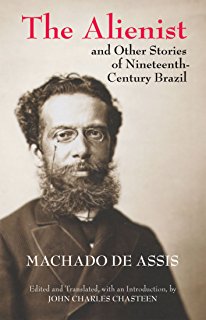
‘The Alienist’ by Machado de Assis – The Out-of-Control Psychiatrist


‘The Alienist’ by Machado de Assis (1882) – 86 pages


Joaquim Maria Machado de Assis is a literary giant.

No one else has written such playful yet psychologically astute satires as Machado de Assis (born 1839, died 1908). His two masterpieces are ‘Posthumous Memoirs of Brás Cubas’ (also known as ‘Epitaph of a Small Winner’) and ‘Don Casmurro’, but much of his other work including some of his stories have withstood the test of time. A new version of his collected stories translated by Margaret Jill Costa and Robin Patterson was just published in June of this year.

Philip Roth called Machado de Assis “a great ironist and a tragic comedian”. Mischievous irony is certainly one of the main devices Machado de Assis uses to connect with his readers.

Usually when Machado de Assis is mentioned, he is called the greatest writer from Brazil or the greatest writer from Latin America. Now it is time to recognize that Machado de Assis is one of those great world class fiction writers who belongs in the same league as such writers as Tolstoy and Dickens and Austen.

I recently read the humorous novella ‘The Alienist’ which can best be described as a playful attack on the science of psychology. The word “alienist” is almost archaic, and the word “psychiatrist” can be used in its place.

A young man named Simão Bacamarte leaves his home village of Itaguai in Brazil to pursue advanced medical studies in Portugal. After completing his education and becoming a brilliant physician, he decides to return to Itaguai and to pursue original research in the new field of psychology. The people in his hometown are happy to have this distinguished doctor back, and he builds a madhouse called Casa Verde for which he picks out residents of his hometown whom he determines are insane and should be locked up. The towns people realize there are some whose madness requires them to be taken off the streets and thus approve of the doctor’s work. At first everything is fine, but soon the doctor decides insanity is more prevalent than he thought, and he locks up more and more of the town residents.

Madness, the object of my studies, was, until now, considered a mere island in an ocean of reason; I am now beginning to suspect that it is a continent.”

The townspeople rebel. By this time three-quarters of the townspeople have been locked up in Casa Verde. The doctor decides to reverse his strategy which you can read all about in the novella.

‘The Alienist’ is a sharp and amusing story about this out-of-control psychiatrist who determines those who are mad and those who are not, but this novella doesn’t quite reach the superior level of those two novels I mentioned above. Start with either of them.


Grade : A-


‘Give Me Your Hand’ by Megan Abbott – Two Friends and Rivals in the Laboratory

Give Me Your Hand’ by Megan Abbott (2018) – 342 pages

‘Give Me Your Hand’ is the harrowing story of two woman scientists, Kit Owens and Diane Fleming, who became good friends in high school and later are members of the same medical research team. The story alternates between ‘Then’ in high school and ‘Now’ ten years later in the research lab. Kit Owens is from a poor background and has had to struggle to achieve anything. Diane Fleming is from a well-to-do family and has always been treated as the perfect one by teachers and others. Diane inspired Kit to new heights of academic achievement. Now they are both working on a medical project involving PMDD (premenstrual dysphoric disorder) which is a severe form of PMS with symptoms of wild mood swings, intense anger toward others, and even violent behavior. Both Kit and Diane are terribly ambitious, and Kit quotes one of her idols Marie Curie:

My head is so full of plans that it seems aflame.”

This is a psychological thriller. Diane has a dark secret from her past which she has disclosed only to Kim, and Kim could destroy her by telling another person at any time. Along the way we meet others who work in the lab including a couple of men and Dr. Lena Severin, the woman who leads the project.

All of us toiling years in the lab, our necks permanently crooked over microscopes, our faces cadaverous from never seeing the sun.”

This is classic Megan Abbott if there is such a thing (I’ve read two of her previous novels) involving sharp conflicts between young women. The movies are starting to come after Abbott’s work with three of her novels being filmed, and she is a writer for the HBO series ‘The Deuce’. Her work is usually classified as crime fiction and she has won the Mystery Writers of America Edgar Award.

I found ‘Give Me Your Hand’ a bit too simplistic and sketchy to be totally satisfying as a novel for me, but it is probably ideal to be used as the basis for a movie. My reaction to Abbott’s work is similar to my reaction to Stephen King’s work. The prose gets a little too breathless at times for it to be totally convincing as a literary novel. I do like the visceral intensity and obsession of Megan Abbott’s novels and will probably continue to read them in the future.


Grade : B