‘Long Day’s Journey into Night’ by Eugene O’Neill (1941) – 179 pages
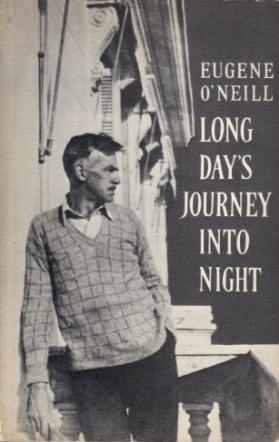
Many claim that ‘Long Day’s Journey into Night’ is the greatest play written by a writer from the United States. Personally I think that distinction belongs to another play written by Eugene O’Neill, ‘The Iceman Cometh’. If you ever get the chance to see Lee Marvin in John Frankenheimer’s movie ‘The Iceman Cometh’ from 1973, don’t miss it. Lee Marvin plays gregarious salesman Harry Hickey who comes to his old bar to destroy the pipe dreams of everyone who is at the bar. Pipe dreams are those lies we tell ourselves to get us through each day. That play profoundly moves me to this day.
But on to ‘Long Day’s Journey into Night’ which is O’Neill’s most autobiographical play. O’Neill wrote the play in 1941 about his wretched early family situation involving his father, mother, and older brother. O’Neill would not publish the play while he was alive, and he made arrangements not to publish it until 25 years after his death. However his widow Carlotta recognized what a great play it was, and had it published in 1956. The play was first performed in November, 1956.
As its title suggests, the play of four acts takes place during one day in 1912. The Tyrone family is living in their summer seaside home in Connecticut. The father James is a famous actor who could have been a great Shakespearean actor if he hadn’t settled for more money. The sons Jamie and Edmund are fully grown. Older brother Jamie works as an actor in jobs that his father gets for him but mainly Jamie is a rake about town spending most of his time in bars and whorehouses. Edmund, the younger son, has worked as a journalist, written poetry, and has traveled widely but is sickly and may have consumption (tuberculosis) probably somewhat due to excessive alcohol consumption. Edmund is O’Neill’s stand-in for himself. All three men are alcoholics, but it is the mother Mary who has the worse problem; she is a morphine addict and has been confined to a sanatorium before.
One can comprehend how difficult it was for Eugene O’Neill to confront his real family situation. This is family realism at its most honest and most brutal. Each character must confront his or her own reality and shortcomings or else another member of the family will point them out for him or her.
“None of us can help the things life has done to us. They’re done before you realize it, and once they’re done they make you do other things until at last everything comes between you and what you’d like to be, and you’ve lost your true self forever.”
 I do think ‘Long Day’s Journey into Night’ is a very strong honest family drama. However it is somewhat of a sad and depressing play with no redemption for its characters. I prefer ‘The Iceman Cometh’ because while it is still brutally honest with the people on stage, it still offers a way out for these people at the end.
Under any conditions, Eugene O’Neill is still the greatest playwright from the United States.
Grade : A
 Tony's Book World
Posted by TravellinPenguin on July 26, 2018 at 4:35 AM
I agree about Lee Marvin’s performance in the Ice Man Cometh. I love O’Neill. I am also a big fan of Tennessee Williams. Death of a Salesman is the play I never get out of my head. Our play reading class read The Glass Menagerie last year. All those plays were depressing but so well written. I enjoyed revisiting this one through you again.
LikeLiked by 1 person
Posted by Anokatony on July 26, 2018 at 7:38 AM
Hi Travellin Penguin,
I really wish they would make more of these intense family dramas today rather than super hero movies. I suppose Eugene O’Neill started it with his plays, and both Tennessee Williams and Arthur Miller were strong playwrights who followed his lead. I remember seeing a movie version of ‘The Glass Menagerie’ when I was quite young that I thought was great. I remem ber there was some mix up between “blue roses” and “pleuroses”.
Today it almost seems like the category “serious drama” has disappeared.
LikeLiked by 1 person
Posted by TravellinPenguin on July 29, 2018 at 5:40 AM
I know. I can certainly agree with that. Probably why I enjoy my U3A play reading class so much.
LikeLike
Posted by Lisa Hill on July 26, 2018 at 5:24 AM
Interesting that the widow jumped the gun with publication… a bit of bad feeling against the family, maybe?
LikeLike
Posted by Anokatony on July 26, 2018 at 7:46 AM
Hi Lisa,
I haven’t studied it too closely. The best light to shine on this story would be that the wife realized the value of the play so decided to release it early. However there could be other scenarios of conflicts within the family. I’m sure the play has been a real money-maker for the family considering how many times it has been performed.
LikeLike
Posted by Lisa Hill on July 26, 2018 at 8:05 AM
I wasn’t thinking of the money she/they might have made, just that if the playwright wanted a 25 year moratorium so as not to hurt the feelings of others, the wife in not complying with his wishes may well have thought, who cares if their feelings are hurt?! But you’re right, we can’t know…
LikeLiked by 1 person
Posted by Anokatony on July 26, 2018 at 5:36 PM
The play takes place in 1912, and all of the people being portrayed were long gone by the time the wife allowed the play to be published in 1956, so I don’t think it was a case of anyone’s feelings being hurt. Still to portray one’s own mother as a morphine addict is pretty strong stuff.
LikeLike
Posted by Lisa Hill on July 27, 2018 at 2:26 AM
Indeed!
LikeLike