Archive for June, 2018

‘Border Districts` by Gerald Murnane – Fiction???


‘Border Districts` by Gerald Murnane (2017) – 132 pages

I believe I gave ‘Border Districts’ a fair chance, but it didn’t work for me.

Usually I can read and appreciate most of the lauded fiction writers. I did not care much for Dario Fo who won the Nobel Prize for Literature in 1997, but giving the prize to him was probably a mistake anyway. Otherwise my major stumbling block has been Samuel Beckett. I’ve read both some of his plays and a few of his novels, but none of his work has reached me in any meaningful way. Not even ‘Waiting for Godot’ affected me that much.

One of the reviews of ‘Border Districts’ by Gerald Murnane that I read mentioned Samuel Beckett.

First of all ‘Border Districts’ reads more like a memoir rather than a fiction. There is even a line in the novel stating that “I am not writing a work of fiction but a report of seemingly fictional matters”. There is no plot. There are no characters. It is mainly the narrator’s memories of what he has read or seen. The language has the verisimilitude of non-fiction. At times ‘Border Districts’ reads like a not very interesting essay on the author’s marble collection among other things.

Despite my lack of appreciation for this book, I did catch its theme. It is about the images which most affect us and which we retain as part of our visual image memory throughout our lives. Hence his fascination with his translucent marble collection. Perhaps some pictures may have helped?

Another image memory the narrator has is of the refracted light through the stained glass church windows of his Catholic youth. He recalls from his reading how during the Reformation, Protestant congregations took over some of the old Catholic churches in Europe, and the first thing the Protestants would do is knock out and break the beautiful stained glass of the Catholic churches they took over. The Protestants got the bare plain un-decorated churches they deserved. This was an image that I could relate to because I can still recall the beautiful stained glass windows of the church of my youth. Ours was a German Lutheran church, but they had the good sense to value and use beautiful stained glass.

I appreciate the stained glass but the images of his marbles and the horse racing colors not so much.

Another positive in ‘Border Districts’ for me was that this attention to one’s visual image memory spurred my own memories. I remembered when after college I got my first white collar job and was bored stiff, so I signed up for an extension Art History course of two semesters which covered art from the Dark Ages until today in two semesters. The guy who taught the course was kind of a shady dark mysterious figure but he made those paintings come alive for me, especially the Renaissance paintings. He became kind of a role model for me. During the Impressionist era, he introduced us to the idea of “the merely pleasant”. Maybe we undervalue “the merely pleasant”. During that time I put up pictures in my room of “La Grande Jatte” by Georges Seurat and “Two Sisters” by Pierre-August Renoir because these represented the merely pleasant for me. I became a crusader for the merely pleasant. As part of the class we went to the Chicago Art Institute, and we actually saw the originals of those two paintings.

The Merely Pleasant?

So ‘Border Districts’ did spur these memories in me, so perhaps I am undervaluing the book also.

However I found the writing in ‘Border Districts’ to be relentlessly flat and the subject matter usually determinedly pedestrian. I considered the sentences rather clumsy and found myself frequently bored by mid-sentence.

In a review in the Washington Post, Jamie Fisher said of ‘Border Districts that “the result is tedious – but fascinating”. For me the bottom line was very tedious and only somewhat fascinating.


Grade : C

.

‘Love’ by Hanne Ørstavik – A Cold Winter Night in a Northern Norwegian Town


‘Love’ by Hanne Ørstavik (1997) – 125 pages               Translated from the Norwegian by Martin Aitken

This is a story about a single night in the lives of single mother Vibeke and her eight year-old son Jon. They have recently moved to this small remote town in the north of Norway. Jon wants to give his mother plenty of space so she can get ready for his birthday tomorrow with a cake and everything, so he goes out of the house without telling her to sell raffle tickets for his sports club

Meanwhile Vibeke is wound up in her own longings and dreams and has totally forgotten about Jon’s birthday, but instead decides to go to the library so she can get more of the romance novels she devours. Even for this short trip, she wants to look nice because, who knows, she might meet someone. She finds out that the library closed early this night, so she decides to stop and visit a carnival which is in town for the weekend. There she meets a young man, Tom, who is a carnival worker, and the two of them hit it off and wind up going to a bar together, and she stays out to bar closing.

Meanwhile Jon is having his own adventures with the strangers he meets selling tickets. The story goes back and forth between Jon and Vibeke usually switching from one to the other without any warning. Several times I thought we were still reading about Jon but the story had moved on to Vibeke or visa versa. There is a sense of eerie foreboding for both Jon and Vibeke as they interact with these strangers and get in and out of strangers’ cars on this cold winter night. One feels that both Jon and Vibeke are too trusting souls among all these strangers, and what is this eight year-old boy doing alone outside late at night?

‘Love’ as a literary novel is Norwegian minimalist realism with a vengeance. The sentences are short with little variety beyond subject, verb, object. The sentences for the mother Vibeke are nearly as simple as those for the boy Jon. Whereas the boy comes across as appropriately child-like, Vibeke comes across as almost childish with her romantic concerns and her almost totally forgetting about Jon. When she meets Tom she works hard to start a romance between them. The short staccato sentences add to the ominous mood.

Its creepy vibe makes this novella an intense read.


Grade :    B


‘Florida’ by Lauren Groff – If It’s not the Alligators and Snakes, It’s the Suffocating Heat


‘Florida’ by Lauren Groff    (2018) – 275 pages

The Florida of this new collection of stories by Lauren Groff is not a very likable place. Groff’s Florida is not the beachfront coastal Florida but the swampy central deep-country Florida of alligators, snakes, and lots of insects. The setting is typical of Gainesville, Florida where Groff currently lives. This is the Florida of makeshift boats in stagnant ponds and “frenzied flora and fauna”. And then there is the oppressive sweltering heat and the quite frequent hurricanes. Even an occasional panther and a lot of bad smells. And the people are nearly as bad as the climate.

Even when the main character somehow escapes Florida to Brazil in ‘Salvador’ and France in ‘Yport’, things don’t get any better in these stories.

In some of the stories the main characters go unnamed. In the story ‘Above and Below’, the main character is referred to always as either ‘she’ or ‘the girl’. In the Guy de Maupassant story ‘Yport’ the main characters are only ever called ‘the mother’ or ‘the older boy’ or ‘the little boy’. This lack of names distanced me from the stories. One of the many problems for me with this collection is its lack of immediacy or charm.

‘Above and Below’ is about a young woman who voluntarily gave up the academic life and descended into the life of the homeless. However it seemed more like she passively sleepwalked into the life of a homeless poor person and it was not a spirited descent. I wearied of this story.

I suspect that Lauren Groff is a writer more suited for the novel rather than the short story. Her stories here are too cluttered and vague for this short form, and we readers lose interest.

In too many of the stories the main character, usually a woman, seems world weary. She is stuck entertaining the kids while any man is off somewhere else. In ‘Yport’ our nameless heroine is in France with her two nameless kids to further study the famous French writer Guy de Maupassant for a potential book about him. She has already discovered that Guy de Maupassant was a total creep, and most of his literary work besides the famous stories is not very good. This could potentially have been a fascinating story about how our literary heroes can turn out to be lousy human beings. Instead the story is mostly about the morose mother listlessly entertaining her children in various French places. Reading about someone who is so dispirited and tired eventually becomes tiresome itself.

I searched the stories in ‘Florida’ in vain for even one spark of the vivacity of Lauren Groff’s ‘Fate and Furies’ which made that novel such a delight. (‘Fates and Furies’ was my favorite fiction read of 2015.)


Grade : C

‘Blue Self-Portrait’ by Noémi Lefebvre – Inspired Chatter


‘Blue Self-Portrait’ by Noémi Lefebvre (2009) – 139 pages Translated from the French by Sophie Lewis

Even though ‘Blue Self-Portrait’ is a relatively short novel, with its exceedingly long sentences and its unbelievably long paragraphs it is probably the most challenging book I have read this year. However at the same time, with its depth and its charm ‘Blue Self-Portrait’ is also one of the most rewarding novels I’ve read this year.

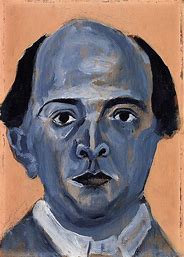
‘Blue Self-Portrait’ is a painting by the music composer Arnold Schoenberg which he did in his spare time.

Two sisters in their late twenties or early thirties are returning by airplane to Paris after a short vacation in Berlin. The one sister, our narrator, looks back on their time in Berlin and especially her romantic interlude with a German pianist composer. Meanwhile she is reading the correspondence between Theodor Adorno and Thomas Mann. This is a stream-of-consciousness novel like no other.

The sisters together on this trip sort of bring things down to earth. Otherwise this novel might have gotten too philosophical and abstract and dry. Here I will quote one of the shorter sentences just to give you the lively flavor of the writing.

I excuse my sister everything and myself nothing, not only do I excuse without calculation but I appreciate more than anything in my sister that which I loathe more than anything in myself, I consider magnificent in my sister whatever horrifies me in myself, am unconditional with my sister and always disappointed in myself.”

The pianist she met criticized our narrator for talking too much. She herself knows she talked too much, “sure that I’d put him off seeing me ever again, even by accident, instilled a lifelong revulsion in him for the kind of girl I am, the kind who talk too much and whose flaws we know well, who go on exasperating those around them down the generations, who ruin the lives of their husbands, children, and lovers, never content with that understanding silence required for happiness”.

But her endless chitting and chatting are some of the most profound and acute yet still charming conversations I have encountered.

Blue Self-Portrait

This is a deep work, yet the two sisters bring it down to Earth. As their plane flies over Wannsee Lake our narrator’s thoughts turn to the terrible Wannsee Conference at which the German Nazi officials planned the implementation of the Final Solution to the Jewish Question, the systematic murder of millions of men, women, and children. The father of Reinhard Heydrich who was the director of the Wannsee Conference was also a composer of German music. January 20, 1942 which is the date of the conference is perhaps the most significant date for whole humanity. January 20 is also her sister’s birthday. This work has the courage to confront pure evil.

I doubt I will read another novel this year as intelligent and filled with ideas as this one. With her incredibly long sentences, Lefebvre manages to be deep yet charming at the same time. If you are up for a challenge, I recommend this one.


Grade :   A


‘Sweet Days of Discipline’ by Fleur Jaeggy – At the Girls’ Boarding School in Switzerland


‘Sweet Days of Discipline’ by Fleur Jaeggy (1989) – 101 pages Translated from the Italian by Tim Parks

‘Sweet Days of Discipline’ starts out eerie and only gets eerier.  Here are the opening sentences:

At fourteen I was a boarder in a school in the Appenzell. This was the area where Robert Walser used to take his many walks when he was in the mental hospital in Herisau, not far from our college. He died in the snow. Photographs show his footprints and the position of his body in the snow.”

This girl’s boarding school is the Bausler Institute, in the Appenzell of Switzerland near Lake Constance. The time is the mid-1950s. Her parents have packed her off to various boarding schools since she was the age of eight so this is normal life for her although nothing approaches normal in this story. We don’t hear much about her father but she writes letters to her mother who is in Brazil and remarried.

This girl is dismissive of her German roommate Marion; instead she is obsessed with the new girl Frédérique and follows her around until Frédérique finally notices her. There is a shortage of males, so regimented school life is all about the girl crushes.

Of course we are experts when it comes to women, we who have spent our best years in boarding schools. And when we get out, since the world is divided in two, male and female, we’ll get to know the male side as well. But will it ever have the same intensity? Will conquering men, I wonder, ever be as difficult as conquering Frédérique?”

By the age of fourteen, most of these girls feel they have been stuck in the authoritarian setting of the boarding school way too long and are hanging out waiting for their actual lives to begin. After fourteen, this feeling of being in suspended animation at the school gets only worse for the girls. But when they finally do get out and experience the vexing freedom of the real world they may long for those sweet days of discipline at the boarding school.

Every sentence is loaded with a grotesque slant in this short novel. We learn little about attending classes or other activities at the school. There is an occasional glimpse of the headmistress Frau Hofstetter who seems nice enough, not at all the wicked headmistress of some boarding school novels. It is most all about the other girls.


Grade:   B


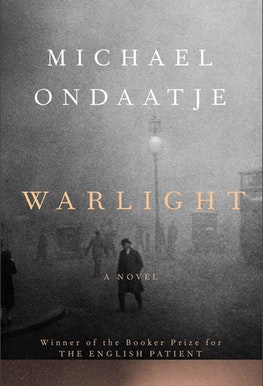
Warlight by Michael Ondaatje – The War That Wasn’t Really Over Yet


Warlight by Michael Ondaatje (2018) – 285 pages

‘Warlight’ takes place in England in the years immediately following World War II. The main protagonists are fourteen year old Nathaniel and his sixteen year old sister Rachel. After the war in Europe was officially declared over, both of their parents leave under mysterious circumstances, and two unfamiliar men whom they call The Moth and The Darter are left in charge of their household, and every night there are colorful strangers crowding into their house.

In 1945 our parents went away and left us in the care of two men who may have been criminals.”

People assume that World War II in Europe ended in the spring of 1945 when Hitler committed suicide, and Germany surrendered. However all the hostilities that had been unleashed did not immediately end. All across Europe, impromptu groups sprung up to carry out vengeance against their fascist neighbors who had brutalized them during the war. Also especially in the Balkan countries guerrilla squads of ex-Nazi soldiers formed to continue the fight. The work of the British intelligence agents continued after the war to bring some semblance of order to the turmoil of post-war Europe, and we find that Nathaniel and Rachel’s mother was involved in that effort.

Michael Ondaatje is very good at capturing the ambiance of London immediately after the war. The term ‘Warlight’ refers to that reduced lighting that was used all over England to somewhat protect itself from German bombers during the war. With the war over, London was like a ghost town but ready to come back alive.

There were parts of the city where you saw no one, only a few children walking solitary, listless as small ghosts. It was a time of war ghosts, the grey buildings unlit, even at night, their shattered windows still covered over with black material where glass had been. The city still felt wounded, uncertain of itself. It allowed one to be rule-less. Everything had already happened. Hadn’t it?”

Later in the 1950s Nathaniel himself pursues a career in British Intelligence partially in order to find out exactly what his mother was doing during the war.

Michael Ondaatje has enough confidence in his literary abilities, he does not have to try real hard to captivate his readers. It comes naturally. The story is not at all direct or straightforward or told in linear fashion, but rather takes many twists and turns. Whereas other writers may have simplified this story to make it more dramatic and palatable to the reader, Ondaatje is sure enough of his own skill to deal with the complexity in meaningful fashion. He succeeded for me. His main achievement is capturing the ambiance and atmosphere of bombed-out England after the war and the mystery and excitement and color of these people waking up and resuming their peacetime lives.


Grade :   A