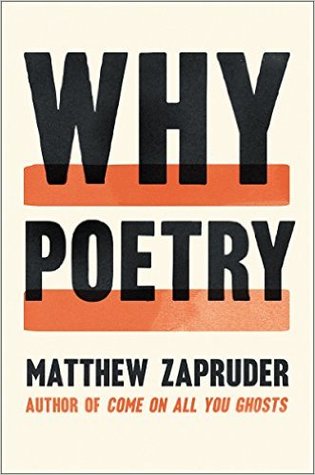
‘Why Poetry’ by Matthew Zapruder (2017) – 226 pages
About half way through reading ‘Why Poetry’, I realized that the main purpose for the book is to serve as a textbook for a college survey course perhaps called Poetry 101. It is written to be a guide book both for appreciating poetry and, to a limited extent, for writing poetry.
Matthew Zapruder occasionally mentions his experiences instructing students in such a course, sometimes at a college near Amherst, Massachusetts. Amherst is the home of Emily Dickinson so it is the ideal place to be teaching poetry.
“Hope is the thing with feathers that perches in the soul.” Emily Dickinson
I cannot imagine a more perfect line of poetry than that.
I totally agree with Zapruder’s main point which is that we readers of poetry should take the words of a poem at face value, trust what is said on the surface of a poem, and not overextend ourselves looking for deep or buried meanings. Poetry is mainly about using words effectively, and we must count on the poet to do just that.
 As for writing poetry, Zapruder’s advice is to not pursue a career of writing poetry unless you absolutely have to, which I think is good advice. For myself, I majored in mathematics in college at the University of Wisconsin in Madison, and I stayed safely on the technical side for my career despite becoming increasingly enamored of literary fiction and poetry during my off hours. I did not have to write fiction or poetry, so I didn’t, although I tried occasionally.
So ‘Why Poetry’ has that comprehensive textbook feel to it which isn’t exactly what I was looking for, but I stuck with it. At the beginning there are some meaningful quotes by famous writers as to what poetry is which I appreciated. Marianne Moore said that a poem is “a place for the genuine”. Aristotle said poets are those who “have an eye for resemblances”.
“A poem, when it works, is an action of a mind captured on a page.” – Anne Carson
The book does not mention my favorite quote about poetry:
“A poet is one who manages, in a lifetime of standing out in thunderstorms, to be struck by lightning five or six times.” – Randall Jarrell
Unfortunately for Randall Jarrell he never did get struck by lightning, and he does not have that one great poem that everyone has heard, although he was a wonderful critic who was responsible for single-handedly rediscovering the novel ‘The Man Who Loved Children’ by Christina Stead.
Anne Carson also has another great quote about poetry which is not mentioned in the book:
“Words bounce. Words, if you let them, will do what they want to do and what they have to do.” – Anne Carson, Autobiography in Red
Here is a line from Matthew Zapruder himself that I liked:
“Art exists that one may recover the sensation of life; it exists to make one feel things, to make the stone stony.” – Matthew Zapruder
 The beginning analyses of poems in ‘Why Poetry’ were quite rewarding for me, but as the analyses grew more complicated, they became less helpful to me. I suppose to some extent my tastes in poetry diverged from Zapruder’s as I prefer the clear, simple and direct whereas he has a taste for the dreamlike and distracting. There are some poets we both like including the aforementioned Emily Dickinson, Anne Carson, and Wallace Stevens. However other poems he uses as examples left me high and dry. I certainly did not study the examples with the intensity required for a college course.
There may be several reasons for my lack of appreciation for a poem. Often, I suppose, it is me not paying close enough attention to the poem. Other times a poem is fine, but it’s just not on the same wavelength as me. The third possibility is that the poem is just not that good.
‘Why Poetry’ probably will work very well as a textbook, but it might not turn you into a poet or even a poetry aficionado.
Grade: B
 Tony's Book World
Posted by Lisa Hill on November 12, 2017 at 3:31 AM
This sounds a bit misleading to me: “the words of a poem at face value, trust what is said on the surface of a poem, and not overextend ourselves looking for deep or buried meanings.”
Because that may be true of many poems, but it’s not true of poets like TS Eliot where you need to be able to recognise symbols and allusions.
LikeLiked by 1 person
Posted by Anokatony on November 12, 2017 at 4:07 AM
Hi Lisa,
I have conflicting views on T. S. Eliot based on two poems, ‘The Lovesong of J. Alfred Prufrock’ and ‘The Wasteland’. I loved Prufrock and consider it to be one of the greatest poems ever. However, except for ‘April is the cruelest month’, I find ‘The Wasteland’ needlessly obscure. I felt all those different languages he uses to be showing off as hopelessly erudite. Then there is the nonsense language which of course no one can figure out.
Overall, I much prefer the work of Philip Larkin.
LikeLike
Posted by Lisa Hill on November 12, 2017 at 6:28 AM
Yes, TS Eliot is a challenge. I was lucky to have excellent tutors at UniMelb who guided us through The Wasteland and made it into a poem I really liked. But that, of course, illuminates your point – and mine too – that some poetry demands much more of a reader than this ‘textbook’ seems to suggest in the excerpt that you quoted.
LikeLiked by 1 person
Posted by Anokatony on November 13, 2017 at 6:22 AM
I’m happy that your instructors helped turn The Wasteland into a poem you really like. I tried to do that for myself a couple of years ago, but wound up writing a post called ‘Six Reasons to Not Like The Wasteland’. :)
LikeLike
Posted by Lisa Hill on November 13, 2017 at 7:40 AM
*chuckle* Only six!
LikeLike