‘The Forensic Records Society’ by Magnus Mills (2017) – 182 pages
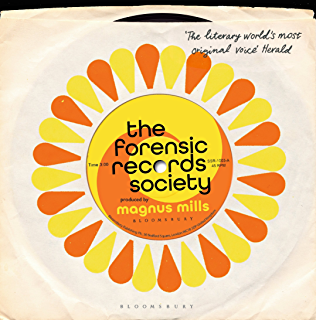 First of all, I adore the deadpan style of Magnus Mills and his offbeat original tongue-in-cheek approach to novels. The setup to ‘The Forensic Records Society’ is absurd and ridiculous, and that’s just fine.
Do young people even know what vinyl records or turntables are anymore? Have they even heard of 45s, those records that had only two songs, an A side and a B side? At this point, vinyl records are about as obsolete as typewriters and dial phones, although there are some experts who claim that these vinyl records capture the sound quality better than the more modern methods.
‘The Forensic Records Society’ harkens back to a time when people took their music much more seriously than today. Of course there are plenty of us old dudes left, survivors of the 1960s and !970s, who still remember the importance that was placed on music and songs in our daily lives back then and probably even remember many of the songs Mills mentions in this novel.
The original Forensic Records Society meets in a back room of the Blue Moon pub. Members bring three songs they wish to play for the group and they take turns playing them. At most there are only about eight members. The rules are strict, no comments or judgments on the records; the members are there solely to listen to the songs.
 What this novel is really about is a somewhat comic analysis of the social group dynamics that spring up when any new group is formed. Soon after the Forensic Records Society begins, a competing group, the Confessional Records Society, is formed which has a charismatic leader, a stronger appeal to women, and engenders an almost religious fervor. Later as a reaction to the strict rules of the Forensic Records Society, the Perceptive Records Society is formed which allows long-playing records as well as singles and also allows members to quote or comment on the songs. Later the spinoff New Forensic Records Society starts. As one might expect, there is much intrigue between the members of these various competing clubs.
What Magnus Mills does in ‘The Forensic Records Society’ is create a whole new world based on this mundane silly premise of competing record clubs. However the reader gets so caught up in the doings and goings on of these various club members as though it were an intriguing espionage or science fiction story. I see Magnus Mills as one of the most original, down-to-earth, and creative purveyors of fiction operating today.
Grade : A
 Tony's Book World
Posted by kaggsysbookishramblings on August 27, 2017 at 1:49 PM
I liked the sound of this one when I read Annabel’s review – sounds perfect for a vinyl record lover like me! :))
LikeLike
Posted by Anokatony on August 27, 2017 at 6:25 PM
Hi Kaggsy,
Yes, perfect for a vinyl record lover. One of the fun things about the book is deciding whether or not you have heard of the songs that they are playing at the club. Some of them are rarities and some are quite familiar, but I’m quite sure that all of them are real and not made up. He even mentions ‘Who Knows Where the Time Goes’ by Sandy Denny and Fairport Convention, my favorite at the moment.
I’ve been a fan of Magnus Mills ever since ‘Restraint of Beasts’ which came out in 1998.
LikeLiked by 1 person
Posted by Guy Savage on August 27, 2017 at 7:33 PM
I haven’t read any Magnus Mills yet. This one sounds like fun. Does it have a fair amount of bickering between members?
LikeLike
Posted by Anokatony on August 27, 2017 at 7:41 PM
Hi Guy Savage,
There is a lot of bickering. It is a study in group dynamics told by the number two guy in the Society. Group dynamics is rather a pretentious term but Magnus Mills brings it down to earth like he always does.
LikeLike
Posted by Nancy okullu on September 7, 2017 at 2:02 PM
true anakatony …
LikeLike
Posted by Nancy okullu on September 7, 2017 at 2:04 PM
sure . true that anakatony
LikeLike