Archive for February, 2017

‘Transit’ by Rachel Cusk – Listening to Other People’s Life Stories

‘Transit’ by Rachel Cusk    (2016)   –  260 pages

9780374278625

‘Transit’ is almost entirely made up of the life stories that other people tell our narrator, Faye.  Instead of getting Faye’s story, we mainly get those of the people around her who tell stories from their lives to her in casual conversations.

I see this as a strategic retreat on our narrator Faye’s part.  She is going through a divorce, and this might be a good time to listen to what the people around her are saying about their own situations rather than dwelling on her own plight.  Perhaps she wants to re-establish her bond with others by listening to them.

First there is old boyfriend Gerard who is now happily married with a family and still living in the old neighborhood to which Faye is returning. There are two ways that a writer can approach dialogue.  In one approach, to be entirely natural and realistic, the writer can have his or her characters speak exactly like real people speak which means they would rarely say anything clever or witty.  In the other approach, the writer has his or her characters speak in witty sparkling epigrams, constantly saying the perfect thing.  Rachel Cusk favors the second approach, and I admire her for it.  Here is a line from Gerard.

“It’s hard not to become self-satisfied,” he said, “with so much self-satisfaction around you.”

Later Faye responds to Gerard as follows:

“I said that it seemed to me that most marriages worked in the same way that stories are said to do, through the suspension of disbelief.  It wasn’t, in other words, perfection that sustained them so much as the avoidance of certain realities.” 

We do find out a few things about Faye as she interacts with the people around her.  She has two children and is going through a divorce.  Her children are staying with her ex while her apartment is being remodeled.  She has a terrible obnoxious couple living below her which is one of the novel’s sources of humor.  She teaches creative writing.  She has started dating again.

But mainly we find out other people’s stories.  The guys who are remodeling her apartment are two brothers from Poland, Pavel and Tony, who are making a go of it in England.  We accompany Faye to her hairdresser and to a literary conference where she is one of the guest speakers.  We learn quite a bit about the other two writers who are guest speakers but not so much about Faye.

Even though Faye is the central figure in ‘Transit’, most of the stories are related to her by the people she meets.  There is essentially no conventional plot and little character development.  Rachel Cusk is on the cutting edge of writers attempting to take the novel to somewhere new and different from its traditional roots. She has a talent for writing eloquent and expressive sentences that many experimental novelists do not have.  I have followed Cusk’s writing from the beginning of her career and am happy to continue to do so.


Grade:    A

‘Sudden Death’ by Alvaro Enrigue – The Sixteenth Century Viewed Through a Tennis Match


‘Sudden Death’ by Alvaro Enrigue   (2013)     261 pages       Translated by Natasha Wimmer


sudden-death

‘Sudden Death’ is an incredibly rich entertaining whirlwind trip through the 16th century presented within the framework of a tennis match in 1599 between Italian artist Caravaggio and Spanish poet Francisco de Quevedo.  Along the way, we have stops for English Queen Anne Boleyn and Spanish explorer Cortés and the church officials during the Counter Reformation as well as other excursions.

“I don’t know what this book is about.  I know that as I wrote it I was angry because the bad guys always win.  Maybe all books are written because in every game the bad guys have the advantage, and that is too much to bear.”

Instead of the usual axe, a sword was used by the special executioner from France brought in by English King Henry VIII in 1536 to behead Anne Boleyn.  There is a rumor that this executioner kept some of her hair to make four tennis balls.  Yes, this is spurious history, and I would not vouch for the accuracy of much that is in this novel.  That does not make these apocryphal stories any less fascinating.    The author Enrigue has these four Boleyn tennis balls bounce through the 16th century being passed from Pope to Cardinal to financier to favored artists.   Thus we get to the time of the Counter Reformation and its accompanying tortures.

“Never were the connections among politics, money, art, and semen so tight or so murky or so unashamedly happy, tolerant, and fluid.”   

There are also occasional side trips to Mexico where the Aztecs led by Montezuma make the fatal mistake of not executing Cortés and his men upon their arrival.  For Enrigue who is from Mexico, the history of Cortés and Montezuma has special significance.  “There are few better illustrations of how a whole host of people can manage to understand absolutely nothing, act in an impulsive and idiotic way, and still drastically change the course of history,” Enrigue says of Cortés and his men.

I did not even know that tennis went back that far, but apparently there was tennis already in the Middle Ages.  Later Caravaggio was known for his realistic paintings and also for using prostitutes as models for his religious figures including the Virgin Mary.   Caravaggio is considered the most important artist of the late sixteenth and early seventeenth century, yet he was jailed on several occasions and had a death sentence pronounced against him after he killed a young man in a brawl in 1604.

‘Sudden Death’ contains so much of history and of rumor that it can be quite an overwhelming experience to read this novel.  However Enrigue presents all of this material in such a methodical and intriguing fashion it is ultimately pleasurable.


Grade:    A


‘Multiple Choice’ by Alejando Zambra – A Fiction Disguised as a Multiple Choice Exam


Multiple Choice’ by Alejando Zambra  (2014)  – 101 pages     Translated by Megan McDowell


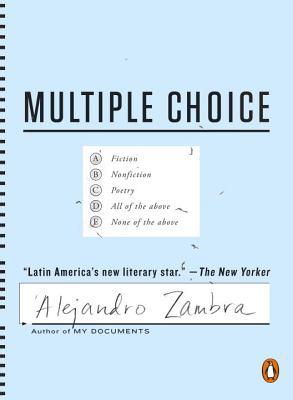
28588315‘Multiple Choice’ takes the form of a standardized aptitude test and consists of a series of multiple choice questions and answers.  Due to its unique format, I hesitate to call it a novel, but it definitely qualifies as a work of fiction.

The multiple choice questions that make up this work are grouped into the following five exam categories: 1) Excluded Term, 2) Sentence Order, 3) Sentence Completion, 4) Sentence Elimination, and 5) Reading Comprehension.

The exam is based on the actual Chilean academic aptitude test of 1993.  At that time right-wing dictator Augusto Pinochet was still in power in Chile, and that fact permeates these multiple choice questions.

For example, in Question 2 you are supposed to mark the word whose meaning has no relationship to the heading or the other words listed.  Here is Question 2:

      2  Choice

            A. Voice
             B. One
             C. Decision  
             D.  Preference
             E.  Alternative

The correct answers are not listed.  My answer would be B, because if you have only ‘One’, you have no choice.  One dictator?  Frequently none of the choices is a good answer.  Some of the questions are impossible to answer.

As the test progresses, the questions get longer and longer until the last Reading Comprehension section where the questions are preceded by a text which itself almost amounts to a short story.  One of these texts is about a wedding party where the fact that divorce was illegal in then Pinochet Chile is discussed and reviled.  Chile was the only country in the world where divorce was illegal, and thus marriages could only be annulled.  Even if the couple had been married for many years, they had to lie in court that they had never lived together.

It was the Nixon administration of the United States that saddled Chile with the vicious incompetent dictator Augusto Pinochet.  It must strike Chileans as poetic justice that the people of the United States have now stuck themselves with Donald Trump.

The questions and the answers are usually either pointed or playful.  One of the sub-themes of this fiction appears to be the utter ridiculousness of these standardized tests.

This multiple choice exam is a clever idea for an experimental fiction.    Several reviewers brought up the works of David Markson as a comparison, but ‘Multiple Choice’ reminded me most of ‘Nazi Literature in the Americas’ by Zambra’s fellow Chilean writer now deceased, Roberto Bolaño.  Both works are sharply humorous yet highly political.


Grade:    B


‘Idaho’ by Emily Ruskovich – An American Gothic Novel

‘Idaho’ by Emily Ruskovich    (2016) – 305 pages

61a9eppwrwl-_sy445_ql70_

The northwestern state of Idaho is not exactly a literary center in the United States although famous author Marilynne Robinson was born and grew up there before moving to Iowa.  From the novel ‘Idaho’, I get that northern Idaho is mostly rural with many rugged mountains, rivers, and wilderness areas providing a scenic backdrop.

‘Idaho’ is a strong haunting novel that will stay with you.  I do have some criticisms of the way the story is told, but these criticisms probably have most to do with the intense feelings that it provoked.

As the novel opens, Ann is a teacher in a school in northern Idaho.  The father of one of her students, Wade, stops by her classroom and is intrigued by Ann’s piano playing, and soon he is taking piano lessons from her.  One day Ann reads a newspaper account that Wade’s wife Jenny has murdered their 6 year old daughter May with an axe and the other 9 year old daughter June has run away to save herself.  Wade doesn’t show up for piano lessons for a few months, but then he comes back and Wade and Ann get married within the year.

They live on a mountain, and Wade makes knives for a living.  His ex-wife Jenny is locked up for life in prison.

The story is mostly told from the new wife Ann’s perspective.  She is of course intensely curious about this horrific event in the near past.  The story jumps around in its timeline in order to relate the full course of events.  In some of the chapters we are with Jenny in prison where she is hapless and affectless and eternally remorseful for what she has done.  She develops a friendship with fellow prisoner Elizabeth who has murdered two people.

One thing I should mention which is never explicitly stated in ‘Idaho’ is that the second wife Ann feels guilt that the beginning stages of her romance with Wade which occurred before the gruesome incident may have been a factor in setting Jenny off.  Emily Ruskovich is a much more subtle writer than I originally gave her credit for.  Later Ann must deal with Wade’s early onset dementia which begins in his early fifties.

For me, perhaps the weakest aspect of this strong novel is that we are never given a single good reason that the first wife Jenny would be capable of murdering her daughter with an axe. The novel does not answer the question, Why?  Perhaps the author Ruskovich is saying that some terrible crimes are just inexplicable.  Jenny is a seemingly fine person up to the time of the crime.  She is a fine person filled with remorse for all the years afterwards.  The murder comes out of nowhere.  There is a vagueness about the details and circumstances of the crime that I found irritating, since it is the central event of the novel.

But despite my reservation, I found ‘Idaho’ a compelling read that held my interest throughout .  I suggest you give it a chance in spite of my grade.


Grade:   B


‘Daisy Miller’ by Henry James – A Severe Reading Setback

‘Daisy Miller’ by Henry James  (1878) – 80 pages

c1a691d8-c361-4ad3-a74f-34d475288fdfimg400

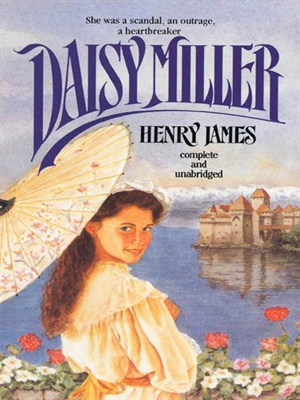
If you want to retain a good opinion of Henry James, don’t read ‘Daisy Miller’.   When you read this novella, you realize that it was written by a haughty snobbish upper class twit.   James’ total contempt for us common people shines through.

The story of Daisy Miller is told through the eyes of a twenty-seven year old man named only Winterbourne.  Winterbourne is an American who has plenty of real money, so he travels around with his aunt to only the finest hotels and resorts in Europe.   In the town of Vevey in Switzerland there is a hotel that is even grand enough for Winterbourne, “being distinguished from its upstart neighbors by an air both of luxury and maturity.”

There Winterbourne meets a rambunctious little American boy named Randolph who introduces him to his pretty older sister, Daisy Miller.

“They were wonderfully pretty eyes, and indeed Winterbourne had not seen for a long time anything prettier than his fair country-woman’s various features – her complexion, her hair, her nose, her ears, her teeth.  He had a great relish for feminine beauty.”    

Winterbourne is really attracted to Daisy, but first he must determine if her money and her behavior are worthy of his refined attention, so he hovers around Daisy for the rest of the novella.   By watching her, he determines that Daisy is kind of a free spirit, and of course Winterbourne severely criticizes her for that.

The Millers decide to relocate to Rome, Italy, and Winterbourne hears rumors about Daisy.

“The girl goes about alone with her foreigners.”

So Winterbourne immediately rushes to Rome where presumably he finds an even more luxurious and exclusive hotel, so that he can continue to hover around Daisy.  He finds out that the free spirit Daisy has gotten involved with an Italian guy called Giovanelli who claims to be a Count.  Winterbourne can tell just by looking at the guy that he doesn’t have any real money, so he pesters Daisy to ditch the Count.  Daisy doesn’t ditch the Italian Count, so soon she becomes a shame and an embarrassment to her entire hotel of snooty people.

Of course in a Henry James story Daisy Miller must die for her sins, and she gets a mysterious fever.  After she dies, Winterbourne moves on to an even more posh elegant hotel in Geneva.

After reading a couple of other works by Henry James, I was just getting to the point where I could stomach his pompous pretentious ways, but I must report that ‘Daisy Miller’ was a severe setback in my regard for Henry James.


Grade:    C-


‘The Winter’s Tale’ by William Shakespeare – Dark Tragedy or Light Comedy or Romance?

‘The Winter’s Tale’ by William Shakespeare   (1610) – 108 pages

9781304880710-medium

“Merry or sad shall it be? As merry as you will. A sad tale’s best for winter.”

‘The Winter’s Tale’ is really two plays that fit together uncomfortably.  The first three acts are a dark tragedy involving a Sicilian King’s insane jealousy resulting in the deaths of his son and wife and banishment of his baby daughter.  The last two acts take place sixteen years later, and we are supposed to believe that the King has redeemed himself for those deaths through penitence to the point where his wife the Queen magically comes back to life.  This is one of the most hokey preposterous scenes in all of Shakespeare.

King Leontes of Sicily is having such a good time with his visiting old friend King Polixenes of Bohemia that he asks his wife Queen Hermione to convince his friend to stay.  Hermione does as her husband asks, but Leontes gets suspicious when he sees Hermione and Polixenes together that they are fooling around behind his back.  Hermione is pregnant, and Leontes immediately suspects that Polixenes is the father of the baby.  Soon Leontes becomes deranged with jealousy, and attempts to have one of his servants kill Polixenes, but instead the servant helps Polixenes escape back to Bohemia.   Leontes puts his wife in prison where she has the baby girl Perdita.  Leontes banishes the baby, and another servant takes the baby to Bohemia whereupon the servant is immediately eaten up by a bear.  A shepherd discovers the baby and takes her home.  Soon the king’s young son dies for missing his mother.  When Hermione hears the news, she collapses and soon she dies also.  Only then is Leontes filled with remorse.

So far, ‘The Winter’s Tale’ is a dark tragedy, but act four begins in a much lighter mood sixteen years later in Bohemia.   The baby Perdita is now a beautiful young woman, and by some strange coincidence King Polixenes’ son Florizel has become enamored by her even though she is a lowly shepherd’s daughter.  Most of Act IV is taken up with the spring sheep-shearing festival where there is much singing and dancing.  A joke figure named Autolycus comes to the festival, and he plays a similar hearty comedic role as Falstaff in Shakespeare’s historical plays. At this point we are far, far away from the earlier tragedy.

0c9fe2b07a411a2db90c3317d96162adA lot of plot ensues but by Act V we are back in Sicily.  The King Leontes has been pining away with regret for sixteen years, but now his banished daughter is back with her royal boyfriend from Bohemia, and both Kings watch as the couple gets married.   After the wedding they all go to see the statue of Queen Hermione that her best friend Paulina has made, and, wonder of wonders, it comes alive, and Leontes and Hermione are reunited.

I suppose there are two ways to look at ‘The Winter’s Tale’.  One way is that the tale is out-and-out preposterous.  The other is to view it as a case study in the magnificent power of redemption for King Leontes.   However I suspect that most modern audiences would find that King Leontes’ previous crimes were too heinous for him to be redeemed.

Grade:   B+

Continue reading