‘Our Spoons came from Woolworths’ by Barbara Comyns (1950) – 196 pages
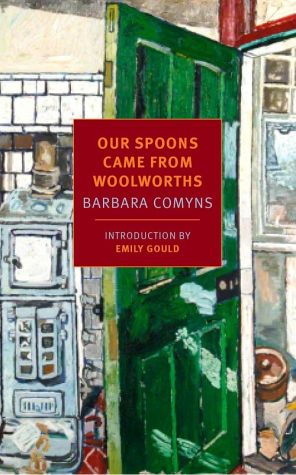
Perhaps the darkest thing about ‘Our Spoons Came from Woolworths’ is that it was based to some extent on the real life of Barbara Comyns. When the novel was first published in 1950, she actually wrote a disclaimer on the copyright page: “The only things that are true in this story are the wedding and Chapters 10, 11, and 12 and the poverty.” The listed chapters are about her horrific experience giving birth to her first child in a public hospital. The poverty of her early marriage years was all-pervasive.
We have all read or heard romantic tales of the starving artist who lives in poverty in order to pursue his grand artistic dreams. However we rarely get the picture of the poverty from the point of view of his starving wife with a baby. The wife and mother must work full time so her husband can stay at home not earning a penny. Somehow the wife keeps up a good front for the family until the baby gets sick or she gets sick and can’t earn anything.
Barbara Comyns has frequently been call a naive Primitivist, but never has a writer depicted day-to-day grinding poverty in more vivid devastating fashion. Perhaps what makes it so devastating is that her narrator always tries to keep up a good front no matter how terrible her plight.
“I was pleased he was going to be away now I felt so unhappy, because I knew men hate women when they are unhappy.”
Comyns can leave a sentence like the above hanging, so that its effect is more desolate than if it were explained.
Barbara Comyns deals in realistic fashion with subjects in a woman’s life that were hardly mentioned at that time including our married woman having an affair and then her back-alley abortion. But there is more to Comyn’s writing than her descriptions of sad destitution. She tells her life in simple and honest terms.
“I was quite glad to see him wearing such stupid clothes. It made it much easier to tell him I didn’t love him anymore.”
We have all been in situations like that, even though we usually won’t admit it. Our narrator in this novel always, always tells the truth even if it makes herself look stupid. But ultimately she is not so stupid; she is living her life the best she can in an extremely difficult situation.
Grade: A
 Tony's Book World
Posted by Cathy746books on November 28, 2016 at 11:29 PM
I’ve never read Comyns but this sounds excellent. And what a title…
LikeLike
Posted by Anokatony on November 29, 2016 at 8:06 AM
Hi Cathy,
Yes, you really must read Barbara Comyns. She was an artist also. She is an antidote to Downton Abbey as there were people who were near starving in England in the 1930s. She came from a comfortably well-off family, but the father was an alcoholic and the mother had mental problems. The family declined. Then she made an even bigger mistake marrying her first husband who was an artist who never earned any money.
LikeLiked by 1 person
Posted by Lisa Hill on November 29, 2016 at 1:01 AM
A lot of people did it very tough indeed in postwar Britain…
LikeLike
Posted by Anokatony on November 29, 2016 at 8:08 AM
Hi Lisa,
I believe the novel takes place before WW2 but am not sure. Still there was a lot of poverty during the worldwide depression.
LikeLike
Posted by Lisa Hill on November 29, 2016 at 1:03 PM
I just checked at Goodreads (not an infallible source, of course) and it says it was first published in 1950.
LikeLike
Posted by Anokatony on November 29, 2016 at 9:58 PM
Yes, the novel was published in 1950, but the story is based on Barbara Comyns’ first marriage which started in 1931. Just saying.
LikeLike
Posted by Lisa Hill on November 30, 2016 at 2:23 AM
Oh, I see, well, that places it in the Depression years. And of course it took some families a very long time to recover from that…
LikeLike
Posted by Max Cairnduff on December 1, 2016 at 6:28 PM
It is an amazing title. Desolate is the word. That unhappy quote is a real punch in the gut. Nice review.
LikeLike
Posted by Anokatony on December 1, 2016 at 7:01 PM
Hi Max,
Stay tuned on Sunday when I put out my Top Ten list for 2016.
LikeLike