‘Wilde Lake’ by Laura Lippman (2016) – 352 pages
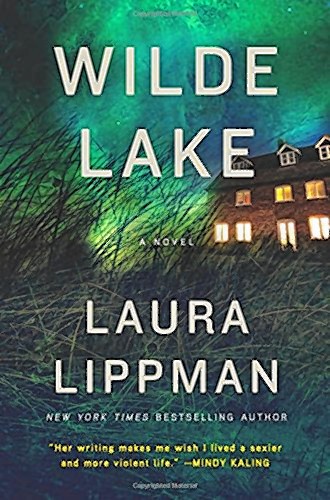
Although Laura Lippman has written twenty-one novels, ‘Wilde Lake’ is the first of hers that I have read. Crime novels are not my usual fare, but in recent years I have been more open to giving them a try.
As a crime novel, ‘Wilde Lake’ has some fine virtues. This story of Luisa Brant, the first female state’s attorney of Howard County, Maryland, is steady and sure-footed and very readable. It has an aura of competent professionalism written by someone who is quite familiar with the workings of the office. Some reviewers have suggested that perhaps with ‘Wilde Lake’, Lippman has transcended being just a crime novelist and moved into the literary category. I don’t think so, and I will explain why not.
There are two separate strands to the story. First we have the story set in the present where Luisa, Lu for short, starts working as the state’s attorney. Second we have a story from Lu’s young childhood involving her older brother and his high school friends. Each strand revolves around its own separate crime. Only much later do the two strands meld together into one.
In the strand where Lu is a child, she sees her father and her older brother and his friends as close to perfect. Her mother died when she was born. Her father was also a state’s attorney, and they live in a richly deserved (according to Lu) upper class house located in a new town near Wilde Lake.
Perhaps the problem for me was that we see Lu’s father and her brother and her brother’s friends through the eyes of a ten year old girl who sees them all as brilliant and splendid. This over-simplistic idyllic view of the main characters sustained for more than half the novel annoyed me. Not only does Lu as a little girl have this view of her family and friends as magnificent, she retains this view into her forties until the events that occur near the end of the book.
Perfect characters have no real depth and are of little interest. These characters are not fully developed to the point where the reader understands how they are going to behave next. Thus you have a character who has been built up to be almost god-like doing the most despicable things without the reader being given any forewarning. I suppose Lippman is making a point about a child losing her illusions about her family as she grows up, but the main characters just do not have the depth to support that point. Also some of the plot situations are too contrived and simplistic for a literary novel.
Grade: B
 Tony's Book World
Posted by Lisa Hill on July 10, 2016 at 4:31 AM
You have nailed my objections to crime novels… for me, a novel usually serves the purpose of learning more about human nature, and the simplistic characterisation of crime novels makes them pointless IMO.
LikeLike
Posted by Anokatony on July 10, 2016 at 10:01 PM
Hi Lisa,
Have you read Georges Simenon? He wrote a lot of detective novels, but he also wrote more ‘psychological’ novels which e called “hard novels”. So he was able to do both. I’ve only read one of his, one of his hard novels which was very good.
Ruth Rendell was a crime novelist whose novels I like. I also think Louise Penney from Canada is sometimes very good.
LikeLike
Posted by Lisa Hill on July 11, 2016 at 2:37 AM
Simenon is on my list of writers to try, but I don’t like Rendell. I haven’t read widely in the genre but I’ve read everything by Agatha Christie (LOL as you do, when you’re young) and the ones I’ve quite liked are PD James and Donna Leon.
LikeLike
Posted by Anokatony on July 11, 2016 at 4:57 AM
I haven’t read Agatha Christie or PD James or Donna Leon. I did see a stage production of Ten Little Indians. I have been tempted to read PD James a few times.
LikeLike
Posted by Lisa Hill on July 11, 2016 at 5:04 AM
Gosh, no Agatha? LOL I’ve even read some of hers in Indonesian… they were ideal practice for keeping my skills up because although I’d read them all before in English, they were all forgettable and so I had the motivation to keep reading to see whodunit…
LikeLike