Agostino’ by Alberto Moravia (1942) – 102 pages Translated by Michael F. Moore
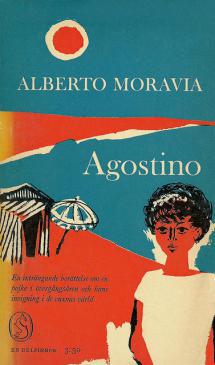
‘Agostino’ begins with an idyllic summer morning scene of a thirteen year old boy, Agostino, out in a rowboat on the Mediterranean with his mother.
“Agostino’s mother was a big and beautiful woman still in her prime, and Agostino was filled with pride every time he got in the boat with her for one of their morning rides.”
Agostino’s father has died, so he spends a lot of time with his mother. On their boat trips, sometimes his mother would dive into the sea.
“Agostino would see the mother’s body plunge into a circle of green bubbles, and he would jump in right after her, ready to follow her anywhere, even to the bottom of the sea. He would dive into the mother’s wake and feel as if even the cold compact water conserved traces of the passage of that beloved body.”
Later while Agostino rowed the boat, his mother would remove the top of her bathing suit to expose her whole body to the sunlight. Agostino steered the boat and did not look back at his mother.
One morning however a tanned young man appears, intruding upon the mother and son’s profound intimacy. In a couple of days the young man and Agostino’s mother go off rowing by themselves, leaving Agostino behind. After that Agostino must fend for himself.
He encounters a gang of rough boys his own age or older who hang around the beach with an adult lecherous homosexual sailor. These ragged boys have disdain for Agostino since they can tell by the way he talks and dresses that he is upper class, not one of them. With nothing else to do, Agostino soon runs with the gang every day.
“The dark realization came to him that a difficult and miserable age had begun for him, and he couldn’t imagine when it would end.”
‘Agostino’ is a fine novella, and as always in Alberto Moravia’s fiction, it deals with elemental issues. Here we have a young boy enraptured by his beautiful mother who must move on and grow up, and growing up is not easy. He must come to terms with his mother being just another woman.
Alberto Moravia captures the real down-to-earth drama that occurs in our lives, not on the glamorous or noteworthy occasions, but instead the subtle every day transformations each of us must undergo. A boy growing up to become a man (‘Agostino’), a wife whose attitude changes toward her husband after two years of marriage (‘Contempt’), a woman who works as a prostitute (‘The Woman of Rome’). By tracing problems that face individuals, he can deal with what causes the fascism sickness of entire societies (‘The Time of Indifference’, ‘The Conformist’).
The lyrical and passionate realism of the novels and stories of Alberto Moravia is just as strong and meaningful today as it was back when they were written in the middle of the twentieth century.

Grade: A
 Tony's Book World
Posted by Lisa Hill on April 28, 2016 at 2:04 AM
Last time you reviewed a Moravia, I promised myself I would read one of mine, but I still haven’t got round to it…
LikeLike
Posted by Anokatony on April 28, 2016 at 2:10 AM
Hi Lisa,
With Moravia it is difficult to name just one of his novels to read, because most of them are so good. He is also an excellent short story writer. His short stories used to be packaged as ‘Roman Tales’ and ‘More Roman Tales’, but I’m not sure how they are packaged today. It is good to see that he now has the NYRB stamp of approval.
LikeLike
Posted by Lisa Hill on April 28, 2016 at 2:51 AM
Mine are old Penguins, very old Penguins…
LikeLike
Posted by Anokatony on April 28, 2016 at 3:17 AM
I must check out the current Penguin catalog.
LikeLiked by 1 person
Posted by JacquiWine on April 28, 2016 at 10:37 AM
I loved this novella as well. It really captures that feeling of the loss of innocence, and Moravia’s prose suits the story perfectly. I must read more by this author – maybe Contempt next.
LikeLike
Posted by Anokatony on April 28, 2016 at 4:52 PM
Hi Jacqui,
‘Contempt’ is an excellent choice, and while you read ‘Contempt’ you might want to watch the movie too. That is what I did, and the movie is very fine too. It is Bridget Bardot’s best acting performance.
LikeLike
Posted by JacquiWine on April 28, 2016 at 5:05 PM
Will do. I’ve been meaning to get hold of that novel for quite a while, so your post is a timely reminder. I wrote about Agostino here if it’s of interest:
LikeLike
Posted by Anokatony on April 28, 2016 at 7:19 PM
Hi Jacqui,
In your review, you capture the elemental quality of ‘Agostino’ about a boy separating from his mother.
Stay tuned on Sunday as I again follow your lead with ‘A Manual for Cleaning Women’ by Lucia Berlin. :)
LikeLike
Posted by JacquiWine on April 28, 2016 at 8:02 PM
Thanks. Looking forward to seeing how you got on (or not) with Berlin in the end. :)
LikeLike
Posted by Emma on May 7, 2016 at 6:06 PM
I loved this novella as well. He managed to condense so many things about adolescence and growing up in a hundred or so pages. Amazing.
Contempt is excellent as well.
LikeLike
Posted by Anokatony on May 7, 2016 at 6:16 PM
Hi Emma,
Yes, Alberto Moravia is one writer who could do it all. His short stories are some of the best. His bigger novels about Fascist society, like ‘Time of Indifference’ and the ‘The Conformist’ are powerful. Then he wrote these short novellas about a particular feeling like ‘Boredom’, ‘Contempt’, and ‘Agostino’.
LikeLike