Archive for December, 2015

‘Beatlebone’ by Kevin Barry – John Lennon in Western Ireland

‘Beatlebone’ by Kevin Barry  (2015) – 299 pages


151102_BOOKS_BEATLEBONE-cover.jpg.CROP.article250-medium‘Beatlebone’ is a novel about John Lennon of the Beatles.  Lennon had bought a small deserted island called Dorinish off the far northwestern coast of Ireland in 1967, and ‘Beatlebone’ is about his unlikely visit to the island in 1978.

John Lennon was surely the edgiest one of the Beatles and the easiest one for people to dislike.  He was the original leader and created the Beatles and was one of  the group’s main singers.  He wrote many of the great Beatles songs including ‘A Hard Day’s Night’, ‘Help’, ‘All You Need is Love’, ‘Ticket to Ride’, and all the way up to their last recorded song ‘Come Together’.  After the Beatles broke up, he wrote ‘Imagine’ and ‘Instant Karma (We All Shine On)’ among many others.  During that solo time Lennon lived in the United States, and the FBI monitored him the entire time he lived there.

Lennon was also the most emotionally fragile of the Beatles.  He frequently came across as droll and sarcastic.  In 1978 Lennon had not recorded an album for three years.  He was finally off the really hard drugs, and he believed if he could spend some time alone on his island, he could get to a place where he could write music again.

Kevin Barry understands the difficulty of writing about Lennon.

 “He is quite nasal and often defensive. There is a haughtiness that can be almost princely, but his moods are capricious – sometimes he is very charming and funny and light; at other times there is a darkness evident, and an impatience that can bleed almost into bitterness.  He can transition from fluffy to spiky very quickly, even within the course of the same sentence.  Often during these interviews he was accompanied by Yoko Ono, who very clearly, from this distance, was the tethering fix in his life; lacking her presence, you get the feeling that he might have unspooled altogether.”

One thing Barry accomplishes in ‘Beatlebone’ is that he does get Lennon’s voice right.  However ‘Beatlebone’ did not work for me well as a novel.  Whereas Barry’s ‘City of Bohane’ was an Irish lyrical imaginary tour de force and I was dazzled by his stories in ‘Dark Lies the Island’, ‘Beatlebone’ did not seem well enough grounded to earth for it to be a compelling read for me.  My interest in the novel tended to float away.

Dorinish Island in Ireland

Dorinish Island in Ireland

And what about Lennon’s island of Dorinish?

“John (Lennon): Turns out the thought of it is the thing, Charlie.  The reality is slippery rocks and freezing fucking sea and creamy fucking gull shit.  Not to mention the banshee fucking wind.”  

I read a review written before he was murdered of John Lennon’s last album ‘Double Fantasy’. In it Lennon’s songs are praised as nice tunes, but Lennon made the unfortunate mistake of alternating his songs with poor ones by Yoko Ono which dragged the whole album down.


Grade: B          
 

‘The Price of Salt’ (‘Carol’) by Patricia Highsmith

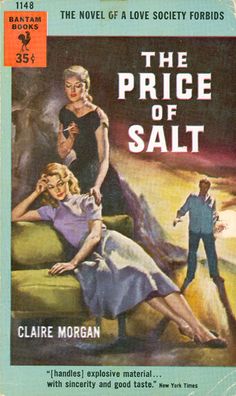
‘Carol’, original name ‘The Price of Salt’, by Patricia Highsmith (1952) – 292 pages

570187e0377bfbb798bfa1876d5a6efa

‘Carol’ actually is the story of Therese Belivet, a 19 year old young woman who has taken a pre-Christmas job working at the toy counter in a department store but who is most interested in designing sets for theatrical productions. Therese has a boyfriend named Richard who loves her, but she gives him practically nothing in the way of affection.  She waits in dread for the nights he will ask her to stay with him, and she usually manages a plausible excuse to turn him down.

One day at the department store, a wealthy suburban wife and mother named Carol comes in to buy a doll.  Therese waits on her, and the sparks fly at once between them.  The attraction on both sides is intense like nothing Therese has experienced before.  Soon Carol invites Therese out for drinks, and Therese eagerly accepts.

The word that best describes ‘Carol’ for me is ‘verisimilitude’.  In other words, the story here has the quality of seeming real.  Individuals probably do not have much control over the ones to which they are attracted or not attracted.  ‘Carol’ captures that overwhelming passion that can occur between two people, in this case the two women.

“With a thousand memories and moments, words, the first darling, the second time Carol had met her at the store, a thousand memories of Carol’s face, her voice, moments of anger and laughter flashed like the tail of a comet across her brain… And she did not have to ask if this was right, no one had to tell her, because this could not have been more right or perfect.”   

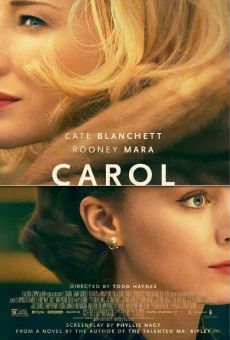
Patricia Highsmith, originally from Texas, wrote this novel soon after her first novel ‘Strangers on a Train’ achieved great success due to the movie Alfred Hitchcock made based on it.  For ‘The Price of Salt’, Highsmith used a pseudonym, and it developed a cult following as a lesbian novel.  Now, over sixty years later, it has been made into an Oscar-contending movie, ‘Carol’, by Todd Haynes starring Cate Blanchett and Rooney Mara.  Later in her writing career Patricia Highsmith, who never married, would write five psychological thrillers with Tom Ripley as the main character.

carol-2015Much of the novel is taken up with a road trip by Therese and Carol across the United States, but don’t expect much of scenery or local color as this is mainly a psychological novel of the heated attraction between these two.  There are a few scenes that take place on the road in the car, but otherwise we hardly ever leave the hotel.  At a few points in the novel the singular intensity of their relationship was not quite enough to sustain my interest.

I can see how ‘Carol’ would work well as a screenplay with the movie cameras providing the outside visuals that are missing from this novel of obsessive love.


Grade:  B+


The Top Twelve List of the Best Fiction I’ve Read in 2015


top12A

Another banner year for reading fiction comes to an end, and here again is my list of the best fiction I have read in the past twelve months.  Of course my list is subjective to the extreme, but that is half the fun of these lists anyway.

Click on the picture or title and author to see my original review.


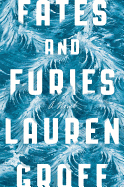
1. ‘Fates and Furies’ by Lauren Groff Fates(2015) – Here is a writer who can comfortably put Greek myth and Shakespeare into a modern marriage story. There is a manic energy and an inventiveness here that puts this novel above the rest.


2. 42780977 ‘Honeydew’ by Edith Pearlman (2015) – Finally a collection of  stories that is at least as good as the quotes on the back cover.  Each story is dense, warm, and poignant. A quirky weirdness permeates most of these stories, all for the better.


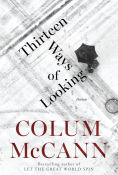
3. ‘T9780812996722_p0_v1_s118x184hirteen Ways of Looking’ by Colum McCann (2015) – The title novella here is the finest fiction I’ve read this year. The prose is lyrical and hypnotic.


14005824. ‘The Story of the Lost Child’ by Elena Ferrante (2015) – The final novel about Lenu and Lila, the two girls from a Naples neighborhood now grown up. Now that it is over, will I face Ferrante-withdrawal?


23269047._UY200_5. ‘When the Doves Disappeared’ by Sofi Oksanen (2012) – A novel about Estonia from the German occupation in World War II through the Soviet occupation which lasted 44 years after the war. The doves disappeared, because the occupying Germans liked to eat doves.


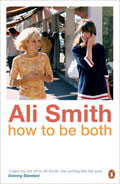
coverimg6. ‘How to be Both’ by Ali Smith (2014) – A playful novel of two parts. One part follows the Italian Renaissance painter Francesco del Cossa. The other part is about a 16 year old girl living in modern England named George who hates the song ‘Georgy Girl’ for which she was named.


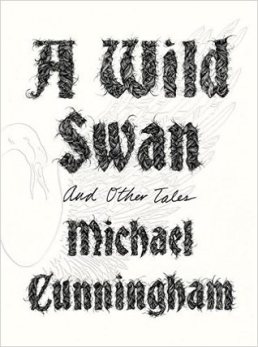
7A wild Swan-web. ‘A Wild Swan’ by Michael Cunningham (2015) – Some of the oldest fairy tales including ‘Beauty and the Beast’, ‘Rumpelstiltskin’, and ‘Snow White’ are re-told from a wicked grown-up perspective.


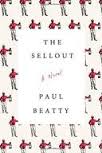
sellout8. ‘The Sellout’ by Paul Beatty (2015) – This is the comic account of the town of Dickens, a rural suburb stuck in the middle of Los Angeles. The sentences in ‘The Sellout’ take so many twists and turns you wind up in a different place than when you started them.


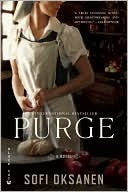
70296689. Purge’ by Sofi Oksanen
(2010) – A second entry for Sofi Oksanen who is my discovery of the year after Groff. It is the story of Zara, a young woman taken up by two violent Russian male pimps, and Aliide Truu, an old woman living in the Estonian countryside. This novel confronts deeper truths of good and evil than other novels do.


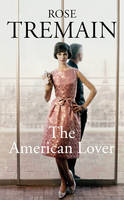
cv_americanlover10. ‘The American Lover’ by Rose Tremain (2015) – A varied group of convincing stories by one of the world’s better novelists. This collection will do until Rose Tremain writes another novel.


9780316231244_p0_v2_s118x18411. ‘There Must be Some Mistake’ by Frederick Barthelme (2014) – A humorous novel about modern junk culture where everyone under thirty looks like a gas station attendant even though there are no gas station attendants anymore. A guy who shows up in cowboy regalia is ‘cowboyed up’. Our food arrives thick, gloppy, greasy, misshapen, lukewarm, and inedible.’


978037417853612. ‘The Dog’ by Jack Livings (2015) – Perhaps the best description of China’s current government is “socialism with Chinese characteristics”.  General Motors now sells more cars in China than in the United States. These stories give us the lively inside story about what’s going on in China today.
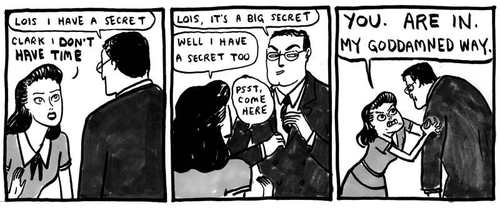
 

Step Aside, Pops – Zany Comics for Brainy Folks

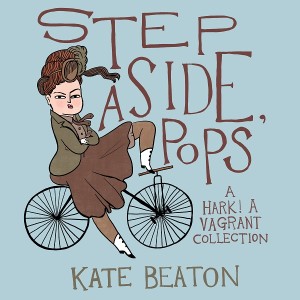
‘Step Aside, Pops – A Hark! A Vagrant Collection’ by Kate Beaton   (2015) – 166 pages


stepaside-300x300If you are looking for a light Christmas present for a brainy person or a brainy couple or a brainy family, I can’t think of anything better than ‘Step Aside, Pops’.

Subjects in this graphic comic collection include ‘Chopin and Liszt’, ‘Juarez and Maximilian’, and ‘Julius Caesar’ as well as less brainy subjects as Spiderman, Lois Lane, Cinderella, the Strong Female Characters, and a male extra from Janet Jackson’s video, ‘Nasty’.  Just about any offbeat topic is fair game for Kate Beaton.

A comic about Jane Austen and the Brontés has the following Kate Beaton aside:

“They say that Austenmania is dead, in which case, long live Brontémania, and may we always have a mania to sustain us.”

That is the lively playful spirit that drives this fun collection.

Not that these comic riffs by Kate Beaton are all that intelligent and uplifting.  Some are just plain stupid.   Yes, a lot of the humor here is ridiculous and sophomoric. That is intentional.  Some I did not get at all such as Kokoro, Parts 1 and 2.  But where else will you find a silly joke about Alexander Pope in a comic as well as Alexander Pushkin, Alexander the Great, and Alexander Graham Bell, all put together in ‘Famous Alexanders’?

One of Kate Beaton’s heroes is the American journalist, Ida B. Wells.  “A statue of Ida in every home, or the world isn’t fair.”  Beaton devotes several pages of comics to her.  I barely recognized the name Ida B. Wells, and thus I went to Wikipedia and Google to find out more about her.  ‘Step Aside, Pops’ left me curious to find out more about several of its subjects.

This year a few of my Christmas presents will be graphic novels.  There have been several write-ups discussing the best graphic novels for the year which I am using as guides.  Graphic novels seem to work better as presents than traditional novels.  I find it next to impossible to pick out a full novel as a present for someone.  A novel is just too much of an investment in time for the reader, and individual tastes are just too personal.  However a graphic novel does not present such a dilemma and can be enjoyed by an entire family.

‘Step Aside, Pops’ is one that I probably will be giving as a present.

tumblr_inline_n1jxffP9Lo1qbujox


Grade: A- 

‘A Wild Swan’, Fairy Tales Wildly Retold by Michael Cunningham

‘A Wild Swan and Other Tales’ by Michael Cunningham  (2015) – 135 pages


23848124In ‘A Wild Swan’, Michael Cunningham starts with the circumstances of some of the oldest fairy tales such as ‘Beauty and the Beast’, ‘Snow White’, and ‘Rumpelstiltskin’, and transforms them into something new and different.

Cunningham uses the declarative language of fairy tales to get us into these stories: a thatched-roofed cottage, a prince and a princess, a giant, a miller, a castle, a gnome. However then Cunningham throws us definite curve balls, language that you would never ever find in a fairy tale such lines as “you embarked on a career of harshly jovial sluttishness”.  Despite their fairy tale settings, these tales are meant for teenagers or adults, each with a wicked slant to which we big people can relate.  These stories wind up being perhaps even more strange and gruesome than the original fairy tale.

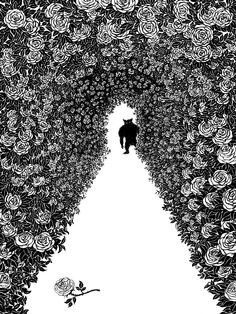
In the story simply called ‘Beasts’, which is Cunningham’s take on ‘Beauty and the Beast’, the father is going off to the city on business and asks his three daughters  what presents they’d like him to bring back.  The two younger daughters ask for silk stockings, for petticoats, for laces and ribbons.  However Beauty, the oldest daughter, asked only for a single rose, her reasoning thus:

“Do you really imagine a frock or hair ribbon will help?  Do you think it’ll improve the ten or so barely passable village men, or alter the modest hope that I will, at least, not end up marrying Claude the hog butcher, or Henri with the withered arm?  Do you believe a petticoat could be compensation for our paucity of chances?

I’d rather just have a rose.”

Does a young lady really require finery to attract Claude the hog butcher?  You won’t find such an ironic sensibility in a young maiden in the old fairy tales, and that is what makes Cunningham’s tales so devastating and fun.

Such phrases as “barely passable village men” and “compensation for our paucity of chances” won’t be found in children’s stories.  These fairy tales have a sharp sensibility.

7aff4f3a7e295164ad814f46561af048These tales remind me of the work of another writer who used folk and other stories as the raw material for his own strange and wonderful novels.   I am thinking of the French writer, Michel Tournier.  Tournier’s novel ‘Friday’ started with the story of Robinson Crusoe.  His novel ‘The Four Wise Men’ was based on the Wise Men who went to see the baby Jesus in the Bible story.  Tournier also took his turn at transforming the old fairy tales in ‘The Golden Droplet’.

I consider Michel Tournier to be a ‘do not miss’ writer.  In ‘A Wild Swan’, I see Michael Cunningham in his witty and wild retelling of these fairy tales as a worthy successor to Tournier.

With its fine illustrations by Yuko Shimizo, ‘A Wild Swan’ would make an excellent Christmas present for any teenager or an adult, but probably not for little children.


Grade: A


Five Short Stories by D. H. Lawrence

SABRDA0000482

Here we have five short stories by D. H. Lawrence which are included in an Audible audiobook collection.  These stories should give me an opportunity to say something meaningful about the English author and poet D. H. Lawrence.

The first story, ‘The Rocking Horse Winner’, is an oedipal story about a mother and her ten year old son.  They are discussing the subject of money.  I make it a rule not to include spoilers in my reviews, but in this case I must.  The boy asks his mother if their family is rich.  The mother replies that, no, they are not rich.  The mother, who came from more prosperous circumstances as a girl, tells the boy that his father is unlucky.  In D. H. Lawrence stories, ‘unlucky’ is usually used as a euphemism for ‘weak and ineffectual’, especially when applied to husbands and fathers.

The boy promises his mother that he will always be lucky.  To prove it he starts betting on the horses with the help of the gardener and the boy’s uncle.  The boy wins every bet hr makes and soon has enough money to supplant his unlucky father as the family provider.  But on the night of his last bet, the boy catches a fever and sadly dies.

My literary guru and guide, Martin Seymour-Smith, says that “D. H. Lawrence never resolved his Oedipal feelings for his mother and it may be that her lack of intellectual quality infected his entire life-style. “  Seymour-Smith’s appraisal of D. H. Lawrence is as follows:

“Much in his (Lawrence’s) writing is lovable and irresistible on any terms but his tiresomeness as a man also intrudes damagingly into it.  He is full of insights, but as full of neurotic and unpleasant idiocies.”

He goes on to say that Lawrence “was ‘awful’ – and he was ‘marvelous’”. According to Seymour-Smith, Lawrence’s second novel, ‘Sons and Lovers’, is a masterpiece, but all of his other novels are “flawed by the sudden angry intrusion of opinion”.  Thus I, following Seymour-Smith’s advice, have not read any of the other novels besides ‘Sons and Lovers’, not even ‘Lady Chatterley’s Lover’.  Seymour-Smith says that, besides ‘Sons and Lovers’, it is in some of the poems and short stories that Lawrence’s genius can best be found.

On to the second story, ‘England, My England’.  Here is another story about a quite useless husband and father, apparently a common theme for Lawrence.  This story takes place in the Midlands coal region of England called Nottinghamshire where Lawrence was born and raised.  Since the father is prone to taking long hikes in the woods when according to his wife he should be working, there are some marvelous descriptions of scenery here.

In the third story which is one of Lawrence’s earliest stories written in 1909, ‘Odour of Chrysanthemums’, a young woman and mother waits for her husband to get home from the coal mine or the pub where he usually stops and stays after work. Again we have the lovely Midlands locale and once again there is a wretched husband and father, although he does work at the coal mine.

In the fourth story which is one of Lawrence’s last stories, ‘The Lovely Lady’, an old woman rules over the lives of her son and niece who live with her.   This story does have elements of the supernatural although it turns out to be only a water pipe which carries sound from one part of the house to another.

dhlawrenceThe final long story, ‘Glad Ghosts’, is a true ghost story.  Most of it takes place at a dinner party and it invokes the spiritualism which was so popular in the 1920s.  It contains some of Lawrence’s perhaps more crackpot ideas about sex.  Colonel Hale is visited by the ghost of his dead ex-wife.  It turns out that the Colonel never paid attention or respect to her physically while she was alive, and thus she is haunting him.  The Colonel finally figures this out and rectifies the situation.  Meanwhile one of the male guests takes care of the Colonel’s young current wife, and the Lawrence-like narrator moves in on that guest’s young wife, Carlotta. All are happy at the end of the story.

In all of these stories, D. H. Lawrence displays a willingness to confront the complex psychological issues of his characters, both male and female.  In too much of today’s fiction, we stay on the surface and do not come up against the problems that are embedded inside each of us from early childhood. Sometimes it seems we have reverted from the complexities of Freudian psychology back to the silly ‘Heroes and Villains’ mentality of Star Wars or Indiana Jones.  Thus much of current fiction is too simplistic and lacking in depth.  D. H. Lawrence, flat-out crazy as he can be, is a corrective to the simple-minded and vacuous attitudes of our times.


Grade: B+