‘Odysseus Abroad’ by Amit Chaudhuri (2015) – 204 pages
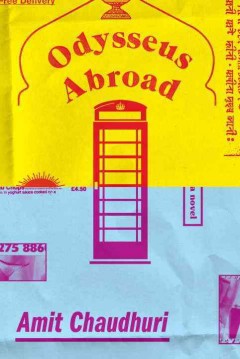
If I were to describe ‘Odysseus Abroad’ for what it is, a pleasantly uneventful novel, you would probably by now be well on your way to another place on the Internet, and I couldn’t blame you.
The plot here is beside the point. Nearly half of the novel is taken up with a “pointless ramble” in London by Bengali graduate student Ananda and his uncle Radhesh during which they stop for tea and later visit a book shop.
As happens with close family members, the uncle and nephew often annoy each other. The two men are like a comedy team with pointed and wicked repartee about nearly everything including the rest of their family members, each other’s sex lives, Indian versus English literature, and restaurant etiquette.
Ananda has strong opinions on the relative merits of Indian and English literature. He finds only a few English poets helpful to his own work: Edward Thomas, Geoffrey Hill, Philip Larkin. He considers the Mahabharata to be the “equal of all of Shakespeare and more”. I particularly enjoyed his views on Thomas Hardy:
“and the later, almost comical tragedies of Thomas Hardy, in which things went relentlessly wrong, as in a Tom and Jerry cartoon.”
‘Odysseus Abroad’ fully embodies Chaudhuri’s views. For the last thirty-five years the novel ‘Midnight’s Children’ by Salman Rushdie and its many successors and imitators have dominated the world’s view of Indian literature. All Indian literature was now supposed to be big, loud, and bold. There was no longer room for the small, the quiet, or the subtle.
Enter Amit Chaudhuri and his “refutation of the spectacular”. He has set about to write novels that are deliberately low key. In order for a novel to be entertaining, it does not have to be explosive or overly dramatic. Perhaps it is more about noticing the little things that happen every day that make the day odd and amusing. Also Chaudhuri’s novels do not deal with a monolithic India but instead with an India consisting of hundreds of different groups of people, each with its own particular culture. Some of these cultures have existed long before England appeared.
To fully appreciate ‘Odysseus Abroad’ requires a change in mindset. It is more like a jaunt around the neighborhood or a bike ride rather than a world changer. Sharp conversation, some humor, subtle insights. Listening to the audio of this book twice in order to fully appreciate it, I spent a lot of time with this novel in which not much happens. That time was pleasant enough
Grade: B+
 Tony's Book World
Posted by Lisa Hill on June 25, 2015 at 1:32 AM
Sacrilege! Poking fun at Thomas Hardy – boo!
But I like the sound of this.
Have you read the Mahabarata? I’ve read little bits of it, but it remains (like the Bible) one of those books I really feel I ought to read all the way through because it’s said to be so pivotal to understanding allusions in IndianLit.
LikeLike
Posted by Anokatony on June 25, 2015 at 5:26 AM
Hi Lisa,
No, I have not read the Mahabharata, but I am interested. The extent of my classical reading of Indian fiction only goes back to R.K. Narayan whom I consider excellent which is the same opinion as Chaudhuri. Anita Desai is another excellent Indian writer. Vikram Seth is another amazing writer.
LikeLike
Posted by Lisa Hill on June 25, 2015 at 7:31 AM
I’ve discovered quite a few (see http://anzlitlovers.com/category/author-origin/asian-literature/indian-literature/) thanks to Vishy’s blog (see my blog roll): he has a list of recommended authors which I have used to guide my reading. I particularly admired Train to Pakistan and The Romantics….
LikeLike
Posted by Anokatony on June 25, 2015 at 6:05 PM
Hi Lisa,
Your list reminded me about Rahul Bhattacharya whose novel ‘The Sly Company of People Who Care’ I too was impressed with. Not sure if I would consider that novel an Indian novel or a South American novel. There are Indian novelists all over the world.
LikeLiked by 1 person
Posted by Lisa Hill on June 25, 2015 at 11:37 PM
Yes, the diaspora has given us Indian voices of great diversity. I have yet to discover one from Australia although there is a large, well-established Indian community here. I shall keep a lookout!
LikeLike
Posted by Kat on June 29, 2015 at 9:03 PM
I did read one of his earlier books and loved it. James Wood loved this book, and you are the first blogger I’ve read on it. It’s on my TBR! Contemporary fiction is not my thing, but this one is blessedly short.
LikeLike
Posted by Anokatony on June 30, 2015 at 2:22 AM
Hi Kat,
It was the James Wood article that got me interested in Amit Chaudhuri in the first place. I like Chaudhuri’s low-key approach to fiction. Not every story needs to be earth shaking. Chaudhuri is a fine writer, but it does not appear that Odysseus Abroad will be his breakout book. Sooner or later he will have a breakout novel.
LikeLike
Posted by Kat on July 12, 2015 at 5:41 AM
Tony, I have to tell you that my husband is reading this book and is not impressed. He told me I had better listen to you instead of Wood!
LikeLike
Posted by Anokatony on July 12, 2015 at 4:37 PM
Hi Kat,
It is from James Wood’s article that got me to read the book also. I like what Chaudhuri is doing with his ‘refutation of the spectacular’, but it is difficult, especially for an American, to read something that is pointless. I had to listen to the audio twice to even begin to like it.
LikeLike