‘F’ by Daniel Kehlmann (2013) – 272 pages Translated by Carol Brown Janeway

‘F’ raises some of the major questions of life, yet somehow manages to be playful. At the same time it is a well-constructed work of fiction.
‘F’ is about a father and his three sons coming to terms or not coming to terms with our post-modern world. Not that the modern world before had been all that great what with the Great Depression and World War II.
But in the post-modern world, even the priests don’t believe in the sacraments they perform or even in God. Many businessmen and politicians cheat and defraud but are rarely punished. And of course the art world and museums are rife with hype and fakes. ‘Sheer noise triumphs over quality.’
 The father Arthur is an author who walks out on his family to pursue his writing after an auto-suggestion from the hypnotist, the Great Lindemann. The sons grow up. One son Martin is a fat priest who still is intrigued by the Rubik’s Cube, one son Eric is a stock broker living the high life but contemplating suicide, and one son Ivan is a gay artist and art critic.
‘F’ is by no means what I would call a ‘straight line’ traditional novel. It is definitely post-modern. It resists any simple plot explanation and it raises a lot of questions it doesn’t answer. That is a good thing. Each of the sons gets to tell his story.
One of the many questions ‘F’ asks is ‘How do people who are mediocre manage to live their lives?’ Ivan wrote his dissertation on ‘Mediocrity as an Aesthetic Phenomenon’.
“Ivan often wondered how people with no particular gifts put up with their existence.”
Each brother has his own way of dealing with Ivan’s question — how do you live with mediocrity, why do you keep on going? The general answer in ‘F’ seems to be that we fake it.
“If I kept on painting, I would be average at best. Would that be terrible? Most people are average by definition.”
Although the tone of ‘F’ is light and playful, it is not an easy novel. However it is a rewarding one. I had to listen to the entire novel twice to get its full effect. One chapter is a story, ‘Family’, the father Arthur wrote. He has no memory at all of his own father, but he traces his ancestors back to medieval times. The story seems to point out how random and stupid fate is that we are here today.
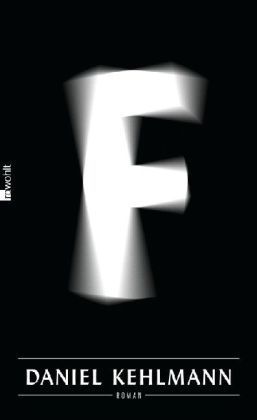 So what does the ‘F’ stand for? My best guesses are ‘Fate’ or ‘Fake’. Maybe the two are interchangeable in our post-modern world.
My review of ‘Fame’, Daniel Kehlmann’s previous novel, can be found here.
 Tony's Book World
Posted by Lisa Hill on November 16, 2014 at 4:46 AM
Hmm, not an author I’m fond of. I read Measuring the World but it didn’t work for me because I am too ignorant about German culture. (Something I am slowly trying to rectify, at least now I’ve read Thomas Mann!)
But there’s a terrific comment from a kind-hearted reader called Johanna who explained what I’d missed so writing the review, embarrassed as I was, turned out to be a useful exercise. (See http://anzlitlovers.com/2010/03/08/measuring-the-world-by-daniel-kehlmann/#comment-2694)
I wonder if F signifies something particular in German??
LikeLike
Posted by Anokatony on November 16, 2014 at 6:03 AM
Hi Lisa,
Although it’s been a long time, I do remember liking ‘Measuring the World’ as well as his novel ‘Fame’. I read an article where Kehlmann says that with ‘Measuring the World’ he was writing an historical novel for people who don’t trust historical novels. With ‘F’ he wanted to write a family novel for people who don’t trust family novels. I think what he means is that in both family novels and historical novels, authors tend to simplify things and take out all the dishonesty and junk that actually is going on. They are just a little too straightforward.
I read the comment by Johanna, and it is nice to get long well-thought-out comments like that.
i suspect the problem isn’t the German or translation, but more likely the post-modernist approach Kehlmann takes which is a bit different than traditional novels.
The writer that Kehlmann most reminds me of is the French novelist Jean Echenoz. I’m wondering if you have read Echenoz and what you think of his work.
.
LikeLike
Posted by Lisa Hill on November 16, 2014 at 9:34 AM
I think you’re right about the postmodernism, and this was a novel that made me realise how important knowing the culture is, where PM is concerned. I’m reading a rather droll Polish book at the moment – it’s called A Thousand Peaceful Cities by Jerzy Pilch – and I suspect that there’s a whole lot of jokes that I’m not getting because I know so little about Poland.
Re Echenoz, I haven’t read him yet but I have a just-purchased copy of his Ravel on my TBR :)
LikeLike
Posted by Anokatony on November 16, 2014 at 3:27 PM
Lisa,
‘Ravel’ is one Echenoz I haven’t read yet, but I am going to soon. Of course there are big differences between Kehlmann and Echenoz, but to me they are both trying to take the novel elsewhere and I admire them both.
LikeLike
Posted by Caroline on November 18, 2014 at 3:52 PM
I didn’t get along with Measuring the World but I loved Me and Kaminski and some of his short stories. I still need to read Fame and this one. He’s a deceptive writer. The language is smooth but there are hidden layers of complexity.
LikeLike
Posted by Anokatony on November 18, 2014 at 4:44 PM
Hi Caroline,
I haven’t got to ‘Me and Kaminski’ or Kehlmann’s short stories yet. Kehlmann didn’t become famous over here until ‘Measuring the World’. I do like that he tries ways of telling stories that are off the well-beaten path, but that makes the whole writing enterprise more risky. I don’t always want to read just another well-told historical novel.
LikeLike
Posted by Kat on November 19, 2014 at 11:20 PM
I tend to avoid novels with names like W, J, and now F. Your review is excellent, though.
LikeLike
Posted by Anokatony on November 19, 2014 at 11:43 PM
Hi Kat,
That’s probably good advice, avoiding novels with one-letter titles. I needed a book for German Literature Month, and ‘F’ by Daniel Kehlmann filled the bill. It turned out quite good though.
LikeLike
Posted by Lisa Hill on November 20, 2014 at 9:48 AM
Noooo, that would mean you would avoid John Scott’s N. And that is such a terrific book, I loved it!
LikeLike
Posted by Anokatony on November 20, 2014 at 3:45 PM
Hi Lisa,
I’m unfamiliar with that one, ‘N’ by John Scott. I’ll be researching that.
LikeLike