Archive for September, 2012

“The Princess of Cleves” by Madame de la Fayette

“The Princess of Cleves” by Madame de la Fayette (1676) – 202 pages    Translated by Nancy Mitford
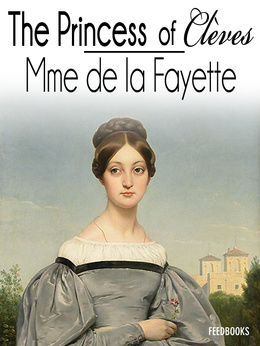
“The Princess of Cleves” gives us an inside view of the French royal court in the sixteenth century.  Although Madame de la Fayette wrote the novel around 1676, the time portrayed in the novel is about 1558 when Henry II was king of France and Elizabeth was just beginning her reign as Queen of England.  In fact one of the main characters of “The Princess of Cleves”, the Duc de Nemours, is considered a major potential suitor for Elizabeth.  However he turns away from Elizabeth due to his magnetic attraction to the great beauty of the Princess of Cleves. 

 The novel is quite historically accurate about this time in French history, yet much of the novel is made up of court gossip.  It seems that nearly all the men and women in the royal court of France, including the King himself, have someone on the side besides their husband or wife.

 “The Court gravitated round ambition and love, the chief occupations of men and women alike, for there were so many factions and intrigues, and the women played so large a part in them, that love and politics were inseparable.  Tranquility, indifference, boredom, and idleness were unknown; everybody was busily trying to better their position by pleasing, by helping, by hindering somebody else.  The occupations of the day were pleasures and plots.”      

For many of the women, love and sex were a strategy for improving their position within the Royal Court.   

Our heroine marries a man who is deeply in love with her and she thus becomes the Princess of Cleves. However she is somewhat apathetic toward her new husband.  She likes him, doesn’t love him.  However when the Princess meets the other young gentleman, the Duc de Nemours, the night before her wedding, they both fall deeply in love with each other immediately on sight.  Yes the Duc falls in love with her too, but you really must question his motives.  Is he just playing with the Princess’s affections?  He is a single man about town who could have any woman he wants, even the young Queen of England.  He constantly puts the Princess of Cleves in embarrassing compromising situations, and her husband soon suspects that there is an attraction there.  Duc de Nemours follows the Princess around almost to the point of stalking.  The Princess resists his advances, but he can tell by her blushes that she is strongly attracted to him.  

 For us United States readers who probably grew up on “Little House on the Prairie” and “The Scarlet Letter”, the novel “The Princess of Cleves” is quite raunchy stuff.  It is hard for us to imagine that back in the sixteenth century these men and women of the royal court were having so many of these not-so-secret love affairs.  Yes, this is a raunchy sexy French novel.    In a way it is quite interesting that there were times in world history when the Puritans were not in the ascendancy. 

 In 2005, former French president Nicolas Sarkozy said, “A sadist or an idiot, you decide, included questions about ‘La Princesse de Cleves’ in the exam for public sector jobs…. “   In protest, there were mass readings of “The Princess of Cleves” at the Sorbonne and other major French universities.   Sales of the novel soared.

“This is How You Lose Her” by Junot Diaz

“This is How You Lose Her” by Junot Diaz  (2012) –  213 pages


None of the stories in Junot Diaz’ new collection of stories is called “This is How You Lose Her”, so this title must be the theme for the book.  Indeed several of the stories are about a young Domo (a Dominican Republic guy; a Dominican Republic gal is called a Dominica) who loses his girlfriend for some reason. 

The magnificent first story, “The Sun, the Moon, the Stars”, has precisely this theme.  Our young guy, a ‘sucio’ (a womanizer) , cheats on his girlfriend Magdalena, and she finds out about it after.  They stay together, but somehow everything has changed.  A door has closed, and there is no way for him to open it again.  

I spent some time looking for the quintessential Junot Diaz sentence, but found out his effect is cumulative, sentence building on sentence.

Here is a typical example. 

Mama tried to keep his ass home.  Remember what the doctor said, hijo.  But he just said, Ta to, Mom, ta to, and danced right out the door.  She never could control him.  With me she yelled and cursed and hit, but with him she sounded as if she was auditioning for a role in a Mexican novela.”

Many of the stories are about the two brothers, Yunior and Rafa, and their mother.  As I recall many of the stories in Diaz’s first story collection, “Drown” were also about Yunior, Rafa, and their mother.   Most of the stories take place in New Jersey or Massachusetts.    Junot Diaz fully captures the colorful adventures of young Dominican-American guys and gals, and his books have already become a lasting part of our literary canon.  Despite all these stories being fine, I do believe it is time for Diaz to move on to different stories.  I felt the stories in “This is How You Lose Her” are quite similar to the stories in “Drown”, and the stories within this collection are quite similar to each other.  Surely the stories could still be about the Dominican-American experience, just be about something different from the dating life.

I realize that releasing a book of stories is an American writer’s version of treading water, but I’ll be expecting something new and different in the next novel by Junot Diaz.      .

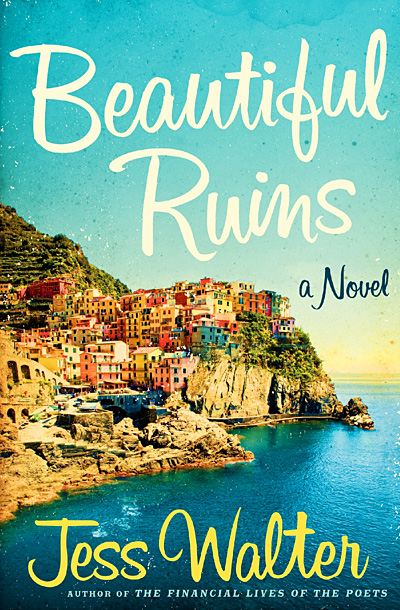
“Beautiful Ruins” by Jess Walter

Beautiful Ruins” by Jess Walter  (2912)  –  352 pages

“Beautiful Ruins” is the perfect example of a novel which is climbing up the best seller lists, but which as a literary work of fiction is laughably bad. 

 I started reading “Beautiful Ruins”, because after reading several very positive reviews, I figured this might be one of those rare novels that make the best seller lists yet still have some literary quality.  Such was not the case. 

 “Beautiful Ruins” begins with the arrival by boat of the beautiful but dying young American actress Dee Moray to the tiny Italian seacoast village of Porto Vergogna.  There we meet the cute, quirky, but lovable stock Italians who live in this tiny village (Italy ought to sue).   Our actress stays at the Adequate View inn which is run by the cute but lovable young Italian man Pasquale Tursi.  He is happy to have the American actress staying there, since the only other American who has stayed at the inn is the handsome but alcoholic Hemingway-esque author Alvis Bender who comes each year to write his war novel (Has there ever been a writer in a bad novel who was not Hemingway-esque?).  Due to his alcoholism and his war memories which have scarred him, Bender has only completed one chapter of his novel.  

“Beautiful Ruins” let’s us read that one chapter of Bender’s war novel.  Frankly, this war story is so trite and hackneyed; if I were the author I would have quit writing it long before I reached the end of the first chapter.

The year is 1962, and the actress Dee Moray is in Italy to act in a small role in the movie ‘Cleopatra’ which is filming there with its major actors Elizabeth Taylor and Richard Burton.   Thus we meet the conniving double-dealing movie producer Michael Deane.  Soon we are flashing forward to modern-day Hollywood so we can admire the entire span of Michael Deane’s career from producing bad movies like ‘Cleopatra’ to producing bad TV reality shows.  So of course, “Beautiful Ruins” gives us a chapter from Michael Deane’s autobiography which is about as awe-inspiring as his pathetic career.

Since we are now in Hollywood, “Beautiful Ruins” subjects us to a movie ‘treatment’ called “Donner” about the ill-fated frontier Donner party.  I suppose this represents all the bad scripts and treatments that are floating around Hollywood, and in that sense it succeeds.   

Later we again skip forward to nearly the present to meet Dee Moray’s son, Pat Bender, who is a tortured, sensitive rebellious rock musician who abuses drugs and alcohol and who is hugely attractive to women.  

“Beautiful Ruins” quotes the dumb-ass sappy lyrics to his best and most famous song, ‘Lydia’, which is about the woman he truly loves while he is screwing all these other sluts.  Later his life is turned into a dumb-ass play ‘Front Man’ of which, luckily for us readers, only parts of acts I and III are in “Beautiful Ruins”.  

So “Beautiful Ruins” is a bunch of stereotypes on top of a pile of clichés.  While reading, I kept a running count of all the original thoughts and authentic feelings that are contained in “Beautiful Ruins”.  The final count was zero.

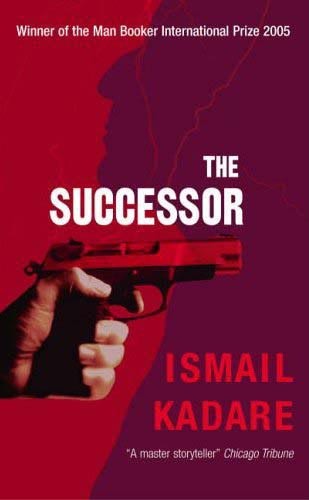
“The Successor” by Ismail Kadare – A Mysterious Death in Albania

“The Successor” by Ismail Kadare   (2003) – 207 pages  Translated by David Bellos via Papavrami (French translation)

“The Successor” is a crystal-clear novel about the mysterious death of the number-two man in the tyrannical dictatorship that ruled Albania.  The official line is that the death of this leader is a suicide, but questions quickly arise.  Despite the cover, it is more of a political novel than a detective novel. Here is the first paragraph: 

The Designated Successor was found dead in his bedroom at dawn on December 14.  Albanian television made a brief announcement of the facts at noon:  “During the night of December 13, the successor succumbed to a nervous depression and took his own life with a firearm.” 

 This novel is a family drama with the dead leader’s wife, daughter, and son being main characters.  They live in a luxurious house which is located near the house of the absolute dictator (‘the Guide’) himself.  The architect of the house gets involved because there is a locked tunnel from the absolute dictator’s house to the number-two man’s house which can only be unlocked from the dictator’s side of the tunnel.

 This story is based to some unknown extent on a real incident that occurred in Albania in 1981 when the Albanian Prime Minister Mehmet Shehu was reported to have committed suicide in December 1981 and was subsequently denounced as a ‘traitor’ to Albania. 

 The writing is as plain and clear as a bell expressing the stark events which occur and the thoughts and feelings of this family.  The novel came to us via the tortuous route of an English translation by David Bellos from the French translation by Papavrami from the original Albanian.   Despite all, I suspect that the novel was written in this simple style to begin with. There is an elegance to the telling of this story that makes the novel powerful to read.  

 There is some criticism of Ismail Kadare on the Internet because he was never imprisoned during the many years of the Albanian dictatorship, while other famous writers who lived in Communist dictatorships such as Milan Kundera, Vaclev Havel, and Imre Kertesz spent time in prison.  Albania had one of the most rigid and tyrannical dictatorships in Eastern Europe, and a writer who opposed the dictator may have been not only imprisoned, but also tortured and executed.  Not having been there in Albania at that time, I really can’t fault Ismail Kadare.

 What I can say is that “The Successor” is a strong stark depiction of the Albanian dictatorship during the Communist years, and the world is fortunate to have Kadare here to testify on those years.  Ismail Kadare was the first winner of the Man Booker International Prize.  I fully agree with the choice of Kadare ahead of subsequent winners Chinua Achebe, Alice Munro, and Philip Roth; his writing is that good.    

“The Successor”, along with “Palace of Dreams”, is an excellent introduction to the writing of Ismail Kadare.

“A Hologram for the King” by Dave Eggers

“A Hologram for the King” by Dave Eggers  (2012) – 312 pages

 This book is just what the world needed, a humorous satirical novel about Americans doing business in Saudi Arabia.  Our man Alan Clay learned the secrets of selling products on his first job working for Fuller Brush Company using the four prime motivators to get people to buy things.

 Money! Romance! Self-Preservation!  Recognition!

  Later he had a good career as a sales executive for Schwinn Bicycle Company, a fine old American business, but then the company decided to move their main factory down South to avoid paying union wages.  That was not a success as the workers had never built bicycles before and besides they were soon underpriced by Chinese factories.  Then Schwinn moved their bicycle production to China, but once the Chinese team learned to make bicycles, what did they need Schwinn for?

 “More efficient without unions, cut ‘em out.  More efficient without American workers, period, cut ‘em out.  Why didn’t I see it coming.  More efficient without me too.”         

So now Alan Clay is 54, almost broke, divorced, and just hanging on in the business world using those old sales techniques that got him started. Most of the actual things get made in China, while we’re making websites and holograms.  So now he’s over in Saudi Arabia selling a holographic program to King Abdullah who is jetting all over the world, while Alan and his team are set up in a tent in the nearly deserted new town of ‘King Abdullah Economic City (KAEC)’  waiting for the King so they can put on their demonstration.

 Besides being a business satire, “A Hologram for the King” is a buddy story as Alan Clay becomes great friends with his driver Yousef.  Yousef has woman problems.  His ex-wife is texting him, and Yousef thinks her new wealthy jealous husband is trying to kill him.   As they drive around Alan tells Yousef these old dirty jokes he’d heard during his long sales career.  That’s a quality I like about Dave Eggers’ writing; he throws in things to make this novel fun.  Saudis are just like us except quite a few of them have a lot more money.

 This novel reads very quickly and it is a light fun story that does make its points about our modern world of business.  Novels about the world of business are quite rare, and “A Hologram for the King” is probably the best business novel I’ve read since “Something Happened” by Joseph Heller or “Babbitt” by Sinclair Lewis.

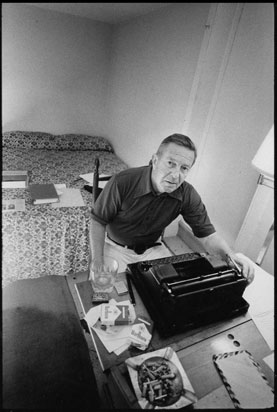
The John Cheever Centenary

The John Cheever Audio Collection

“The deep joy we take in the company of people with whom we have just recently fallen in love is undisguisable.”  –  John Cheever

“The telling of lies is a sort of sleight of hand that displays our deepest feelings about life.” – John Cheever in a 1969 interview with the Paris Review

“I still lack a political, religious and philosophical world view—I change it every month—and so I’ll have to limit myself to descriptions of how my heroes love, marry, give birth, die, and how they speak.  –  Anton Chekhov at age 28

John Cheever could very well have written the above sentence from Anton Chekhov.  In his stories Cheever was the chronicler of everyday suburban life in the middle of the twentieth century.  Cheever’s suburbia is about as far removed from our suburbs of today as was the French royal court in the sixteenth century (Forgive me, I’m also reading ‘The Princess of Cleves’ by Madame de Lafayette).  For one thing Cheever’s suburb is distinctly upper class where nearly every house has a swimming pool.  Each summer weekend there are cocktail parties by the swimming pools where the neighbors are invited.   And just like at the French royal court, the rich people in Cheever’s stories are fascinated by and indulge in extra-marital and illicit love affairs.

 Cheever’s stories are realistic mixed with a heavy dose of irony.  To make my point about irony, I will examine one story in particular, “The Brigadier and the Golf Widow”.  The story begins with a couple named the Pasterns admiring their brand new nuclear fallout shelter.  This fixes the story in time as there was a fad in the early Sixties for home owners to build their own fallout shelters.  Then Mrs. Pastern tells her husband to visit two homes to collect for her charity, since the people were not there when she went around the first time.  Mr. Pastern goes to the Flanagan’s where only the Mrs. is home.  She invites him in for drinks and after six drinks, she invites him upstairs to her bedroom.  Mr. Pastern has done this kind of thing many times before, but Mrs. Flanagan says, “I’ve never done this before.”  Mr. Pastern and Mrs. Flanagan get together a few more times, and then Mrs. Flanagan makes a demand on him.  She wants a key to his fallout shelter, and he winds up giving her a key.  Mrs. Pastern finds out about this gift through the neighborhood gossip.  Mrs. Pastern has been aware of his many infidelities before and forgiven him to some extent.  However Mrs. Pastern can not forgive him for giving this strange woman the key to their own fallout shelter.    .

 Nearly every story in this Cheever collection has some ironic twist.  Sometimes you feel that Cheever is laughing at his suburban characters. It is a gentle humane laughter, but he does make his points.   It is Cheever’s imagination that takes these stories several steps above straight realism to somewhere more poignant and meaningful.  It is Cheever’s sense of irony and parody as well as the energy of his writing that make each of these stories an event in itself.   It is amazing how Cheever can capture such a strong sense of a person’s or persons’ lives within ten to twenty pages.

 This is the year of John Cheever’s centenary.  I listened to each of the twelve stories in this audio collection twice.  Even though most of the stories have a suburban setting, each is a world onto itself, totally different from the rest.  As I said before, these stories go well beyond realism into irony, parody, and symbolism.   As many of the famous writers of the middle and late twentieth century fall by the wayside, John Cheever will remain part of the literary canon.

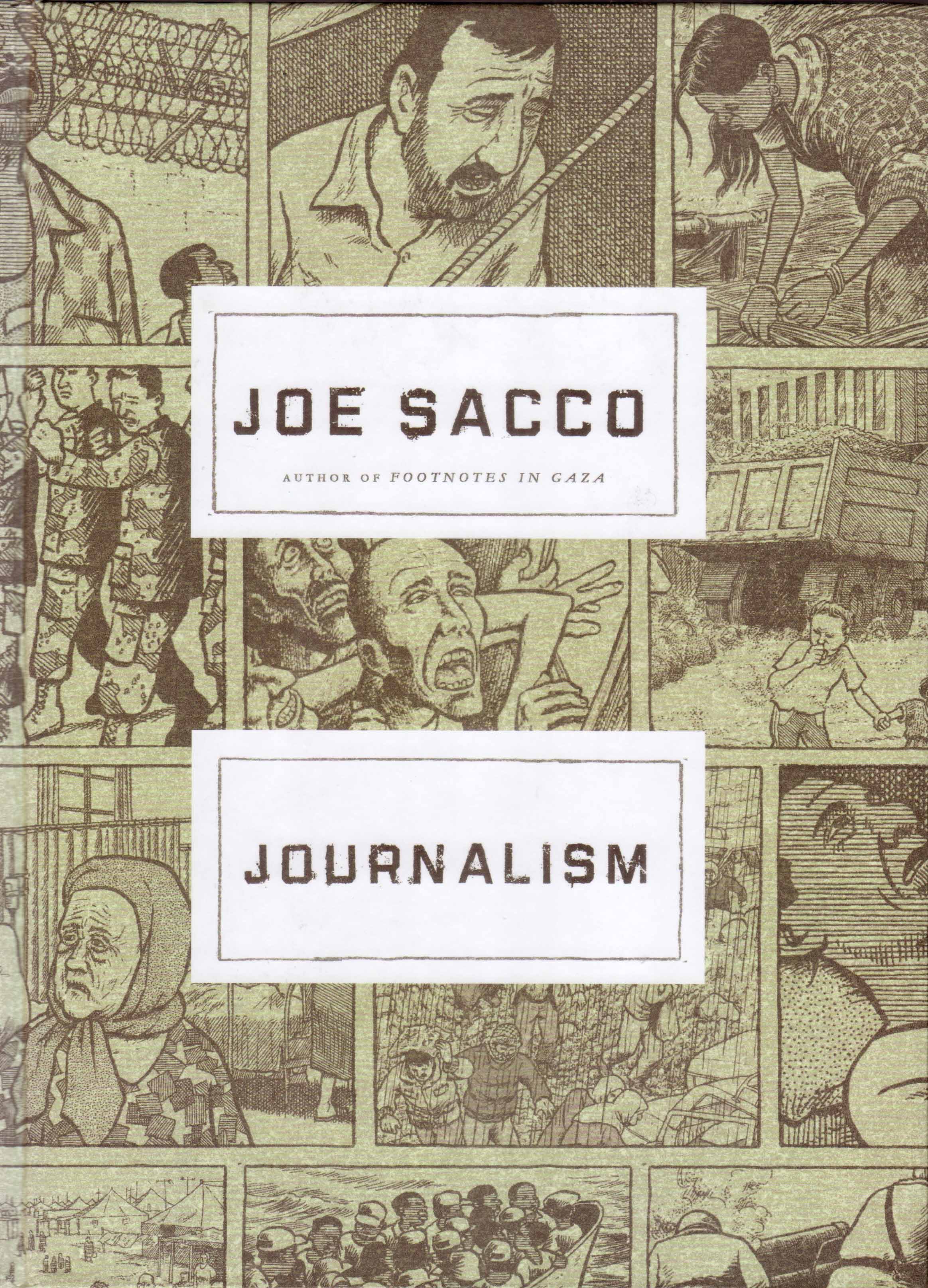
Comic “Journalism” by Joe Sacco

“Journalism” by Joe Sacco  (2012)  –  190 pages

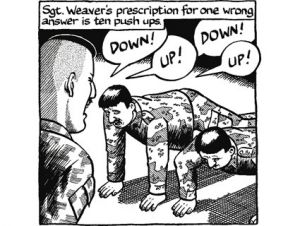
 Here is something new and different.  Usually comics are light, humorous takes on life.  However these comics by Joe Sacco are deadly serious.

 Joe Sacco goes to the worst trouble spots in the world, interviews people there, and then writes comics about them to enlighten people on what’s really going on.  Sacco calls his work ‘comic journalism’.  Although he realizes that comics by their very nature are subjective, he attempts to present an honest picture of each situation.  In each of these volatile situations there are the powerful and the weak, and in many cases, they become the oppressors and the oppressed.   

 Here are the trouble spots covered in this book.

The war crimes trials at The Hague to sort out the atrocities committed during the Bosnian War

         The conflict between Israelis and Palestinians in Hebron

         The displacement of refugees from Chechnya during the war there   

         The Iraq War

         The African migration to Malta

         The plight of the Dalits (formerly the Untouchables) in India

 “Journalism” was remedial reading for me.  I must admit that I don’t keep up on what’s going on in these troubled areas of the world.  I spend my time reading mostly fiction which is more enjoyable for me.  I suppose there is a natural tendency to avoid these desperate situations.  This book is a relatively painless way for one to keep informed, much less difficult than reading newspaper or magazine articles.

 “Underneath the India of billionaires and Bollywood stars, the India whose growth rate rivals China’s, is a country in which more than three-quarters of the population – 836 million people – live on less than half a dollar a day and where the prevalence of underweight children is nearly double of Sub-Saharan Africa.

I had no idea.

 The United States is included in these comics with three articles about the Iraq War.  Two of these articles have never been published in the United States before.  The last of these articles is about two Iraqi businessmen who are plaintiffs in a lawsuit against former US Defense secretary Donald Rumsfeld that alleges “torture or other cruel, inhuman, or degrading punishment” while they were in US military custody.

 The longest comic – 48 pages – is called “The Unwanted”, and it is about the many fleeing African refugees who wind up in Malta, an island just south of Italy. This is one crisis area with which I was totally unfamiliar. This story probably had special meaning for Joe Sacco, since he is a Maltese-American.  He frequently includes drawings of himself as he is interviewing the various people for his stories.

 These comic strips are a good way to keep up with the world.

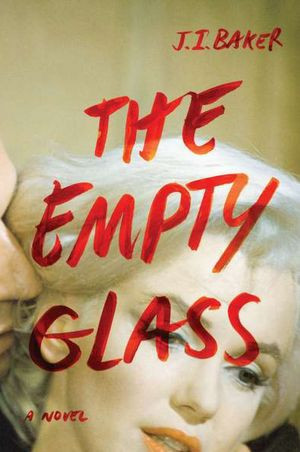
“The Empty Glass” by J. I. Baker, A Nasty Noir about the Death of Marilyn Monroe

“The Empty Glass” by J. I. Baker  (2012) –  325 pages


Now that fifty years have gone by since Marilyn Monroe died on August 1, 1962. it must be time for her death to be turned into a dark noir fiction just as the death of Elizabeth Short, the Black Dahlia murder fifteen years earlier, has been turned into several noir novels and movies.  “The Empty Glass” by J. I. Baker is a dark noir fiction based on the death of Marilyn Monroe.  

 The plotting here is pretty standard stuff for noir fiction.  It’s like J. I. Baker wanted to touch all the noir bases without adding anything original of his own.  I would call ‘The Empty Glass’ a ‘Coroner Procedural’ just as some novels are called ‘Police Procedurals’. Our main character Ben Fitzgerald here is a deputy coroner.   The first time our hero encounters Marilyn Monroe is when he helps perform an autopsy on her lifeless corpse. 

 Did Marilyn Monroe commit suicide or was she murdered?  That is the main question of “The Empty Glass”.  Certain details from the autopsy were suspicious such as Marilyn supposedly took all these big pills, but the empty glass near her bed had not been used recently.  Also her body was in a position which would indicate that it had been moved. Also there is a six hour gap between the time her body was discovered at 10:30 PM and the time the authorities were called at 4:25 AM. 

 Inevitably the story revolves around the Kennedys especially Robert who happened to be in the area at a Hollywood house party with Rat Pack friends Frank Sinatra and Kennedy’s brother-in-law Peter Lawford.  Robert had apparently broken off his affair with Marilyn a few weeks earlier.  He showed up at Marilyn’s apartment in the afternoon before the night she died, and they had a big fight.  Marilyn resented being passed from brother to brother and then dropped entirely.  Robert Kennedy was tired of her constant attempts to reach him and his brother John.

 The dialogue in “The Empty Glass” is short and snappy as you would expect in a noir novel. 

 “You started with us as . . .”

“Deputy Coroner.  Suicide Notes and Weapons.  I was an embalmer before.’

“So you wanted a change.”

“The truth is I wanted more money.  My son was born.  I needed it.  So I took the civil service exam and the walk-through test.”

“The walk-through test?”

“You have to walk through this place and not pass out.” 

There are also hard-as-nails scenes about Ben’s personal life, all pretty routine tough-guy stuff for a noir novel, beatings by Rat Pack bodyguard thugs, sticky sentimental encounters with his seven year old son, etc.   These are only a sidelight, not the main plot line.    

 There’s a lot of stuff on the Internet regarding the death of Marilyn Monroe mystery and room for questions about what happened.   J. I. Baker seems to take a lot of pleasure in trashing the Kennedys.  He even falls out of his noir style so he can more carefully conjecture the Kennedy involvement. I question the author’s motives but realize this is strictly fiction.  Was this supposed to be a Hollywood mystery or an anti-Kennedy screed?  What starts our as a dark noir turns into a nasty political novel.