Archive for October, 2011

“The Apothecary” by Maile Meloy, Her Young Adult Novel

“The Apothecary” by Maile Meloy (2011) – 353 pages

“The Apothecary” is the new young adult magical adventure novel by Maile Meloy.  So far I had read three of Meloy’s adult realistic novels and story collections and have been much impressed with her work.  Her last story collection “Both Ways is the Only Way I Want It” – love that title! – made my best of the year list for 2009.  If I like an author’s work in one genre, I will read their work in another genre, because literary talent is literary talent. 
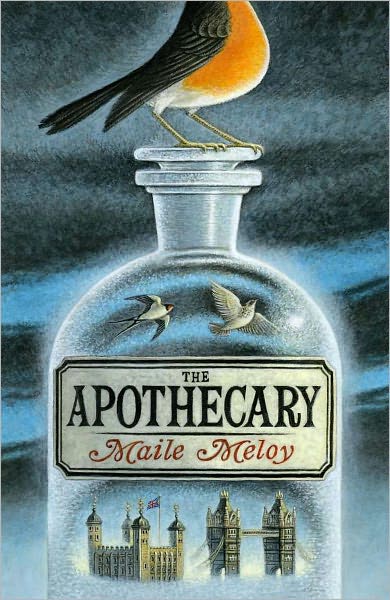
 “The Apothecary” is about a band of early teens involved in a fantastic and magical adventure in England. Does that sound familiar?  If one were cynical, one might think that Meloy is going for the Harry Potter market now that Harry Potter is winding down.

 In these magical adventure stories, one of the main things a writer must do is establish the main character’s credibility early on so that when the events turn extraordinary the reader accepts them.  As “The Apothecary” begins, our hero (or heroine) Janie is living with her screenwriter parents near Hollywood in 1952.  This was the time when the House Un-American Activities Committee was holding hearings into alleged communist propaganda and influence in Hollywood. Many friends of Janie’s parents were being forced to testify against others in the movie industry, many of whom would then be blacklisted.   Janie’s parents were worried that they would soon be called to testify and might even lose their own passports, so before that happens they relocate to England.   This is all realistic, since many actual Hollywood careers were destroyed and families were dislocated by the House Un-American Activities Committee.  This back story establishes the credibility of our main character Janie for what is to follow.   

  At first Janie feels like a fish out of water attending her English grammar school St. Bedens, but she soon becomes friends with a boy in her class named Benjamin whose father is an apothecary or, in American-ese, a druggist.  Benjamin’s father has a special book called the Pharmacopoeia. 

There follows a story of spies and counter-spies and international intrigue and magic.  There is even a sly boy named Pip who is borrowed from Charles Dickens.

 Young adult adventure stories are not my usual reading fare.  I’ve never read any Harry Potter, so I really can’t judge how this story compares.  All I can say is that the characters in “The Apothecary” are well developed and there is always some wild occurrence going on in the story to hold my interest.  I prefer Maile Meloy’s much different adult work, so if you want to get a real evaluation of “The Apothecary”,  you may have to ask a fourteen year old to read it and ask her or him for an evaluation.
“The Marriage Plot” by Jeffrey Eugenides, It Sure is not Jane Austen

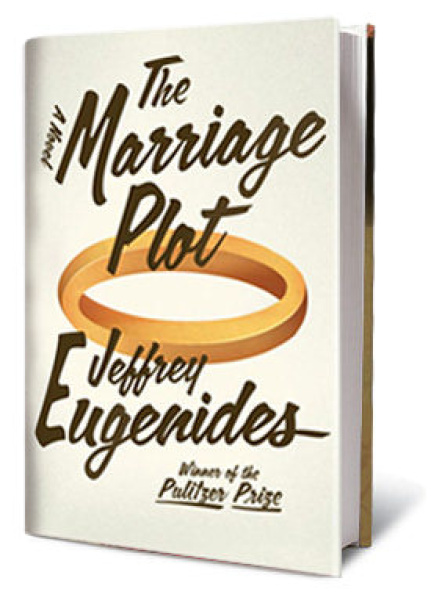
“The Marriage Plot” by Jeffrey Eugenides  (2011) –  416 pages

 My first problem with “The Marriage Plot” is that I didn’t like any of the three main characters, these three Brown University graduating seniors.  Not the privileged Madeleine or the manic-depressive Leonard.  Not even Mitchell who, inspired by Mother Teresa, travels to India to work in one of her hospitals only to be grossed out by the huge staph infections and large tumors he finds on patients’ bodies there.  All three characters seem to see themselves as enormously self-entitled, perhaps typical 1980s college graduates.


Madeleine is majoring in English Literature.  The early eighties was the time when the literary theory of deconstruction and its proponents Derrida, Lacan, and Roland Barthes had taken over the academic literary world.  At that time semiotics (which I’ve always considered a branch of the academic study of idiotics) was in full flower.  Madeleine is more interested in Jane Austen, Henry James, and other Victorian novelists who frequently wrote ‘the Marriage Plot’.  The marriage plot centers on marriages of the main characters. 

 The novel ‘The Marriage Plot’ is itself a marriage plot, but  I can tell you that Jane Austen has not a thing to worry about.  Whereas in Jane Austen’s novels the heroine gradually comes to see the positive qualities of her suitor usually culminating in their marriage,  in ‘The Marriage Plot’ the marriage is the result of the mania induced when the suitor stops taking his lithium.   Up until this point our heroine was turned off by his bad breath, the digestive/alimentary disturbances, and the lethargy caused by the suitor’s lithium dose.  Modern times. 

 Maybe I appreciate the discretion of Jane Austen and the Victorians, but I really don’t need or want a lot of detail about trips to the bathroom or graphic descriptions about specific sexual acts.  There’s a lot of that kind of detail in ‘The Marriage Plot’.

 One thing that is missing in the plot is a central character who is a little older, who can look at these graduating college seniors with a little distance, a little irony. As it is I felt mostly claustrophobic disdain for these youthful characters.  One wishes that Madeleine were a stronger character, that Leonard was not so psychologically messed up as to virtually have no free will in his actions,  

 I read Eugenides’ ‘The Virgin Suicides’ quite a few years ago, and I was charmed by that novel.  However I found this latest novel ‘The Marriage Plot’ to be utterly charmless.

“We the Animals” by Justin Torres, Families are not All Alike

“We the Animals” by Justin Torres   (2011) – 125 pages

Sadly, none of us gets to choose which family we are born into.  And when we arrive here, we are babies and don’t know anything.  It will take us years and years to figure out exactly what kind of family we’ve been put into and even more years to figure out how our family is different from other families.

The three boys in ‘We the Animals’ have a mother and a father.  The father was 16 when he married the mother who was only 14.  They had to drive down to Texas from New York to get married legally.  Soon they have the three little boys.  The father sometimes cooks for the boys, jokes with them, dances with them, spanks them hard while the mother works.  The mother works all night, so she has to sleep during the day, and the little boys run into the bedroom and try to wake her up.

One day the father carries the mother into the house.  Her cheeks are purple, and she has been beaten up.  The father tells the boys that the dentist had to punch on her to loosen up her teeth before pulling them out.  Little boys will believe anything.  For three days the boys are forbidden to go into the bedroom, and when they do, the mother lifts her head off the bed and says ‘My beautiful baby boys’.

After a couple of weeks they go on family outings again, swimming and so on.  But then the father leaves.  Someone tells one of the boys they saw him leave with a girlfriend.  The mother stops going to work, stops cooking, stops eating.

The three boys have to fend for themselves a lot of the time.  One time they got into their neighbor’s, the Old Man’s, garden.  They taste the food, trample the plants, and lay waste to the entire garden.  Old Man watches them from his porch and calls them ‘Animals’ and comes into the garden to try to fix some of the broken plants.    A lesser writer would have made Old Man mean, angry, perhaps given him a gun to carry.  Here Old Man brings the boys up on the porch and talks to them.

The father of the three boys comes back after a few months, and things go decently for a while.  The family needs a new car, and the father takes the three boys along with him, and he buys a new big truck.  When they get home from the dealer, the mother asks, “How many seat belts does it have?”  The truck has only three seatbelts, and there are five of them.  “… she kept screaming at him, right up in his face, ‘Big-dick truck! Big-dick truck!”  Her neck and cheeks were flushed red, and she was lost in tears, in rage…”

The three boys grow up.  Only later do they discover that they are not all the same, that there are huge differences between them.

Someone had to write this brilliant novel, a must-read book.

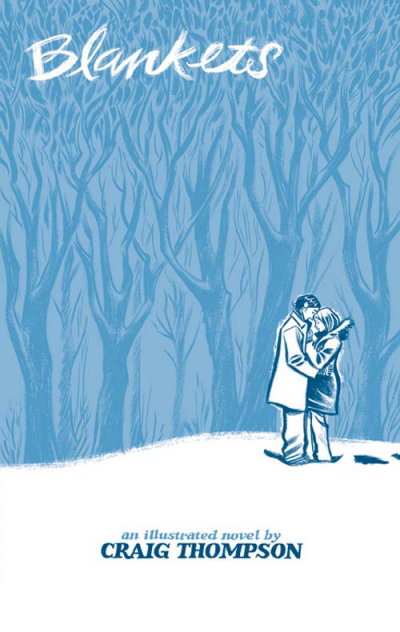
“Blankets” by Craig Thompson, A Graphic Novel

“Blankets” by Craig Thompson  (2003) – 582 pages

 I suppose in the world of graphic novels, when Art Spiegelman, author of Maus and Maus II, sends you a long letter of praise for your own book, you know you’ve reached the top of the graphics world.  That’s what happened to Craig Thompson and his graphic novel “Blankets”.   I looked all over the Internet to find out exactly what Spiegelman said in this letter of praise, but apparently the letter was private.  That didn’t stop most reviewers from mentioning Spiegelman’s letter in their reviews of “Blankets”.  Me neither. 

 “Blankets” is 582 pages, but being a graphic novel with very few words on each page, it reads rapidly.

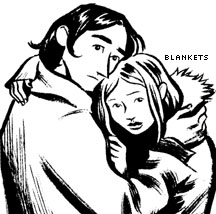
 “Blankets” is a sweet and not-so-innocent story of first love.  Teenager Craig meets teenager Raina at a Baptist Christian winter camp, and the two hit it off immediately.  The two become inseparable and a little later Craig goes to stay at Raina’s home in Michigan for two weeks.  He gets to know Raina’s family which consists of her father and mother who are separated and getting a divorce, her adopted brother Ben and adopted sister Laura who are both retarded, and her biological sister who is married and has a baby Sarah. 

 Craig’s stay at Raina’s home is like a winter idyll, almost dream-like in its perfection.  There is a simple charm to these scenes of Craig and Raina together in the cozy house and the snowy outdoors.

 There is much about Jesus and the Christian religion in this novel, but it is not the harsh extreme right-wing evangelical Christianity so prevalent today.  Here the religion is gentler and more accepting and fits in with the story.

 While the story is sweet and simple, the book has also gotten into trouble for the explicitness of some of its pictures. 

 Once again I find myself committing that cardinal sin of book blogging, discussing one of the author’s previous books just when he is releasing a brand new book.  Craig Thompson has just released a new book this month called ‘Habibi’. I must be nearly the last person on earth to have discovered “Blankets”. 

 In a world where so many graphic novels and anime are cynical and ultra-violent, “Blankets” is a quiet peaceful life-affirming exception.

“God of Carnage” by Yasmina Reza, Coming to a Theatre near You

“God of Carnage” by Yasmina Reza  (2008) – 67 pages   Translated by Christopher Hampton

 As of now you may not have heard of Yasmina Reza or her play “God of Carnage”, but you soon will, you will.  The play has just been turned into a movie “Carnage” directed by Roman Polanski and starring Kate Winslet, John C. Reilly, Jodie Foster, and Christoph Waltz. The movie opened the New York Film Festival on September 30 and is scheduled for general distribution before Christmas. 

 I had the good fortune of seeing the live  “God of Carnage” production  at the Guthrie Theatre in Minneapolis, Minnesota this summer, and after that I read the written version of the play. 

 The setup of the play is quite simple.  One boy punched another boy on the school playground requiring some dental work to fix.  The parents of the boy who got punched invite the parents of the boy who landed the punch over to discuss the incident civilly.  The parents of the boy who got punched are well meaning and expect other people will be good-intentioned also.  The father of the boy who punched is a cutthroat lawyer who is constantly on his cell phone advising his clients, drug companies, on how they can get out of sticky legal situations.  Soon interactions between the two sets of parents become chaos.

'God of Carnage' at the Guthrie Theatre, Minneapolis, MN

These four characters are the only characters in the play, and the entire play takes place in the one living room.  There are no intermissions.  This is a perfect play for actors and actresses.  The entire play is the dialogue between these four. 

 This play is a comedy, outrageously humorous, yet never leaves the concrete situation at hand.  Each of the four roles is well-defined, and each stays in character for the play.   Brooke Allen in a review of “God of Carnage” described the play as follows. “What is really clever in this play is the way the alliances between the four characters keep shifting: sometimes its men against women, sometimes couple against couple.  Sometimes we the audience, find ourselves sympathizing with a particular character…only to be repelled by that same character the very next moment.” 

 I have high expectations for the movie, even though I don’t believe Roman Polanski has directed a comedy before.

 The playwright Yasmina Reza is already famous in France, originally as an actress and now for her many plays.

 “Laughter is always a problem… Laughter is very dangerous.  The way people laugh changes  the way you see a play.  A very profound play may seem very light.  My plays have always been described as comedy but I think they’re tragedy.  They are funny tragedy, but they are tragedy.  Maybe it’s a new genre.”

      Yasmina Reza, in “Art and artifice” by Simon Hattenstone, The Guardian, January 1, 2001   

“Snowdrops” by AD Miller, A Moscow Story

“Snowdrops” by AD Miller (2011) – 262 pages

 “Moscow is Moscow,” Masha said.  “Bad roads and many fools.”

 “Snowdrops” by AD Miller is an amiable novel about Moscow and Russia in the late 1990s and the early 2000s, the Putin years.  Russia was still in the early stages of its transition from Communism to capitalism, and at that point at least, capitalism seemed to the Russians to be little more than a form of organized crime.

 I remember in my grade school days when everyone here in the US was worried that the Soviet Union was passing the United States in the Space Race.  The United States media propaganda made out the Soviet Union to be entirely drab and the people there, especially the women, to be hopelessly dumpy. Later I discovered that Russia had a colorful literary tradition that puts that of the United States to shame.  And only later did we discover that the Soviet Union had more than their share of the most beautiful women in the world.

 Which brings us back to “Snowdrops”.  Our thirty-eight year-old lawyer hero from England gets involved with a young pretty Moscow woman, Masha, who is in her early twenties and her ‘sister’ Katya whom he meets on the Moscow Metro.    Our lawyer guy is in Russia to close an oil deal taking place in Murmansk, a small city up near the Arctic Circle.

 “Snowdrops” reminded me of one of my favorite authors, Graham Greene.  Greene also wrote novels situated in exotic locations.  Another quality I believe that Miller shares with Greene is that even though he is writing from the point of view of an outsider looking in at this foreign culture, the outsider just by being there is complicit in whatever happens in this foreign place.  In this case our lawyer is more than complicit.  He adores the attentions of these two young women who impress his work mates and the other Russian men when they are out in public with him.      

 I am always interested in reading about what is happening in Russia since the fall of Communism.  It did seem the description of Moscow was a bit outdated and familiar, the same picture we got in the Putin era.    The beggars and the drunks laying in the streets, the capitalist businessmen who dress and act like gangsters, the exotic erotic nightclubs.  We’ve seen this picture before. 

 I enjoyed “Snowdrops”, this Man Booker shortlisted novel.  I’m not sure whether or not this novel should win the Man Booker.  It has no pretensions to greatness or profundity, but to read it is a pleasant way to spend some time in Moscow.

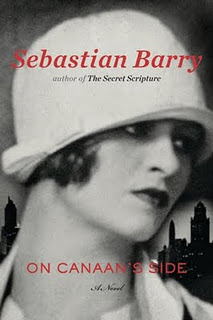
“On Canaan’s Side” by Sebastian Barry – This Novel Did NOT Work for Me

“On Canaan’s Side” by Sebastian Barry (2011) – 262 pages

 Has this ever happened to you in your reading experience?  You read two novels by a writer, and you are impressed with both of them, and both of them wind up on your ‘Best of’ year-end lists.  You eagerly anticipate the next novel from this writer.  The next novel finally arrives, and it is a complete disaster. 

 That is my reading experience with Sebastian Barry.  I read ‘A Long, Long Way’ and ‘A Secret Scripture’ and considered both excellent novels.  I awaited the next.  Then “On Canaan’s Side’ arrived, I read it, and it was indeed a complete fiasco for me. 

 “On Canaan’s Side” contains the memoirs of Lilly, an old, old woman who has out-survived all the people in her life. It seems like every week or so another writer writes another story about the old woman who has survived everything looking back on her life.  

 All of the people in her life have fallen victim to Unearned Tragic Situations.   By my estimate, an Unearned Tragic Situation occurs about every twenty pages.  An Unearned Tragic Situation befalls the heroine’s father, the heroine’s boyfriend, the heroine’s husband, the heroine’s best friend, the heroine’s son, and the heroine’s grandson.     After slogging through one Unearned Tragic Situation after another, it becomes very difficult to slog through the next.  

 An Irish novel should probably never have a young single woman expecting a baby as part of its plot.  This plot line must have been used billions of times in Irish novels.  We really don’t care about the machinations of the priests, monks, and nuns anymore. This is like English writers putting queens, kings, princes, or princesses into their plots.  What a bore. 

 “On Canaan’s Side” starts out on an estate in Ireland, but most of the novel takes place in the United States.  I suppose Canaan is supposed to be meant as ‘The Promised Land’, but at least as much misery occurs in the United States as in Ireland where things are miserable enough.   Lilly lives in Chicago,  Cleveland, Washington DC, and New York State, but the descriptions of these places are so murky and nondescript it really doesn’t matter where she lives.

 By the end of the novel Lilly has lived through so many other people’s Unearned Tragic Situations.   What could be more fitting than she have her very own Unearned Tragic Situation?

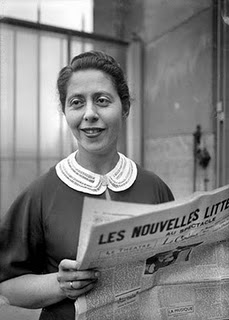
“All Our Worldly Goods” by Irene Nemirovsky, a Devotee of Leo Tolstoy

“All Our Worldly Goods” by Irene Nemirovsky (1947) – 264 pages   Translated by Sandra Smith

 “As far as Russia is concerned, I place no one above Tolstoy.  He has everything.”  Irene Nemirovsky

 It is well to remember that Irene Nemirovsky was not originally from France.  She was born in Kiev in the Ukraine and spent her childhood in St. Petersburg; thus she was well-acquainted with Russian literature.  

 Before writing “All Our Worldly Goods” and her last major novel, “Suite Francaise”, she re-read ‘War and Peace”.  Tolstoy’s novel served as a large-scale model for both of these Nemirovsky novels.  Her notes indicate that she was trying to capture that same dichotomy between war and peace in the lives of ordinary people as Tolstoy.  Whereas Tolstoy’s war occurred fifty years before his novel was written, ‘Suite Francaise’ describes World War II as it was happening.     

 “All Our Worldly Goods” is a story of an extended family living in a small village in northern France near the Belgian border, and its timeframe spans from before World War I up to the re-invasion of France in World War II. So the novel covers one war, a twenty-year respite of peace, and then the start of another war.  In both wars Germany captures, occupies, and destroys their small village, and the family is forced to leave.   Before the start of World War II, the French villagers can’t believe that war could possibly happen again, but it does.   At the end of “All Our Worldly Goods”, World War II appears to be a repetition of World War I.  Only later did World War II turn horribly worse than World War I, which was the time when Nemirovsky was writing “Suite Francaise”.

 I think the primary quality that Irene Nemirovsky shares with Leo Tolstoy is the vividness of their writing.  Both writers are able to make their people and events come alive, and you deeply care what happens to these people.    I remember reading “Anna Karenina” and “War and Peace” and being fascinated at how adeptly Tolstoy handled both the larger matters of nations and cities and the smaller matters of family life and individuals.  Nemirovsky brings that same quality to her own writing. As Helen Dunmore put it so well in the Guardian, “Némirovsky comes across as an intensely Russian writer, lyrical, forceful, earthy, idealistic and yet without illusions.”

 I’ve kept up with all of her novels as they’ve been released in English, because I believe Irene Nemirovsky is the major European writer of the twentieth century.   I can think of no other writer who captured events and people with such poignancy and vividness.  Sadly we may be nearing the end of the novels she wrote in her 39 years.

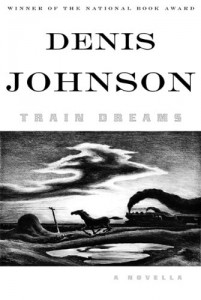
“Train Dreams” by Denis Johnson

“Train Dreams” by Denis Johnson (2011) – 116 pages

It is a good thing when one of our most noted writers presents us with a novella. One gets an opportunity to encounter a writer quickly and painlessly. For me, the immediate pleasure is knowing that I will not have to carry around a heavy tome.

“Train Dreams” is a western that mostly takes place in the narrow Idaho panhandle which borders Canada. The book is not one of those westerns that have a lot of characters interacting with each other. In fact most of the novella is consumed with one character, Robert Granier, who is very much a hermit and a loner. Robert Granier does not interact with people very much, so each small meeting with another person assumes vast importance. There is also an element of magical realism in “Train Dreams”.

I’ve read several books by Denis Johnson starting with “Angels” which I consider an edgy masterpiece. Another excellent book of his is “Jesus’ Son” which is a collection of linked stories about drug-demented troubled drifters. I want to read ‘Tree of Smoke’ which is one of those over 600 page tomes I mentioned above and won all kinds of awards. Denis Johnson writes about madness, losing oneself, and redeeming oneself like no one else. He writes as one who lived through it, having battled alcohol and drug addiction for much of his life.

“Train Dreams” is a much more austere story than Johnson’s previous work. This novella focuses nearly exclusively on the loner’s thoughts and actions.

Most of the reviews I’ve read of this novella approach this book with near total adoration. I don’t share their enthusiasm for “Train Dreams”. I did think it was perhaps an above average story, but it was too plain, sparse, and dry to captivate me, to always hold my interest. I hope Johnson is not falling in to the Cormac McCarthy school of spare novel writing. That would not be good.