Archive for August, 2011

“Gilead” and “Home” by Marilynne Robinson

These people who can see right through you never quite do you justice, because they never give you credit for the effort you’re making to be better than you actually are, which is difficult and well meant and deserving of some little notice.” – Gilead


Marilynne Robinson’s three novels affect me on a deeper level that most novels do.  Yet originally I resisted their hold on me.  These novels about ministers in the small town of Gilead, Iowa, seemed far removed from my own life.  But now I’ve read all three once and the second book “Gilead” twice.

At first glance, Robinson’s novels seem so aggressively out of fashion.  If one were going to write about Christian religion at all today, wouldn’t one write about the right-wing evangelicals who seem to hold such sway in our country today?  Yet Robinson’s novels focus on liberal churches and ministers.  Certainly she is swimming against the tide?

When I completed the third book “Home” two years ago, my original reaction was one of rebellion, ‘Enough of this churchly stuff”.  Both “Gilead” and “Home” are told from the point of view of elderly ministers.  I felt suffocated by this extreme dose of Protestant religion.

Yet there is one character who appears in both novels that entirely intrigues me.  This is the prodigal son, Jack  Boughton.  Originally I thought with disdain “It wouldn’t take much to be a prodigal son in a preacher’s family”.  However, it turns out that the son Jack has really done some mean and wrong acts in his life.   As a boy, he is mischievous, and he keeps getting into serious trouble well into adulthood.  Now Jack is in his forties and lives far away from home perhaps as a form of penitence.  When he decides to visit home, his father is overjoyed.  His father’s best friend Reverend Ames knows all about the damage Jack caused to others in town, can’t forgive him, and actively dislikes him.     .

 Actually “Gilead” and “Home” are the same story told from two different perspectives.  “Gilead” is told from the perspective of Reverend Ames who dislikes Jack.  “Home” is the same story told from the perspective of the overjoyed father Reverend Boughton who is happy to have his son home.

A lesser novelist than Robinson would have softened Jack the prodigal son, made him rakish and loveable.  What gives these novels their power is that in them we are dealing with the real evil that Jack has done.  Jack has to live with it, his family has to contend with it, and the rest of the town is looking on.

In summary, “Gilead” and “Home” are powerful moral novels which deal with personal wrongdoing.

Church and Me

My grandfather on my mother’s side said when I was a young child that I had the makings of a church minister. He probably said that because I was  totally useless on the farm, and I did get good grades at school.

Burr Oak Lutheran Church

My father didn’t have much use for church. He would only go to church on Christmas and Easter, for weddings and funerals. That was it for him. But my mother tried her best to bring us three boys up as upstanding members of her family church in Burr Oak, Wisconsin. On Sunday morning she would try to herd us boys together to get us all to Sunday school. But we were our father’s sons, and we balked at eating breakfast, dressing up for church. Precious time passed. My mother was truly a wonderful woman, but she did tend to get hysterical in impossible situations. By the time she finally got us in the car we would be at least five minutes late even if she drove fast, and she would be screaming and crying.

By the time we finally did make it to the church, we would have to straggle in late to Sunday School classes which had already started. The sons and daughters of the church elders, the church Ladies Auxiliary, and the choir would already be settled in their seats, dressed in their full suit and tie or in proper dresses. Did these regular Sunday School members look at us with disdain or was that just my imagination? Of course, we’d show up in our plastic windbreaker jackets, no tie, and in my case, probably with one or both shoes untied.

Our Sunday school teacher would pause in mid-sentence whatever beneficent lesson she was teaching to allow us late-comers to get seated. She over-compensated for her irritation by treating us too kindly you could tell

Despite all this, some of the religion I got as a child apparently stuck to me as an adult, because several times as an adult I’ve started attending a church only to wind up going erratically or not at all.

Probably the closest I’ve come to becoming a regular church member occurred when I first got married at age 27. My new wife got me to attend her family church in Madison, and surprisingly I was happy to go. Since I can’t sing and am no good doing any of the handy work every church needs, I was rather a useless appendage, but I did attend regularly. I became on speaking terms with all six ministers on the staff of this quite large church. For two and one-half years I attended church regularly, promptly. Then my wife went into the hospital to have our first baby. The baby, a baby girl, was delivered fine, and they sent me off to the baby room with the baby. As I was going back, a nurse came out of the delivery room to tell me that my wife had had an aneurysm of the brain toward the end of the delivery. My wife died less than two days later.

I heard that the minister at our church had put our specific situation in the  sermon that week. He came to visit me several times during those first weeks while I was still numb. He didn’t say much, what can you really say in that situation? But I did develop a true appreciation for ministers who must deal with circumstances like these often.

Many years later now, I’ve reverted back to my usual habit of going to church infrequently or not at all.

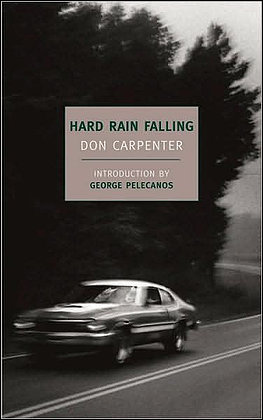
Don Carpenter and “Hard Rain Falling”

“Hard Rain Falling” by Don Carpenter (1966) – 308 pages

 This is the story of an author and his novel “Hard Rain Falling”.

 Don Carpenter was born in Berkeley, California in 1931 and spent most of his life in California.   He published his first novel “Hard Rain Falling” in 1966, and the book received high praise from critics and fellow writers although it didn’t sell that many copies.  This was a continuing theme in Carpenter’s career as a writer. 

 Soon after this, Carpenter went to Hollywood to work as a screen writer.  First he wrote TV scripts, a script for ‘High Chaparral’ and one for ‘The Outsider’ as well as others.  Then he turned to the movies, writing the script for a movie called ‘Pay Day’ starring Rip Torn as a country singer.  As with his novels, the movie got good reviews but didn’t sell many tickets.  Carpenter wrote three novels based on his Hollywood screenwriting experiences.  I read one of those novels, “A Couple of Comedians” a long time ago.  I remember liking it a lot, but don’t remember any details.  Carpenter wrote 8 novels and a couple of short story collections during his career. 

 In the early Eighties, Carpenter contracted a particularly severe form of tuberculosis and there were other serious medical problems as well.   He continued to write, but was losing his eyesight.  In 1995 at the age of 64, he killed himself with a bullet to the chest.  All of his novels were out of print at the time of his death. 

 That could have been the end of the story.  However, “Hard Rain Falling” was re-issued in 2009 by New York Review Books (NYRB) with an introduction by George Pelecanos as part of its Classics series .

 I recently read “Hard Rain Falling”.  It is about two young guys, Jack Levitt and Billy Lancing, who meet in a pool hall in the early Fifties.   When Jack Levitt was a baby, neither of his parents wanted him; besides they both were dead within a few years of his birth.  So he was brought up in an orphanage, later spent much of his teenage years in a reform school. In reform school, a warden punishes him by locking him in the Hole for three months of solitary confinement. Here is a description of Jack.

    “He had penetrating, flat, almost snakelike blue eyes which ordinary citizens found difficult to look into…even when he smiled there was too much ferocity in his expression to relax anyone.”

 Billy Lancing, light-skinned but definitely black, is a pool hustler, one of the best around the Portland, Oregon area where much of the story takes place, Billy is a smart young guy navigating a world of racists. 

 They both inevitably get into trouble with the law, maybe due to high spirits more than anything else.  Jack passes out drunk at a party at a rich guy’s house he and his friends have broken into, later gets a statutory rape charge which he probably could have gotten out of if he could have afforded a decent lawyer.  Billy is one of the few pool-shooters with money until his luck runs out.    They both wind up in prison in San Quentin and become roommates.

 So “Hard Rain Falling” is a tough novel about two guys who are outside society, outside the law.  Don Carpenter gets all the details right.  This is no ‘social problem’ novel where these guys are over-sentimentalized, and society is blamed for all their problems.  These guys are actually enjoying the things they can grab in this world, and we enjoy them along them.  Sure Jack and Billy are foolish sometimes, but aren’t we all?  At the same time, “Hard Rain Falling” is not one of those tough guy novels where the characters are tougher and meaner than people really are, so tough you can never get inside their minds.  Carpenter’s achievement is that he has complete empathy for these guys who are living pretty much on the street and in prison.   

 When you read the novel, you live life along with Jack and Billy, and you encounter all their ups and downs.  This novel is not for the faint of heart

 Where does Don Carpenter fit in United States fiction?  “Hard Rain Falling” is a work of detailed psychological realism.  I would put Don Carpenter in the following continuum. Theodore Dreiser to John Steinbeck to Nelson Algren to Don Carpenter to Richard Price.   I admire all of these authors, and Don Carpenter is worthy to be included.

Did the Man Booker Prize take a Hard Right Turn?

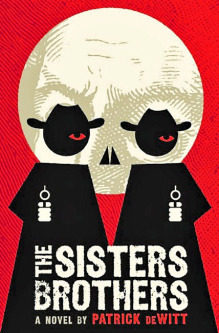
“The Sisters Brothers” by Patrick DeWitt (2011) – 325 pages

Looking at the Man Booker prize winners for the last three years, it makes one wonder where it’s headed. “The White Tiger’ by Aravind Adiga, the winner in 2008, had the traditional deeply conservative viewpoint of a large segment of the Indian population. In 2009, I suppose one might forgive the Man Booker for the continuing endless fascination with royalty, palace intrigues, and all its trappings, specifically of that most ridiculous and obnoxious of all the English kings, Henry VIII. Although I wasn’t impressed by the book, “Wolf Hall” by Hillary Mantel was probably a reasonable choice for the Man Booker. However the awarding of the prize in the following year to the not-very-good ultra right-wing “The Finkler Question” by Howard Jacobson which was supposedly a humorous novel but was actually a grim extreme political diatribe, seems inexcusable. It makes one think that the Murdochs must have taken over the Man Booker award along with everything else in Britain and turned the Man Booker into a hard-right political award rather than a literary award.

Which brings us to our book of the day, the western “The Sisters Brothers” by Canadian author Patrick DeWitt which is long-listed for the Man Booker this year. The Sisters Brothers are hired killers out west in California during the Gold Rush. There is no frontier justice in the Sisters Brothers world; it is a ‘kill first or be killed’ world. As the novel begins, the brother Charlie has just been promoted by his boss, the Commodore, to the team lead position of the two brothers over his brother Eli. That means Charlie will get more money and Eli will get less money. Charlie has exactly the same cruel brutal view of the world as the Commodore which Eli apparently lacks.

The whole novel is from Eli’s jaded resentful point of view which is quite humorous. Not only has Eli been demoted; he has started to have human feelings which are totally unacceptable in a hired killer. Instead of selling his crippled horse Tub for horse meat, he nurses the horse along, even when the horse needs to have an eye removed. We get a lengthy graphic account of the removal of the horse’s eye. Eli even develops some meaningful relationships with women who are not prostitutes.

In a comic novel about paid killers, there is probably little room for character subtleties. The farther up in the command chain you go in the novel, the more vicious, violent, and self-serving the characters get. The few women in the novel are sketchily drawn.

Overall “The Sisters Brothers” was an enjoyable comic read, a humorous account of a reasonable man, Eli, living an unreasonable life. I found the novel worthy of its place on the Man Booker longlist. However when I compare “The Sisters Brothers” with another American western written by a Canadian, “The Last Crossing” by Guy Vanderhaeghe, I found I much preferred “The Last Crossing” even though that novel did not even make the Man Booker long list when it was published in 2002. I suppose liking a novel for its subtlety and humane approach is old-fashioned; so be it.

However, “The Sisters Brothers” with its ‘Kill first or be killed’ and ‘Take all you can get as long as you can get away with it’ mentality might be exactly what the Murdochs are looking for in a novel or in a political statement.

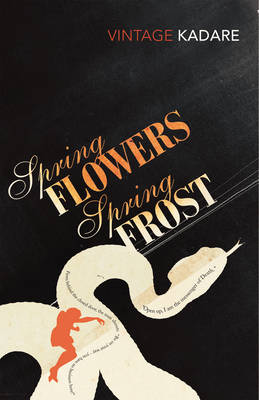
“Spring Flowers, Spring Frost” by Ismail Kadare

“Spring Flowers, Spring Frost” by Ismail Kadare (2000) – 182 pages

    “They were really flowers
    But March was gone
    Or else it was March
    But the flowers were not real”

It is hard to believe, but it has been more than 20 years since the Great Awakening of Eastern Europe when the Communist regimes fell in many of these countries including Albania. We all remember the tremendous jubilation and celebrations in these countries at that time, but what has happened in these countries since then? Spring is the time when Nature re-awakens after the long cold winter, and Ismail Kadare uses “Spring” as a metaphor for the re-awakening of Albania after the long cold Communist winter. As the title “Spring Flowers, Spring Frost” suggests, there have been some good things that have occurred in Albania since the Communist regime was deposed and some not so good.

“Spring Flowers, Spring Frost” takes place several years after the Communist downfall. Mark Gurabardhi, the main character of the novel, works as an artist. His specialty is nude figure painting, and his girlfriend is his main model. He has total artistic freedom. Later a bank robbery occurs which was unheard of in mostly small-town Albania until recently, another sign of the modernization and westernization of Albania

At the same time the ancient ways are now returning after having been outlawed by the Communists for many years. The Kanun, the archaic Albanian Mafia-like system of blood feud and vendetta, is returning. Men mysteriously disappear. Some of these blood feuds between families go back hundreds of years.

Although parts of “Spring Flowers, Spring Frost” held my interest, I did not find the novel at all compelling. The stories were disjointed with a lot of potential plot lines brought up but none of them developed fully. The main characters were sketched rather than fully drawn, and I found it difficult to care one way or another about any of them. The novel seemed more of a checking-in on the current state of Albania in fragments rather than a completely developed story. Later I found out that the English translation was actually based on the French translation rather than the original novel, and that may have been part of the problem.

I have read another of Kadare’s novels, “Palace of Dreams”, which was written during the Communist era and was banned by the Communists for its portrayal of a tyrannical dictatorship which was strikingly similar to the Hoxha regime in Albania at the time. “Palace of Dreams” is a strong novel, and I would recommend you read that book instead of “Spring Flowers, Spring Frost”.

Ismail Kadare was the first winner of the Man Booker International Prize in 2005, and he is frequently mentioned among those who could win the Nobel Literature Prize. However I would recommend you skip “Spring Flowers, Spring Frost” in favor of one of Kadare’s other novels.

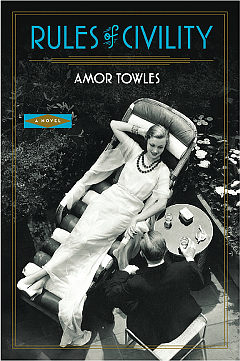
“Rules of Civility” by Amor Towles

Rules of Civility” by Amor Towles (2011) – 337 pages

 This is the time of year when people are trying to figure out which of the Man Booker longlisters will make it to the coveted short list.  This year, for a change, there is even some excitement among book people in the United States mainly due to a debut novel written by a 46 year-old money manager at an investment firm, Amor Towles.  “Rules of Civility” is already moving up the bestseller lists, quite an accomplishment for a literary novel.

 “Rules of Civility” is a special novel, a throwback to a more elegant time and place. 

 Most of “Rules of Civility” takes place in New York City during 1937 and 1938, and it centers on a young woman, Katie Kontent, and her friends and acquaintances.  When the novel starts out, Katie is living in a dorm-like apartment building for young women and working in an office as a typist.  She befriends Eve Ross, and they become roommates in the dorm.  On the last night of 1937, Katie and Eve go out to a jazz club called The Hotspot, where they meet the clearly well-to-do young man Tinker Grey. 
 

    “Eve saw him first. She was looking back from the stage to make some remark, and she spied him over my shoulder. She gave me a kick in the shin and nodded in his direction. I shifted my chair.

    He was terrific looking. An upright five foot ten, dressed in black tie with a coat draped over his arm, he had brown hair and royal blue eyes and a small star-shaped blush at the center of each cheek. You could just picture his forbear at the helm of the Mayflower—with a gaze turned brightly on the horizon and hair a little curly from the salt sea air.

    –Dibs, said Eve.”

 Soon Tinker is taking both working girls to the finest restaurants and night clubs in New York City.   One of the many charms of “Rules of Civility’ is seeing the jazz clubs, the expensive restaurants, and New York City through Katie’s eyes.  The short, snappy, sharp one-liner dialogue between Katie and Eve is humorously diverting.  Amor Towles provides all the stylish sensuous details of the late Thirties.   Even though ‘Rules of Civility’ takes place in a completely different era than ‘Mad Men’, both of these works caused me to look at our own time in comparison and find it wanting in style.  Many of the characters in “Rules of Civility” are well-to-do, and they are polite, amiable, and deeply interested in art, music, and literature.  This is not at all like today when most of the rich people seem like vicious ignorant Tea Party blowhards. 

 The title of the novel comes from the “110 Rules of Civility and Decent Behavior in Company and Conversation” which sixteen year-old George Washington wrote out by hand.  The first rule is “Every Action done in Company ought to be with some Sign of Respect to those that are Present.”  The rules are all about being polite and getting along well in society.  The character in the novel, Tinker Grey, adopted these rules as his own.   Perhaps in real life these “Rules of Civility” might be even more important than any list of moral precepts.  All 110 rules of civility are listed at the end of the novel.

 About the only thing that doesn’t work in the novel is the framing device with the novel starting out at an art show in a museum in the 1960s, and then flashing back to 1937.  There just did not seem any good reason for the Sixties scenes except as a device for Katie to look back on her younger days with fond memories.  But maybe that was enough reason.    

 How long has it been since you have read a smart stylish elegant novel?  If you are interested, “Rules of Civility” is the ticket.         


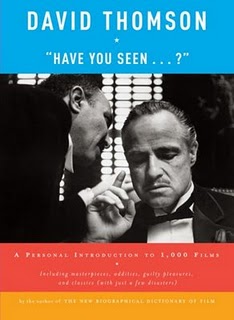
“Have You Seen…” – A Personal Introduction to 1,000 Films by David Thomson

“Have You Seen…” – A Personal Introduction to 1,000 Films by David Thomson (2008)  1002 pages

“Have You Seen …” is an encyclopedic book of film in which David Thomson describes in detail the circumstances of 1,000 movies he considers essential. These movies are not in all cases his favorites; in the short one-page articles for each movie, Thomson expresses his opinions about each movie freely. These opinions are about the direction, the actors, the writing, the staging, the camerawork, the lighting, etc. The movies range from the year 1895 to the year 2008 when this book was written.

Thomson has described his film writing as “personal, opinionated, unfair, capricious,” However his detailed knowledge of the making of each of these movies is so wide-ranging, Thomson is entitled to his strong opinions. It is that opinionated capriciousness that makes his writing so interesting and so much fun.

In my own movie watching, I have reached the point where the oldness of a movie does not impede my selection of it as a movie to watch. The modern technical razzle dazzle has no effect on me whatsoever. In fact I much prefer watching many of the older films over watching still another comic book movie whether it is a so-called drama, comedy or indeed a comic book. There are still good movies being made, but you need to hunt for them. Of the movies of 2010, I actually preferred “The Fighter” over “The King’s Speech”.

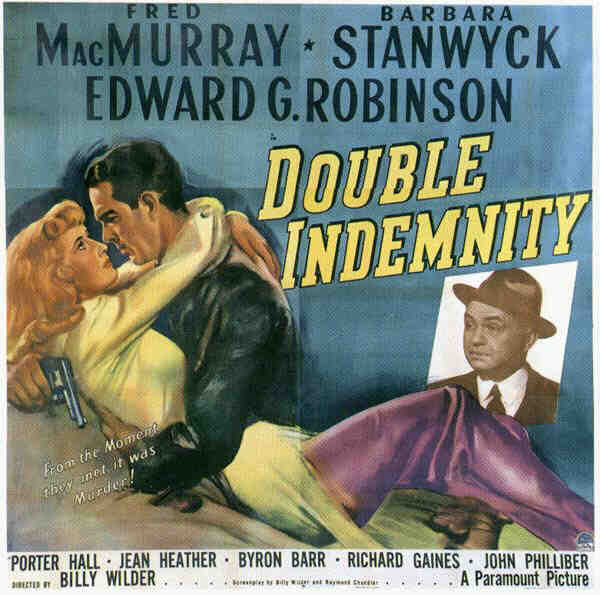
Next, I’m going to quote two somewhat long excerpts from “Have You Seen…” about the movie “Double Indemnity” that will indicate the sweep of David Thomson’s knowledge as well as the quality of his insights.

“When Phyllis (Barbara Stanwyck) comes downstairs she is dressed, and she wears that anklet that catches Walter’s (Fred MacMurray) eye the way a hook gets a fish. Very soon they’re into this counterpunching flirtation that isn’t in the novel and that you could easily attribute to Wilder’s co-writer Raymond Chandler. But everything you get here is part of Wilder’s grinning fascination with nasty, sexy people and his huge respect for Cain’s basic story.”

““The casting is of a kind that changed Hollywood. Stanwyck was a little reluctant to be so nasty, but then she saw that it made her. Fred MacMurray simply looks a better and better actor as the years pass, and there are volumes to be said about a man who hates himself even while he is trying to look so good. But still, it’s Keyes who holds the film in place, and Edmund G. Robinson is a fussy little treat, nagging away at detail and looking for his matches.”

Every movie entry in “Have You Seen…” is filled with these fascinating insights into the movie being discussed. This is an excellent movie compendium.

Lastly I will leave you with one last excerpt from the book about the movie “The Sound of Music”.

“Yes, you’re right: I am a very sick, vicious old man, but writing 1,000 of these little recommendations can drive you crazy, especially when I come to a picture that I loathe but which — unquestionably — has to be in the book, if only because millions of the stupid and aggrieved will write in to the publisher, ‘Where was The Sound of Music?’ if it is not. It is here.”

From who else can you get candor like that?

Based on the write-up in “Have You Seen…”, my wife and I recently re-watched “The Right Stuff” which was fine and probably, as Thomson writes, should have won the Best Movie Oscar in 1984 over “Terms of Endearment”.