Archive for January, 2011

Locked in “Room” by Emma Donoghue

“Room” by Emma Donoghue (2010) – 321 pages

 Irish writer Emma Donoghue must have spent many long hours listening to a five year old, because she gets the voice of Jack, the narrator of her novel “Room”, exactly right.  As parents know, there is a huge difference between how a four year old speaks and how a five year old speaks, between how a five year old speaks and how a six year old speaks.  If Jack did not sound right for his age in even one of his sentences, the novel could have been a failure.  Fortunately that does not happen. 
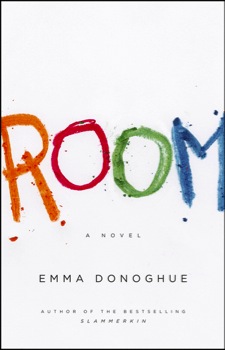
 

I listened to “Room” on audio, and the woman who read for Jack sounded very much like a five year old.  In this case, I think the audio enhanced the experience of the book.

Up until the age of five, children take for granted that their family situation is ‘normal’ no matter what that situation is.  Little children have no real experience of what other families are like.  They are completely dependent on whoever is taking care of them.  One of the beauties of this book is how Jack’s mother is able to provide him with a whole world even though they are locked in this small room. It is an act of love, and at the same time she is saving herself from despair by caring for Jack. 

Donoghue’s description of the room and all their activities in the room is so vivid and real, the room probably became more real for me than my own surroundings.  This is one of the most moving accounts of the bond between mother and child I’ve yet encountered.   The boy Jack, of course, takes all these things for granted, and only we the readers recognize how difficult it is for the mother to provide this whole world for her child under these extreme conditions.

I think “Room” has a better chance to become a classic than just about any other novel published in the last five years.  First the plot is completely original.  Second this novel appeals to both literary readers as well as to the general public.  Literary readers can delight in the perfection of the voice, while the general public will get caught up in this unusual story.  Currently the Minneapolis Public Library has a waiting list of 756 people in line to check out “Room” which is the longest waiting list I’ve seen.
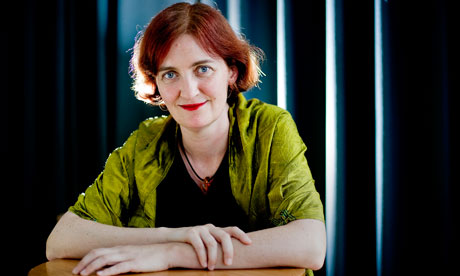
This is not the first Emma Donoghue novel I’ve read.  Her novel “Slammerkin” is also excellent.  “Slammerkin” is an 18th century historical fiction.  I give Donoghue a lot of credit for mixing it up between the historical and the contemporary. 

 “Room” would make a wonderful movie, but I don’t see how they could find a five year old who could  play such a big role and say all the lines.   Somehow I expect Hollywood will figure something out.  Maybe they will get Tom Hanks to play the five year old.

“Foreign Bodies” by Cynthia Ozick

“Foreign Bodies” by Cynthia Ozick    (2010) – 255 pages

“Foreign Bodies” is an updating of the Henry James novel “The Ambassadors”.  In  James’ “Ambassadors”, a United States business magnate sends his ‘ambassador’ over to Paris, France to convince the magnate’s son to come back to the States.  When this ‘ambassador’ gets to Paris, he finds that the magnate’s son is having the time of his life delighting in the refined elegance of the French culture and a romantic attachment, and the son does not want to leave.  Cynthia Ozick’s novel takes place about fifty years later in 1952, and things have vastly changed.   France has endured two devastating wars.  Uprooted people, many who have lost family members in the war, are wandering from city to city in Europe, and many ultimately end up in Paris.  Paris, far from being the city of enlightenment, has become the city of darkness and decadence. 

 In Ozick’s novel, the ‘ambassador’ sent to Paris is the magnate’s sister, Bea Nightingale, who hasn’t seen her brother for many years and has never seen her nephew.  She travels from New York to Paris to California and back to Paris.  “Foreign Bodies” starts with that jaunty feel I’ve come to expect from Cynthia Ozick.  Some of its short chapters are a tourist’s view of Paris, some are straight narration, and some are short letters between characters in the novel.  I like the variety that moves the novel along.

 For about the first one hundred pages, the novel entertained quite well.  After that, my problem with “Foreign Bodies” was that none of the main characters intrigued me enough to sustain my interest.  Instead of a jaunty ride, the novel became a grueling slog during the second half.   Let’s look at the characters.  First there is Bea who is a vocational school teacher who is mainly just an observer anyhow, but not a perceptive or insightful observer.  Also there is the business magnate father who in all ways is an obnoxious loudmouth.  He is so crudely drawn, that he could be a caricature. A caricature implies humor, but there is no humor in “Foreign Bodies”.  There is the neurasthenic mother.  Then there is the feckless son  (Does ‘feckless’ mean without ‘feck’?) who is rude and aimless with no redeeming qualities.   The son’s girlfriend who is a refugee from Romania is pretty much in a zombie state from losing her family during the war.  Then there is the son’s sister who seems to just hang around.  Finally there is Bea’s ex-husband from whom she has been divorced for about twenty years.  He wanted to be a composer, but ended up doing what he is told providing Hollywood movies with music background.  

 The trouble with “Foreign Bodies” is that the main character Bea Nightingale hasn’t seen any of these people for many years, and she doesn’t seem to care any more about them than I do which is very little. 

I think the best format for Cynthia Ozick is the long short story or the novella such as “The Shawl”.  Also “The Puttermesser Papers” showed she could handle humor well, and “Heir to the Glimmering World” proved that she could sustain a complete novel.   However “Foreign Bodies” does not work.   It feels more constructed than lived.

A Young English Lord Chases after a Poor Irish Gal named Kate

“An Eye for an Eye” by Anthony Trollope (1879) – 201 pages

    “A man’s love, till it has been chastened and fastened by the feeling of duty which marriage brings with it, is instigated mainly by the difficulty of pursuit.” – Anthony Trollope

Anthony Trollope, having lived in both Ireland and England, wrote novels about both places.  “An Eye for an Eye” is an interesting mix in that it takes place in both countries.  

The Earl of Scroope and his wife the Countess are looking for someone to inherit the lordship and the Scroope Manor after their own son died of dissipation in France.  They settle on their oldest nephew Fred Neville.  Fred Neville is only too happy to one day become the Earl of Scroope, but he asks to spend one more year with his calvary regiment stationed along the coast in Ireland.  The Countess of Scroope doesn’t like this at all, fearing Fred will only get into trouble over in Ireland.  Fulfilling the Countess’s worst fears, Fred soon meets and falls in love with the sweet and beautiful Irish girl Kate O’Hara who lives with her mother in a little cottage near the ocean.  .

A lot of the fun of “An Eye for an Eye” is watching the Countess’s worst nightmare come true.  The Countess has her own spy in Ireland, Lady Mary Quinn, who sends her regular reports about what Fred is up to.  As soon as the Countess finds out about Kate, she invents a pretense to get Fred back to Scroope Manor.  The Countess invites a suitable young woman Sophia Mellerby to Scroope Manor to entice Fred, but Fred wants no part of it, only itching to get back to his regiment and his wild Irish Kate.  So the Countess as well as the Earl of Scroope only get more worried and angry. 

One could say this is a very stock situation, fodder for a thousand Victorian melodramas.  However Anthony Trollope makes the story come alive.  From our perspective, it is easy to sneer at the Earl and Countess of Scroope for their prejudice against the Irish and for their trying to prevent Fred from making his own decisions.  However Fred is a self-indulgent young guy, and does he really know what he wants to do with his life?  I wonder if parents still intervene when their children seem to be making the wrong choice of life mate.  Are children still reckless and willful, and do parents still want the best for their children?  Somehow it seems today that everyone thinks that the kids are always smarter than their parents, and it doesn’t matter what the old people want.  But there are still young people with money and young people without money. 

The Earl and Countess of Scroope.  ‘Scroope’ is a humorous name, and the name does help us to sneer at them a bit.  I’ve read Trollope’s “The Warden” and “Castle Richmond”.  This time I wanted a short dip in Trollope, not a long wallow, and thus picked this relatively short novel rather than one of his longer novels.

One of the reasons Anthony Trollope is still widely read is that you can trust him to know exactly how each of his characters would think and act, given their place in society and the family.  You can always depend on him to get the people in his novels right.  Sometimes Trollope is called the great novelist of money.  Yes, he did know the importance that money plays in people’s lives, not as an object itself but as a reflection of what it means for people’s self-image, property and place in the community and their society.  He was not particularly innovative, deep, or orginal in his novels, but AnthonyTtrollope was better than anyone in capturing the way we really are.   

“An Eye for an Eye” is a rich study of English and Irish life that left me completely tuned in up to the end of the book.  Only in its last few pages does the story turn into overwrought Victorian melodrama. 

    “It may almost be a question whether such wisdom as many of us have in our mature years has not come from the dying out of the power of temptation, rather than as the results of thought and resolution. “ – Anthony Trollope.

Maybe the Bitchiest Novel Ever – “After Claude” by Iris Owens

“After Claude” by Iris Owens (1973) – 206 pages

“I left Claude, the French rat.”  That is the first sentence of “After Claude” spoken by the main character Harriet.  A good description of Harriet would be that she is a cross between Joan Rivers with her sharpest, nastiest tongue and the comedienne Sarah Silverman.  I will let Harriet describe her own story.

    “I am essentially a light-hearted person who tries to see the humor in this freak show called life.”

It’s almost a miracle to me that New York Review Books (NYBR) has now re-published “After Claude”.  The novel caused a stir when it was published in 1973 and got a lot of very positive reviews, but the book and its author, Iris Owens, have long since been nearly completely forgotten.

Iris Owens had an interesting background.  After graduating from Barnard, she went to Paris with her heroin-addict boyfriend and became a writer of erotica for Olympia Press.  Using the pen name Harriet Daimler, she specialized in rape fantasies.  The pornography she wrote for Olympia Press is still available at Amazon with such titles as “Darling”,  “Innocence”,  and “The Woman Thing”.  She had such a brutal caustic wit, she was the only writer that Olympia Press, specialists in this kind of material, told to “tone it down”.

Many novels such as “Portnoy’s Complaint” or “Confederacy of Dunces” were written in the 1960s and 1970s with anti-heroes.  Finally we have found the long missing anti-heroine; Harriet in “After Claude” is someone who can slouch right up next to those male anti-heroes.

“After Claude” is a comic masterpiece, but it is not for everyone.  Here are a series of disclaimers.

Do not read “After Claude”, if you can’t stand to have the joys of female friendship disparaged.

    “If there’s one thing on this earth that irritates me, it’s when a dumpy, frigid, former nymphomaniac assumes that my tongue is hanging out, thirsting for marital bliss.”

Do not read “After Claude”, if you find it offensive to hear Jesus called “a Jewish fag”.

Do not read “After Claude”, if you don’t want hard-working flight attendants and nurses to be degraded.

    “Tell me, do you believe that stewardesses and nurses are pathologically promiscuous as a result of their occupations constantly confronting them with death?”

Do not read “After Claude”, if the following revolts your sense of cleanliness.

    “A bum in Dr. Kildare’s blood-smeared ducks shuffled over and mechanically wiped the table with a cloth that looked as if it had been dipped in extract of smallpox infection.”

Do not read “After Claude”, if you don’t want to read about “that brain-dead segment of the population called women”.

I think everyone who wasn’t offended by the above will adore this book.   The woman who wrote the introduction to “After Claude”, writer Emily Prager, was no longer on speaking terms with Iris Owens when Owens died in 2008.  Somehow that seems appropriate for “After Claude”.

To read a more comprehensive and insightful review of this book, please read the BookForum review by Gerald Howard.  BookForum is one of only two book reviews I still get in the mail.

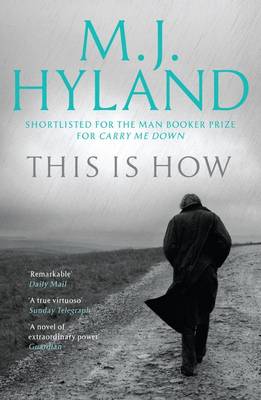
“This is How” by M. J. Hyland

“This is How” by M. J. Hyland  (2009) –  376 pages

 M. J. Hyland has a way of penetrating the minds of her main characters that goes deeper than most writers.  With her short sentences and exact details of their daily lives at the moment, Hyland allows you to see clearly what is going on inside the minds of these persons, and it is not always pretty; sometimes it is ominous.

In “How the Light Gets In”, we are in the mind of a sixteen year-old girl exchange student from Australia living in Chicago.  In “Carry Me Down”, it is a twelve year old Irish boy whose mind we enter.  In “This is How”, it is a young English man named Patrick who is just starting out on his own independent life.

Speaking of exact details, I’m not going to reveal details about “This Is How” except to say that the novel starts out in a boarding house in England. 

Suffice it to say that “This is How” is a fine novel that will leave you totally involved with the story.  So M. J. Hyland has now written these three excellent novels.  Leave it to me to suggest to Hyland a major change to the structure of one of her next novels.  Let me elaborate.

In each of her three novels she has gone deep inside the head of her leading person by showing his or her life in detail.  The central conflict is within the head of that one person.  This has been a very rewarding technique for her and us, but it is time to try something a little differently.

I would like to see Hyland develop two main characters, each of whose minds she probes.  This could be done with alternating chapters between the two persons.  At some point within the novel, these two people would come into conflict, and we would understand exactly why since we know what is going on inside each person’s head.   Each of these persons could have a valid world view, but the detailed circumstances of their lives would cause them to clash.    

I’m not going to make any suggestions at all as to the setting of the story or the details of the lives of the protagonists.  So far Hyland has excelled in showing the conflicts within one individual.  I would love to see her use her same technique to delve into the conflict between two individuals. 

She also should work on her book titles a bit.

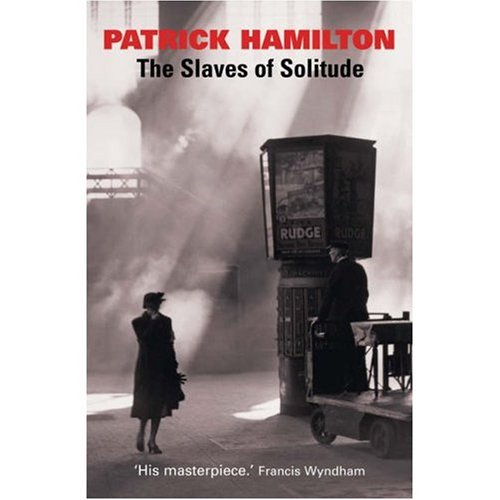
“The Slaves of Solitude” by Patrick Hamilton

“The Slaves of Solitude” by Patrick Hamilton  (1947) – 242 pages

 It happens; it is not always just paranoia.  Two or more people in a small group will gang up and work in league to defeat, humiliate, or embarrass someone else in the group.  It’s human nature.  Miss Enid Roach in “The Slaves of Solitude” has that mix of fierce independence, stubbornness, and painful sensitivity that incite two other residents of her boarding house to team up to oppose her.

The time is 1943, and we are in Thames Lockdon which is some miles from London.  There has been a lull in the German bombing, and thousands of United States soldiers are there preparing for next year’s reclaiming of France.  These United States soldiers are looked on as the saviors of England and are  popular with the single women.  Somehow even thirty-nine year-old Miss Roach gets involved with her American soldier, Lieutenant Pike, who takes her to a park bench along the river where they kiss.  “On the whole she disliked this at first, but after a while she found that she disliked it a great deal less.”  Miss Roach also befriends a woman from Germany, Vicki Kugelmann, who has been the victim of anti-German prejudice whom Miss Roach invites to stay in her boarding house.  That is when the real trouble begins.    

Up until the time Vicki Kugelmann moved into the boarding House, Miss Roach only had to contend with Mr. Thwaites who has hounded her for years. We all know a Mr. Thwaites, “a lifelong trampler through the emotions of others” who especially has it in for Miss Roach.  Vicki Kugelmann, far from being Miss Roach’s defender, teams up with Mr. Thwaites.  Vicki makes a play for Miss Roach’s American soldier, and she has this kittenish too familiar way of talking to Miss Roach.  “You are not sporty.  You must learn to be sporty, Miss Prude.”  If this type of humiliating talk wasn’t enough, she also casually uses Miss Roach’s own comb which is the worst sin of all.  Before long Miss Roach “knew she hated Vicki Kugelmann as she had never hated any woman in her life…Then it was that she knew that it was war to the death – malignant, venomous, abominable, incessant, irreversible.” 

Patrick Hamilton has a way of making the stories in his novels come vividly alive.  No wonder so many of his books and plays have been made into movies.  The four main characters in “The Slaves of Solitude” – Mr. Thwaites, Lieutenant Pike, Vicki Kugelmann, and of course Miss Roach – are all memorable.  Hamilton’s novels have the immediacy of plays, and it was as a playwright that Hamilton originally excelled.  His first great play was “Angel Street” which was made into the movie “Gaslight”.

The entire novel “The Slaves of Solitude” is told through the eyes and mind of Miss Roach.  This is the first Hamilton novel I’ve read where the main character is a woman, and he pulls it off very well.  Miss Roach is a unique sympathetic character. 

Sometimes when reading English novels, one tires of reading about Lords and Ladies, manors and fox hunts.  Patrick Hamilton was one of those English novelists like Alan Sillitoe, Colin MacInnes and of course Charles Dickens who wrote about the people on the streets.  Unfortunately Hamilton died at the relatively young age of 58 due to health problems related to alcoholism.

“Poor Man’s Orange” by Ruth Park

“Poor Man’s Orange”  by Ruth Park   (1949) – 274 pages

 Can fiction writers change the real world?  Yes, if their fiction is powerful enough and contains the truth of how the world actually is.  Ruth Park’s two novels of the late 1940s, “Harp in the South” and “Poor Man’s Orange”, shocked Australians in their dramatic depiction of the hard life in the Surrey Hills tenement houses of Sydney   Many newspaper letter-writers were outraged and claimed these novels were a “cruel fantasy”, because Sydney had no slums.  Later Sydney did tear down these slum houses only to replace them with high-rise tenement buildings which apparently Ruth Park liked even less. 

 I have now completed “Poor Man’s Orange”, and I will say that this second novel is just as strong as the first, “Harp in the South”.  “Poor Man’s Orange” is a continuation of the trials and tribulations of the Darcy family At the beginning of this novel, there are six persons living in the tenement house, Hugh Darcy, his wife usually called ‘Mumma”, their daughter Roie and her husband Charlie, their other daughter Dolour, and the neighbor Patrick Diamond.  Just as in “Harp in the South”, many terrible and a few wonderful events occur to these people, some related to living in the tenement and others which are inexplicable and happen to us all. 

In the first book, Hugh Darcy was pretty much a loveable drunk who still came through for his family.  In “Poor Man’s Orange”  we see a darker side of him.  Some of his acts are despicable and cause his family terrible embarrassment.  To me, this honesty only made the story of the Darcy family seem even more real    Ruth Park does not soften reality, and she has the strength to let even one of the Darcy family have severe faults  It would have been easier to sentimentalize this story, but Ruth Park is a tough-minded writer who doesn’t let that happen.

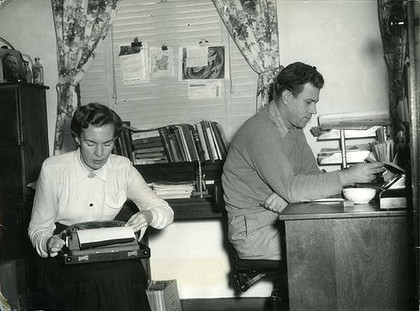
Ruth Park and D'Arcy Niland

Since each character in “Poor Man’s Orange” is a struggling human being, you deeply care what happens to each one of them.  If Ruth Park had a special character in the Darcy family that she most strongly identified with, I would guess it is Dolour.  I frequently thought while reading both novels that Dolour was a stand-in for Ruth Park.

 Although Ruth Park did live with her husband author D’arcy Niland in the Surrey Hills tenements for a few months, the novels are by no means autobiographical.   In fact she spent much of her early life living in tent-camps in the forest while her father worked on bush roads and bridges as well as in sawmills. 

    “I cannot emphasize sufficiently the importance of my early life as a forest creature, The mind-set it gave me has dominated my physical and spiritual being. The unitive eye with which all children are born was never taken away from me by the frauds of civilization; I always did know that one is all and all is one.”

                         Ruth Park, “A Fence Around the Cuckoo”

Ruth Park died about a month ago, December 14, at the age of 93. 

   .       .

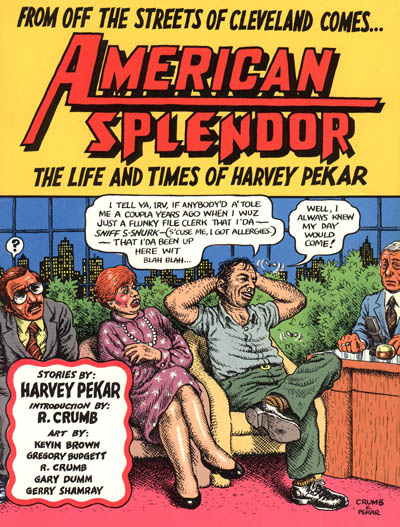
“American Splendor” by Harvey Pekar, Master of the Mundane

“American Splendor” by Harvey Pekar  

 “Ordinary life is pretty complex stuff.”  –  Harvey Pekar 


The “American Splendor” comics are not about superheroes.  Harvey Pekar who died last July due to an accidental overdose of prescription drugs was the chronicler of the mundane and the dispirited.  The comics for which he wrote the words and for which several artists including Robert Crumb drew the pictures were sold in underground magazine shops, ‘head’ shops, etc.  They never did have very good sales, and Pekar kept his job as a file clerk in a government office up to the end of his life.   He documented his everyday life as a file clerk in Cleveland in his “American Splendor” comics.  Now Pekar’s comics have been packaged in high quality trade paperback book form, and the books are quite popular.

I have just read the first ‘American Splendor’ collection which was all written in the Seventies, the post-Hippy era.  This was an era when everything was ‘awesome’ or ‘far out’.  Most men wore their hair long, some elaborately styled but most rather ragged and shaggy.  Feminism was in full force, yet women were still called ‘hot chicks’ or ‘foxy ladies’.  This was the time of disco and the one-night stand, and the drugs were plentiful.  Pekar and the artists capture the full scruffiness of the era in these short stories.

Each of these stories which are all only a few pages long chronicles the common incidents in Harvey Pekar’s life.  Lots of the pictures are just him facing toward us explaining something about his life.  Many of the pictures are of him walking the streets of Cleveland or talking to other employees during his file clerk job. His main interest outside work was collecting jazz records and many of the stories are about that.  Sometime the pictures are just Harvey walking down the Cleveland streets thinking about how he can get some famous recording.

 Harvey Pekar was very much a depressive, and that certainly comes out in these stories.  Yet also at the same time in the stories he does meet and go out with a lot of different people.  Pekar is very observant and picks up on the way different characters talk and their small quirks, all of which go into the stories.  Some are about women he dated, and Pekar is honest enough to tell the story even if they didn’t end very successfully for him.  Honesty is the quality that comes across most clearly.  Nothing here is prettified; this is real life.

 This collection is very good in its portrayal of life in the Seventies, a time when couples were more likely to shack up than marry, and there were a lot of post-college men and women living in single apartments.  The collection ranks for me right up there with “The Ice Storm“ by Rick Moody in its description of the Seventies.  Who can forget that scene in “The Ice Storm” where during the suburban house key party, all the men throw their car keys in a hat, and all the women without looking draw out a set of keys, and each woman spends the night with the man whose keys she draws.  Ah, the Seventies.             

After reading the “Maus” series, the “Persepolis” series, Posy Simmonds’ “Tamara Drewe” and “Gemma Bovery”, and now “American Splendor”, I am running out of graphic novels to read.  I’m not interested in manga or anime, superheroes, vampires or zombies.  Just about anything else would be of interest.

I’m hoping that some of you can come up with some more graphic novel recommendations.  Thanks.

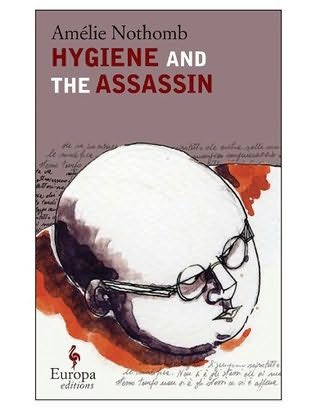
“Hygiene and the Assassin” by Amelie Nothomb

“Hygiene and the Assassin” by Amelie Nothomb  (1992) – 167 pages – Translated by Alison Anderson

 Amelie Nothomb’s audacious novel “Hygiene and the Assassin” is about Nobel literature prize winner Pretextat Tach.  Some of the novels the ficticious Pretextat Tach has written are “Pearls for a Massacre”, “Crucifixion Made Easy”, “Prayer on Breaking And Entering”, and “Dying without Adverbs”

Like those of other Nobel literature prize winners, nearly every sentence that Tach says is taken as a pronouncement.  Journalists from nearly every major newspaper and literary magazine or review want to interview him.  But even Nobel prizewinners aren’t always what they seem;  Pretextat Tach is a mean-spirited and pretentious man, and above all he hates women.

 Tach’s literary hero is French writer Louis-Ferdinand Celine.  Everyone who holds literature in high esteem must come to terms with Celine.  Celine wrote at least two of the great novels of the twentieth century, “Journey to the End of the Night” and. “Death on the Installment Plan”.  Yet in many ways Celine was a despicable person. who was a fascist and rabid anti-Semite.  The lesson Celine’s life teaches us is that being a fine writer does not necessarily make a fine person.

 Back to “Hygiene and the Assassin”, Tach has announced that he only has two weeks to live, and journalists from all over the world have requested private interviews with him.  Five journalists are chosen.   Nearly the entire novel “Hygiene and the Assassin” is the dialogue of these five interviews. Tach makes short work of the first four interviewers, all men.  Sensing that these men have only a casual limited interest in literature at best, he attacks them and they leave defeated.  The fifth interviewer is different, a young woman named Nina who has closely read all of Tach’s novels and proves more than equal to going up against the Nobel literature prize winner. She earns the rabid misogynist Tach’s grudging respect, because he was bored by the first four lightweights they sent in.  She successfully counters Tach’s hatred of women not with clichéd feminist arguments but with her own unique intelligent reasoning.    

 Although “Hygiene and the Assassin” was only translated into English in 2010, the novel is actually Amelie Nothomb’s first novel which she wrote when she was 25 in 1992.   What an original, daring, and stimulating first novel this is! I get the idea that Amelie Nothomb with this novel is saying to the world that not even Nobel prize winners intimidate her. To make her first novel almost entirely dialogue is a high-wire act by Nothomb that completely succeeds.   I was hanging on every word of the dialogue, especially in the conversation between Nina and Tach,.   I rate “Hygiene and the Assassin”  as one of Nothomb’s best novels along with “Fear and Trembling”, “The Character of Rain”, and “Loving Sabotage”.  Forget the dismal New York Times review of this book as it must have been written by one of those lightweight journalists above.  There are plenty of very positive reviews of “Hygiene and the Assassin” out there.

Although Amelie Nothomb is starting to be read here, she is still much better known in the rest of the world than she is in the English-speaking countries.  I suspect she herself will soon be the deserving subject of Nobel literary prize speculation after Haruki Murakami gets the award.  She’s been averaging one novel a year for almost twenty years now, so I’m hoping she will have a new novel for us this year.               

.