“For a Night of Love” stories by Emile Zola (1880-1883) – 97 pages
- “I am an artist…I am here to live out loud.” – Emile Zola
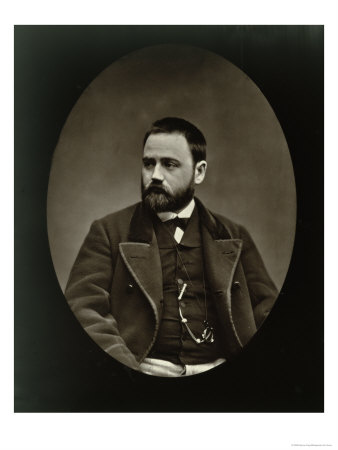 Emile Zola is a prime example of a strong intellectual who was not afraid to speak out. Many of his statements were blunt, harsh, and controversial. Perhaps his most famous newspaper article was “J’accuse” which was published in the French newspapers in 1898 as an open letter to the French President accusing the highest levels of the French army of obstruction of justice and anti-Semitism for having wrongfully convicted Alfred Dreyfus of espionage.
I have read several of Emile Zola’s major novels including ‘Nana’, “Germinal”, “La Bete Humaine”, and “The Debacle” as well as his short novel “Therese Raquin”. These novels are deeply involving, because they contain nearly a complete picture of Parisian society in the middle of the nineteenth century. The portrayal of the main characters is so vividly detailed that you become intensely involved in their stories almost as if you were there. Zola does not bypass the rough seamy side of life, and his novels were always in trouble with the censors. Despite or because his novels were racy and sordid, the novels were extremely popular.
Emile Zola was the primary advocate of literary naturalism which according to Wikipedia was a movement that “used detailed realism to suggest that social conditions, heredity, and environment had inescapable force in shaping human character.” Naturalism is not only realistic; it attempts to show how the underlying forces of heredity and environment influence the actions of individuals. Frequently these underlying forces lead to brutal consequences such as poverty, racism, disease, alcoholism, and prostitution. Zola’s fiction contained them all.
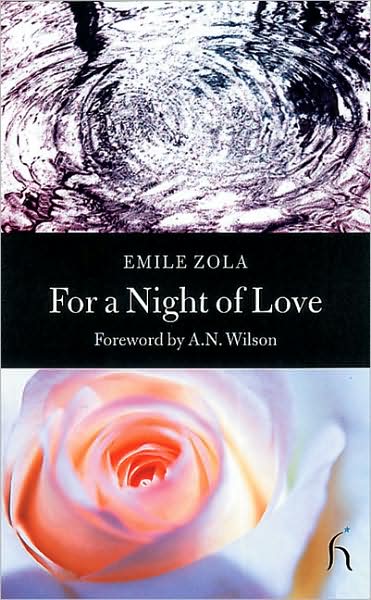 Emile Zola was not usually a short story writer. The strength of his novels is in the vivid detail and the complete depiction of a society. However, he did write a few stories, three of which are collected in the book “For a Night of Love”. The first two of these stories, “For a Night of Love” and “”Nantas”, are small examples of Zola’s larger technique. I don’t want to give away the details of these stories, but I can say they are very much in the style of the novels depicting characters operating within the Parisian society and driven to extreme circumstances. The last story, “Fasting”, is more a sketch than a story
Although these stories give you a small dose of the Zola technique, I think you need to read one of his great novels to undergo the full brilliant effect. These novels are about a specific place, Paris, at a specific time, the Second Empire. However the novels cover the Parisian society so completely and in such depth that they are universal and timeless. They are still a pleasure and well worth reading today.
The major United States writer who was most influenced by Emile Zola was Theodore Dreiser. Especially in his novels “Sister Carrie” and “An American Tragedy”, Dreiser gives a full and colorful picture of his society that doesn’t back away from the tragic and gruesome details.
 Tony's Book World
Posted by Lisa Hill on December 2, 2010 at 7:03 AM
Yes, yes, yes, I *am* going to read some Zola next year!
LikeLike
Posted by anokatony on December 2, 2010 at 1:56 PM
Hi Lisa,
I know, I know, I know. Always another author.
LikeLike
Posted by Tom C on December 3, 2010 at 8:17 AM
Alas, a gap in my reading. I am concentrating on Balzac this year – on my third in fact. Perhaps Zola in 2011. Interesting review containing things I didn’t know before.
LikeLike
Posted by anokatony on December 3, 2010 at 1:37 PM
Hi Tom,
I was actually trying to decide between Zola and Balzac, opted for Zola this time. I’ve read several novels by both of these hyper-prolific writers. With these two, we will never run out of good novels to read.
LikeLike
Posted by Kat on December 4, 2010 at 1:33 AM
I love, love, love Zola. Haven’t read his short stories, though. I neglect short stories. Looks like a nice edition and maybe I’ll try to track it down. If I ever pay off my new computer…
LikeLike
Posted by anokatony on December 4, 2010 at 2:56 AM
Hi Kat,
Speaking of short stories, have you ever read Theodore Dreiser’s short stories? I read a selection of them, and they are spectacular.
LikeLike