“The Painted Drum” by Louise Erdrich (2005) – 276 pages
“The Master Butchers’ Singing Club” – a play at the Guthrie Theatre, Minneapolis, Minnesota
- “Of course, I’m ambivalent, I’m human. There are times I wish that I were one thing or the other, but I am a mixed-blood. Psychically doomed, another mixed-blood friend once joked. The truth is that my background is such a rich mixed bag I’d be crazy to want to be anything else. . . . Through the difficulty of embracing our own contradictions we gain sympathy for the range of ordinary failures and marvels.” – Louise Erdrich
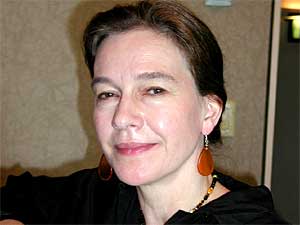 In “The Painted Drum”, Louise Erdrich again does what she does best, juxtaposing the lives of native Americans with the lives of people whose ancestors arrived here much later. Louise Erdrich is a tremendous storyteller who learned the lessons of William Faulkner and Flannery O’Connor very well.
“The Painted Drum” begins in New Hampshire, which happens to be the home of Dartmouth College where Erdrich graduated from college. In the house of the recently died son of an ex-Indian agent, an antique dealer discovers a large Indian drum. She knows the Indian agent took the drum without the tribe’s consent, and since she is one quarter Indian herself she realizes how valuable this ceremonial drum would be to the Ojibwe people it was taken from. She takes the drum all the way to North Dakota to return it to them. The novel then tells the story of the creation of the drum and then a story of the Indians living there today.
As time goes on, the stories that are part of our lives accumulate. Some are joyous stories, some not so happy, even tragic. People being human, they sometimes make major mistakes. Some of the stories necessarily involve human weakness and maliciousness. Erdrich, by juxtaposing the stories of Native Americans with the stories of others, allows us to consider the similarities rather than the differences between people. The following passage from “The Painted Drum” sums this up quite well.
- “Life will break you. Nobody can protect you from that, and living alone won’t either, for solitude will also break you with its yearning. You have to love. You have to feel. It is the reason you are here on earth. You are here to risk your heart. You are here to be swallowed up. And when it happens that you are broken, or betrayed, or left, or hurt, or death brushes near, let yourself sit by an apple tree and listen to the apples falling all around you in heaps, wasting their sweetness. Tell yourself that you tasted as many as you could.”
I’ve read several Louise Erdrich novels over the years, including “Love Medicine”, “The Beet Queen”, “Tracks”, and “The Bingo Palace” She is a reliable and exciting teller of stories that have an eloquent insight into our lives.
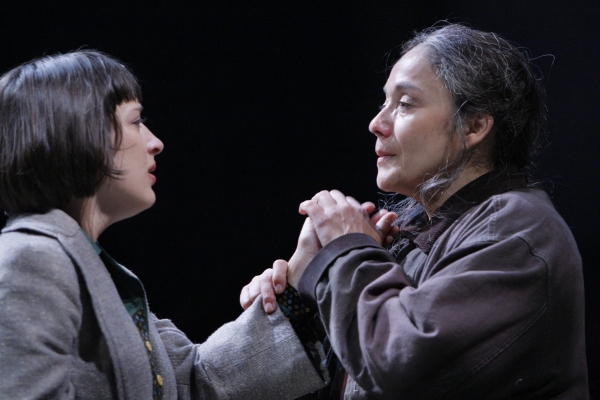 I also recently had the pleasure of seeing the theatre adaptation of “The “Master Butchers’ Singing Club”, another of Erdrich’s novels, at the Guthrie Theatre in Minneapolis. This play, although it does have its Native American elements, is mainly about the German immigrants living in a small town in North Dakota in the early Twentieth century.
- “Here I am, where I ought to be. A writer must have a place where he or she feels this, a place to love and be irritated with.” – Louise Erdrich
 Tony's Book World
Posted by whisperinggums on October 20, 2010 at 9:04 AM
Now this is an author I’ve been meaning to read for a while. In fact I have The bingo palace in my TBR pile and every now and then I go to pick it up. The only one of hers I’ve read is the collaborative one with her ex-late (or is that late-ex?) husband Michael Dorris, The crown of Columbus. It was OK but not particularly memorable. It hasn’t put me off reading her again though.
LikeLike
Posted by anokatony on October 20, 2010 at 12:15 PM
Hi WhisperingGums,
I did avoid ‘The Crown of Columbus’ for that very reason, because it was a collaboration. I think Louise Erdrich is the real writer of the two. I’ve heard a lot of good things about her quite recent novel, ‘A Plague of Doves’. It got nominated for the National Book Award, etc.
BTW, thanks for the ‘Harp in the South’ trackback!
LikeLike
Posted by whisperinggums on October 20, 2010 at 1:48 PM
Yes, I rather gathered at the time that she was probably the writer of the pair. So, I will try to get to her.
As for trackback, it’s a pleasure. I missed it at first but am glad I remembered where that other review I’d recently read was! There are so few people reviewing Australian literature that I do want to give credit where it’s due!
LikeLike
Posted by shallseminole on November 26, 2010 at 1:51 AM
She is one of my role models.
LikeLike
Posted by anokatony on November 26, 2010 at 3:40 PM
Hi shallseminole,
Yes, Loiuse Erdrich is a great writer and would make a cool role model. Thanks for stopping by!
LikeLike
Posted by Andrea V on August 9, 2011 at 7:10 PM
What would you say is the theme in her novel “The Painted Drum”? This is by far the best author i’ve heard of.
LikeLike
Posted by anokatony on August 14, 2011 at 3:25 AM
Hi Andrea V.
I’ve read a lot of Louise Erdrich over the years, and she being of mixed blood, she has the perspective of seeing both sides of her family. Certainly there is evil in all peoples, but it is probably the white peoples who are most likely to trivialize the hopes and dreams of other peoples which is probably the greatest evil of all. I think that is the theme of ‘The Painted Drum; where the drum is taken from its rightful owners for no good reason at all.
LikeLike