“Crabwalk” by Gunter Grass – (2002) 234 pages
In Dresden, Germany on February 13 of this year, about 5,000 neo-Nazis gathered to stage a ‘mourning march’ to protest the Allied bombing of Dresden 65 years ago. However, there were over 10,000 other counter demonstrators there whose purpose was to stop the far-right sympathizers from staging their march. The demonstrators were able to stop the neo-Nazi march by forming a human chain to block the route. Police informed the right-wing marchers that they couldn’t guarantee their safety if they went ahead with it. The march was ultimately called off.
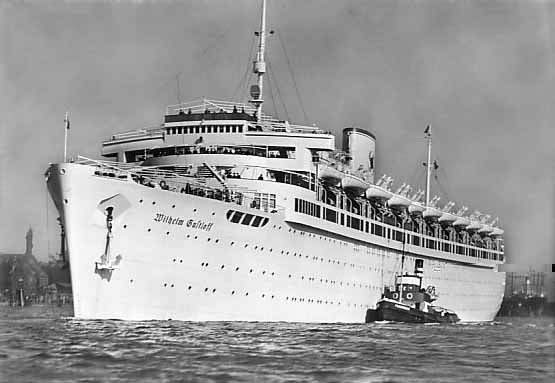 “Crabwalk” by Gunter Grass is mostly about two subjects, the sinking of the Wilhelm Gustloff ship in 1945 and neo-Nazism in modern Germany.
The largest ship disaster of the Twentieth century was not the Titanic, not the Lusitania, not the SS Andrea Doria. It was the sinking of the German ship Wilhelm Gustloff torpedoed by a Russian submarine in 1945 near the end of World War II. The ship was being used to evacuate German refugees from East Prussia which was surrounded by the Red Army. No one knows exactly how many people were on the ship when it sunk, and estimates of the number of people killed range from 6,000 to 10,000. The torpedoing of the Wilhelm Gustloff is somewhat controversial as most of the people who drowned were women and children, although there were military personnel aboard the ship.
As is usually the case in Gunter Grass novels, Grass personalizes the history. In “Crabwalk”, a woman named Tulla gives birth to the novel’s narrator Paul after she has been moved from the sinking ship to a rescue boat.
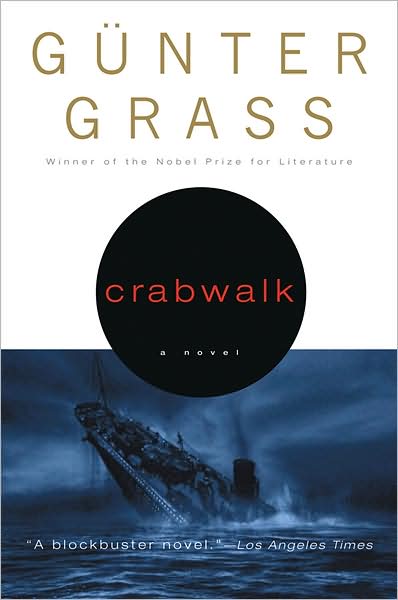 As I mentioned before, there are two main parts to the novel. One part is the history of the Wilhelm Gustloff which started as a cruise ship for Hitler’s ‘Strength through Joy’ program on which our narrator Paul’s grandparents take their first real vacation. The history of the ship ends with the dramatic telling of the ship’s sinking. The details of the sinking are only Grass’s way to move sideways, to ‘crabwalk’ toward his real subject which is modern neo-Nazism. Paul discovers a website devoted to the “martyr” Wilhelm Gustloff and the “atrocity” of the sinking of the ship. Paul discovers to his horror that it is his son Konrad who is running the website. Konrad is very close to his grandmother Tulla and adopts some of her pro Nazi or at least pro World War II Germany leanings which he puts up on his Internet web site. Konrad’s father looks askance at these Internet outpourings of his son, but there isn’t much he can do about it, especially since his son is not living with him.
I’ve read Grass’s “Danzig Trilogy” (“The Tin Drum”, “”Cat and Mouse”, and “Dog Years”) and consider the complex and disturbing trilogy one of the greatest accomplishments in modern literature. Gunter Grass is definitely deserving of the Nobel Prize for Literature which he won in 1999. I urge everyone to read all three of these novels. What about “Crabwalk”? I don’t see it as a work on the same level as the Danzig Trilogy. It held my interest throughout, but I did not find it as exciting, compelling, or urgent as the trilogy. The sinking of the ship is told in workman-like dramatic fashion, and the Internet story was also quite interesting. However I see this work as more of a minor work by a literary master.
 Tony's Book World
Posted by lizzysiddal on September 30, 2010 at 6:09 AM
True – it’s no Tin Drum but it’s a book I would recommend nevertheless particularly as it is more current in its concerns and more accessible. The Tin Drum can be very obscure.
My issues were mainly with the translation.
What did you think of it?
LikeLike
Posted by anokatony on September 30, 2010 at 12:45 PM
Hi Lizzysiiddal,
I never feel qualified to write on whether a translation is bad, because I don’t know what the translator was starting from. If I really enjoy a translated novel, I assume it is a good translation, but if I don’t entirely like a novel, I don’t know if it is the translation or the novel itself. I read your review of “Crabwalk” in its entirety, I hadn’t read it before I wrote mine. It’s interesting to compare approaches. I do think you liked the book somewhat more than I did,. I suppose I compared it too much to Grass’s earlier works and found it wanting. I enjoyed the book, but wasn’t completely bowled over.
Spoiler Alert – one thing that annoyed me is that the parents of the boy Konrad shot weren’t more angry – that didn’t seem likely to me; they talk so very reasonably with Konrad’s father.
LikeLike
Posted by KevinfromCanada on September 30, 2010 at 3:30 PM
I have a copy of Crabwalk — keep looking at it and putting it back on the shelf, Despite some of your concerns, this review convinces me that I should try it soon. Revisiting the Danzig Trilogy is a major project (I have read all three but so long ago that it was a very different me who did the reading) the involves some planning — perhaps this book would be a handy motivator.
LikeLike
Posted by anokatony on September 30, 2010 at 5:17 PM
Hi Kevin,
Too bad that a person’s writing weren’t something that continually gets better. However I find that there are many novelists that peaked before they were 40, and none of their later work quite matches their previous. I’m not saying this is true of Gunter Grass. On the other hand there are writers that write their greatest work after 70 such as Molly Keane, possibly Philip Roth.
LikeLike
Posted by Tom C on October 1, 2010 at 7:58 AM
I totally agree with you – a minor work by a literary master. I am great admirer of Grass. Which reminde me, I must get hold of his new one The Box when its released in November
LikeLike
Posted by anokatony on October 1, 2010 at 12:10 PM
Hi Tom,
I hadn’t heard about “The Box”, so thanks for mentioning it. I’ll be looking for it and will pay attention to the reviews.
LikeLike