“Tinkers” by Paul Harding (2010) – 191 pages
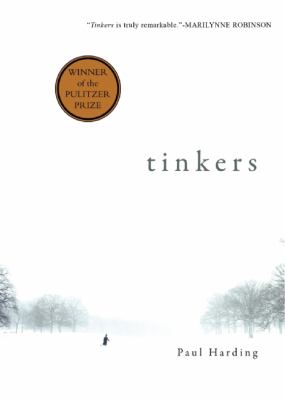 “Tinkers” is a novel about George Washington Crosby, an eighty year old man living in New England. The novel covers the eight last days of his life as well as his reminiscences from when he was a child. As such, this busy, busy novel has not much of a detectable plot.
What is there instead of plot? There are sensory pictures of New England, its slate quarries, its fishing ponds, it quaint rugged little farms, its wildflowers. There is so much homey nostalgic imagery of New England one might have thought this book was written by the New England Tourist Bureau, but even they would have toned it down a little. All the pet horses, cats, and dogs in the book are given cute names like Prince Edward the Horse, Buddy the Dog, and Russell the Cat, and their doings are discussed at length even when they have next to nothing to do with the plot. Perhaps plot is not so important when you are setting the mood, the atmosphere. All of the other characters in the novel besides George, his father Howard, and his grandfather Samuel, are only there to be part of the local color.
There is one moving story in this novel. It is the story of George’s father Howard and his family’s struggle with Howard’s epilepsy. Set inside this crisp, cool, clean New England atmosphere, the severe impact of Howard’s struggle with epilepsy becomes even more affecting.
Howard is a tinker, and carrying on that tradition George fixes clocks in his spare time. There is much about the intricate inner workings, the springs and gears, and pulleys, of a clock. One supposes there is an analogy between when the workings of a clock go wrong and when a person gets epilepsy or some other terrible disease. I don’t find that analogy very convincing, but I’m the world’s worst mechanic.
After this moving story about Howard, we go back a further generation to when Howard himself was a boy and his father Samuel is a minister. Samuel starts to have problems giving his sermons because he is losing his mind. To me, this story struck me as the author going to the same well twice, first with Howard’s epilepsy and then with Samuel’s mental deterioration. I found this second story a pale imitation of the first story.
Since the first line in the novel is “George Washington Crosby began to hallucinate eight days before he died.”, there is no suspense about what happens to George. George is on his deathbed, and “Tinkers” is an exercise in New England nostalgia. George’s own family is only more of the local New England color.
Even though my own opinion of this novel is that it is not that good, I could see how some other readers, especially readers from New England, could love this book.
 Tony's Book World
Posted by Kerry on September 5, 2010 at 2:50 AM
I do believe you have insulated my TBR from this particular book. Thank you.
LikeLike
Posted by anokatony on September 5, 2010 at 2:49 PM
Hi Kerry,
You could read the book to prove me wrong , but there are a lot of books TBR out there. It’s a bit of an awesome responsibility changing someone else’s course of action.
LikeLike
Posted by Mark Kohut on September 5, 2010 at 5:31 PM
I stopped out of Tinkers, feeling at least two howlers…but whether they were there or it was me, I do think the clock repair vs. epilepsy might be an allusion to Descartes who first wrote of a clockwork universe, set in motion by God vs. what a friend of mine once said: Nature never makes a mistake….
Which, of course, is what epilepsy is: A God/Nature mistake…
LikeLike
Posted by anokatony on September 5, 2010 at 6:02 PM
Hi Mark,
Thanks for bringing the Descartes allusion which I wasn’t familiar with. I suppose the moving of the stars and planets are signs of a clockwork universe, but I see Nature constantly making mistakes with storms, earthquakes, etc. and human nature is probably the most mistake-prone of all. And epilepsy is truly a God / nature mistake.
LikeLike
Posted by JoAnn on September 12, 2010 at 4:22 PM
I put this aside after 75 pages… thought the writing was beautiful, but I just wasn’t engaged in any way. May have been a case of right book, wrong time….
LikeLike
Posted by anokatony on September 12, 2010 at 4:54 PM
Hi JoAnn,
I can understand that. If I were not doing a blog entry for “Tinkers”, I may not have completed it either. You’re right that much of the writing is beautiful, lyrical, but to what purpose?
LikeLike