As of This Writing – The Essential Essays (1962 – 2002)
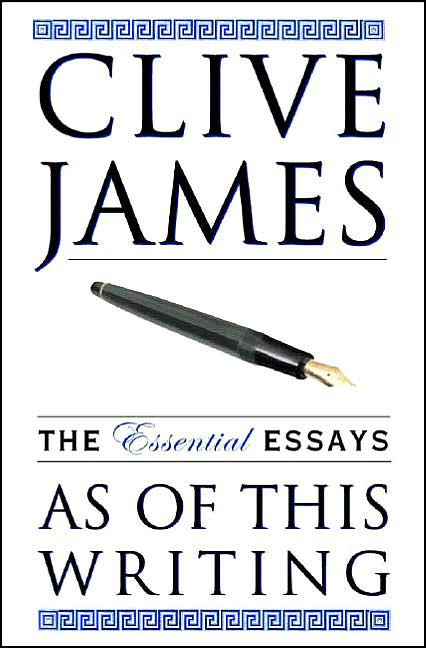 The great majority of my reading is fiction, plays, or poetry, but every once in a while I will encounter a writer whose non-fiction is irresistable. In previous posts, I’ve discussed my admiration for Martin Seymour Smith and Camille Paglia; there are a few others who will be covered in due time. Today I would like to discuss a few essays by the latest non-fiction writer whose work is irresistable, Clive James.
James first won me over with his book and TV series “Fame in the 20th Century”. Last year I put his book of essays “As of this Writing” on my Amazon wish list, and, wonder of wonders, I received the book as a present last Christmas. The three essays I will be discussing were picked out from this book by me using a somewhat random but not too random method.
Theodore Roethke – On his Collected Poems (1968)
I picked out this and the following essay, because lately I’ve been considering reading Theodore Roethke’s poetry. In this essay, James takes the stance that only a few of Roethke’s love poems are good, and that the great majority of his collected poems are just mimicry of his influences such as Auden, Eliot, Dylan Thomas, and Yeats. James ends the essay with :
- “Now that Roethke’s troubled life is over, it is essential that critics who care for what is good in his work should condemn the rest before the whole lot disappears under an avalanche of kindly meant, but effectively cruel, interpretive scholarship.”
James’ reasoning is why I generally avoid poets’ collected poems, and usually read their selected poems instead.
Theodore Roethke – On his Selected Letters (1970)
By the time he wrote this essay, Clive James had progressed to an active dislike of nearly all of Theodore Roethke’s poetry.
- “If this sounds rough, perhaps its best to get the gloves off early. I don’t like much of Roethke’s poetry, and the little of it I do like I don’t like intensely. I like this book of letters scarcely at all. A biography that spills all the beans could well tip the balance towards active loathing.”
James main complaint was that sometimes Roethke would mimic another poet’s work, then send it to that poet to get some praise which Roethke would pass along to his would-be publishers. This is poetry as a career rather than as poetry.
In 1992 which was 22 years after writing this essay, James was still concerned that he may have been too rough on Roethke. James then added a Postscript in which he writes :.
- “Certainly the vocabulary was too harsh: “condemn”, ”contempt”, “loathing” are strong words springing from a weak conception of the critical task, which is not that of a vigilante.”
But he pretty much stood by his original negative verdict on Roethke.
As for me, so much for reading Roethke…
Les Murray and his Master Spirits (1996)
I picked this essay to read, because I admire Les Murray’s verse novel “Fredy Neptune”. In this essay James discusses one of Murray’s anthologies of poetry “FiveFathers”. One of the nice things about this essay is James’ remembrance from Sydney University which Clive James, Les Murray, and Robert Hughes were all attending at the same time.
- “At Sydney University in the 1950s, most of the young poets were men but would haunt the cafeteria of the Women’s Union, Manning House. The reason was simple: in Manning House you could linger over a single coffee cup for hours without getting thrown out, whereas from the Men’s Union ejection followed precipitately upon the first gurgling of the dregs.”
James writes in regard to Les Murray :
- “At his own table in Manning House, Murray always looked as if he was dug in to stay. A boy from the country for whom Sydney was exotic enough…”
James considers Les Murray to be the ideal editor for Australian poetry anthologies because of Murray’s huge interest in Australian poetry. The FiveFathers of this anthology are the following forefathers of Australian poetry : Kenneth Slessor, Roland Robinson, David Campbell, James McAuley, and Frances Webb. For each of these poets, James has his personal remembrances and opinions.
My favorite poem of those that James quotes is from the poet whom James considers the most shallow of these poets, the colonialist dandy David Campbell.
- The cruel girls we loved
Are over forty,
Their subtle daughters
Have stolen their beauty;
And with a blue stare
Of cruel surprise
They mock their anxious mothers
With their mothers’ eyes.
At one point Clive James says as an aside, “in the 1950s we were male chauvinist pigs almost to a man, but none of us were going to argue with poets Gwen Harwood or Judith Wright.” In this essay, as opposed to the other essays, James has a very positive view of Les Murray and Australian poetry.
 Tony's Book World
Posted by enligt O on October 6, 2010 at 5:01 PM
Imorgon smäller det…
I found your entry interesting thus I’ve added a Trackback to it on my weblog :)…
LikeLike
Posted by anokatony on October 6, 2010 at 5:11 PM
Thanks for the TrackBack – much appreciated. I visited your blog, do you have a translate function?
LikeLike