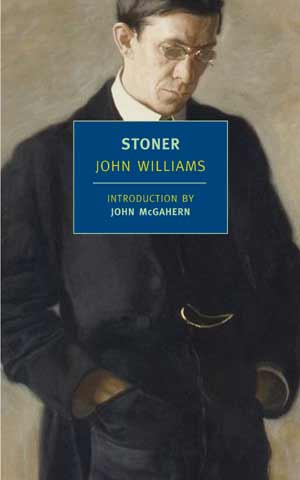
“Stoner” by John Edward Williams (1965) – 274 pages
No novel has been treated with as much reverence and adoration by book reviewers and bloggers during the last three years as “Stoner” by John Edward Williams. Spurred on by an appreciative introduction by the recent master of quiet realism, John McGahern, first the book reviews fell all over themselves calling the novel ‘masterly’, ‘stellar’, ‘a classic’, ‘powerful’. Then the book bloggers got into the act heaping praise on “Stoner”. After all of that acclaim, I just hate, hate to be the one to burst the bubble, to be the fly in the ointment.
The genre of this novel is what I would call “dismal realism”. You are born in pain, you grow old or maybe not, and you die. You somehow escape the hardscrabble family farm into the academic life, only to have almost your entire career destroyed by academic politics which are nearly as harsh and brutal as private company office politics. Along the way, some enchanted evening you meet a stranger across a crowded room, you marry her, and she turns out to be your worst nightmare for forty years. Then you have a family that is irretrievably damaged in the warfare between husband and wife.
Usually when an unhappy marriage is depicted in a novel, it is set up so that either both the husband and the wife share the blame, or the husband is completely to blame. In Stoner’s point of view, it is the wife who is completely to blame by her erratic and willful behavior, while he himself is long-suffering. Yet from the description of the wife in the novel, it is difficult to figure out what is so terrible about her. The same is true of the academic politics in the novel. Stoner does the right thing, so he is severely punished by the evil department chairman. If there were a trace of wit in the novel, these attitudes would be easier to take. However both “Stoner” the novel and Stoner the person are essentially humorless.
Out of the 274 pages of the novel, there are about 20 pages of relative happiness when Stoner has an affair with a younger female colleague. Stoner’s marriage is so miserable, his fooling around seems almost pure and redemptive in comparison. Whereas Stoner’s wife is a disturbing troll whom Stoner somehow tolerates, his young lover is the idealized perfect woman.
It’s hard to imagine that Williams was writing this somber realistic novel at the same time that Phillip Roth was writing his whacked-out “Portnoy’s Complaint”. It was the wild crazy Sixties; no wonder “Stoner” was ignored. Yet there was another realist writing at this same time. That would be Richard Yates. Some of Yates’ novels are at least as dismal as “Stoner”, the main difference being that the male characters in Yates’ novels are usually mostly responsible for their own miseries rather than someone else getting the blame. Somehow I can identify with Yates’ faulty male protagonists more closely than with Stoner. Probably my favorite realist novel of all time is Theodore Drieser’s “An American Tragedy” where the male ‘hero’ pushes his fiancée off his small boat and she drowns, so he can pursue his relationship with a new girlfriend. At least this guy is not too good to be true.
I suppose the point of “Stoner” is that there is glory and beauty in persevering through a miserable pointless life. I’m not sure I want to read about it though.


Posted by Lisa Hill on August 22, 2010 at 7:19 AM
Love this, Tony, I love it when someone ‘bursts the bubble’.
Sometimes a book that’s been widely praised is good, but often it’s just marketing hype.
A review like this – with enough info provided so that I can tell whether it’s the kind of writing I might like or not – is a valuable contribution to the LitBlog scene.
Thanks
Lisa
LikeLike
Posted by anokatony on August 22, 2010 at 3:08 PM
Hi Lisa,
I just read your review of “The Room”, talk about bursting the bubble. My review of “Stoner” was a mash note compared to yours. And thanks for the pingback.
LikeLike
Posted by Lisa Hill on August 23, 2010 at 8:06 AM
*chuckle*
Well, I paid $32.99 for that wretched book Room!
Lisa
LikeLike
Posted by Room, by Emma Donoghue « ANZ LitLovers LitBlog on August 22, 2010 at 8:22 AM
[…] fellow-blogger Tony over at Tony’s Book World has just ‘burst the bubble’ on Stoner by John Edward Williams and I thought as I pondered my reaction to the Booker longlisted and much-hyped Room that I […]
LikeLike
Posted by John Self on August 22, 2010 at 10:09 AM
What I like about your honest review, Tony, is that I agree with pretty much everything you say – even though I was one of the bloggers praising Stoner! But then I have always had a weakness for ‘dismal’ stories, and raced hungrily through Richard Yates’ novels when they were reissued in the UK over the last ten years.
LikeLike
Posted by anokatony on August 22, 2010 at 3:17 PM
Hi John,
I much enjoy reading your reviews, even though I disagree with them once in a while. I am a big fan of Richard Yates myself, having read all he wrote. One point I could have made is that ”dismal realism’ is a classification with nothing to do with the quality of the novel. I’ve loved quite a few books of dismal realism. It was a bit facile of me to use this classification in a negative review.
LikeLike
Posted by kimbofo on August 22, 2010 at 1:31 PM
Hehehe, this made me laugh! You make the book sound utterly terrible with no redemptive qualities whatsoever. I haven’t read the book myself, although I did purchase it recently on the strength of all the recommendations you point out. Perhaps I need to bump it up the queue to see which side of the fence I fall on?
LikeLike
Posted by anokatony on August 22, 2010 at 3:22 PM
Hi Kimbofo.
I even used the word ‘redemptive’ in my description of 20 pages of the novel It was only the other 254 pages I didn’t like. Actually the fact that I conpleted ‘Stoner’ says a lot for it. It’s just that sometimes the underlying attitude of the author bothers me, and that must have happened here.
LikeLike
Posted by KevinfromCanada on August 22, 2010 at 4:19 PM
I came to Stoner through the Wallace Stegner route, well before I was aware of the book blogging world, so there have been other routes (although I would agree that there is a bit of a Stegner, Williams, Maxwell critical “cult” out there). While I can see some comparison with Richard Yates (whom I also very much like), I think Stegner and Maxwell are fairer comparisons, if only because of the geography. I’d be inclined to compare Yates to John Fante — but again would agree that “dismal realism” is not an inaccurate descriptor for any of them. And as a Western Canadian, I would have another set of Prairie references (Vanderhaege, Kroetsch, Mitchell) based more on the geography than the realism.
Finally, my version of your experience with Stoner would be Sinclair Ross’s As for Me and My House, written a quarter century earlier, but set in the Depression a quarter century later. It shows up occasionally as a best Canadian novel and I had as much trouble finishing it as you did Stoner — for much the same reasons.
LikeLike
Posted by anokatony on August 22, 2010 at 4:54 PM
Hi Kevin,
Of the writers you mention, I’m a big fan of William Maxwell, John Fante, Guy Vanderhaege, and Richard Yates, heard a lot about Walllace Stegner but am not very familiar with his work, and don’t know Mitchell, Kroetsch, and Sinclair Ross. I have no problem with the genre of prairie realism, only when an author stacks the deck so it doesn’t seem real to me at all.
LikeLike
Posted by Frisbee on August 25, 2010 at 1:07 AM
True to form, I’ve read John Williams’ Augustus but not Stoner. I enjoyed Augustus: a good historical novel.
Stoner is on my TBR list, but I’ll probably never get around to it. Occasionally I’ve been disillusioned by an
NYBR title–I’ve probably never read anything worse than Elaine Dundy’s The Old Man and Me and was disgusted by a semi-pornographic NYB Italian comic book about Orpheus. Of course this is a problem when one publisher becomes the arbiter of taste.
I love An American Tragedy: the only Dreiser I can stand.
LikeLike
Posted by anokatony on August 25, 2010 at 2:13 AM
Hi Frisbee,
Thanks for your responses. We do disagree on one particular. I’m a big fan of all of Dreiser’s work including his short stories. As far as John Williams, if ‘Augustus’ is about Caesar Augustus, I probably would have liked it better than ‘Stoner’ – I still remember ‘I Claudius’ fondly.. I haven’t read enough NYBR books to have an opinion either way.
LikeLike
Posted by Learn Spanish with Maria Fernandez | barracuda spam appliance on September 3, 2010 at 6:40 PM
[…] “Stoner” by John Edward Williams « Tony's Book World […]
LikeLike
Posted by Leire Kortabarria on May 6, 2012 at 9:15 AM
I came across your review while searching the web for information about John Williams. I have read the book in one day and I am astonished at how such a masterpiece has been so systematically ignored, just as the gifted author who penned it. Needless to say I -respectfully, but firmly- disagree with all you wrote about it. In my opinion, it is a masterfully written portrait of a good man. Stoner is a rare hero in this age, and he reminds us of the inherent value of living by a set of beliefs, of having a passion, of pursuing it to its final consequences.
I encourage everyone to read this exceptional, mesmerizing novel. It is just different, and genuineness breathes through every one of its pages.
(Excuse my English, it isn’t my first language.)
LikeLike
Posted by anokatony on May 6, 2012 at 4:52 PM
Hi Leire Kortabarria,
I read your well-written response above, and agree to disagree. You are definitely in the majority and I am in the minority in our opinions on “Stoner”.It just felt to me that Stoner blamed his problems on everyone except himself.
I agree that the novel was ignored when it came out, because it didn’t match the freewheeling spirit of the Sixties. Maybe a better description of “Stoner” than ‘dismal realism’ would be ‘sober realism’.
I suppose every book has its supporters and its detractors.
LikeLike
Posted by Leire Kortabarria on May 6, 2012 at 6:29 PM
Thanks for your response :)
LikeLike
Posted by Jenna Roberts on December 7, 2012 at 5:01 AM
Sometimes people love a book when they identify with the character all too well. It’s hard to find maturity and personal responsibility even in todays middle aged people. Maybe that’s why so many people love Stoner, because it’s not their problem, right? It’s everyone else… I agree with you, Tony, I can’t stand weak characters. We are responsible for our own happiness. Stoner is a weak character who suffers because of his own choices and acts as if he is a helpless victim of circumstance, and that there is some merit to his unwillingness to change his situation. So he escapes by taking a lover that’s easy to get, because why should he try to better himself? There is no glory in self induced suffering. Thank you for your astute observations, Tony. I can’t see how a cheat who lives a false reality is a hero.
LikeLiked by 1 person
Posted by anokatony on December 7, 2012 at 2:36 PM
Hi Jenna Roberts,
I just re-read this review and the comments with it. You nailed what I found distasteful about the book when you said “Stoner is a weak character who suffers because of his own choices and acts as if he is a helpless victim of circumstance, and that there is some merit to his unwillingness to change his situation.”
It’s always his wife or his colleagues who disappoint him, never himself. It would have been really good if John Williams had written another novel which told the entire story from Stoner’s wife’s point of view. I bet that would be a completely different story. As it is, we get a completely one-sided view.
I’m happy to read your point of view regarding ‘Stoner’.
LikeLike