At first they were called epic poems; now they are likely to be called novels in verse. Usually I find that when a story is told in verse, that provides an extra dimension to the work, an added attraction. The discipline of rhyme causes the author to try harder to find the exact wording to convey their thoughts more precisely, more rhythmically. Kat at mirabile dictu has entirely convinced me to read ‘The Aeneid’ by Virgil, the Robert Fagles translation. In the meantime, these are the novels in verse that I have liked the best.
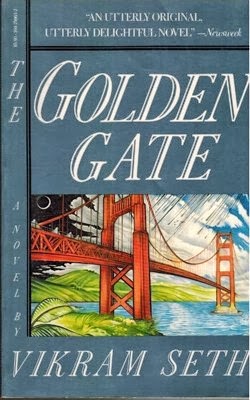
The Golden Gate by Vikram Seth (1986) – This San Francisco story was my first novel in verse, a complete delight. The entire novel is 690 sonnets. I still look back warmly on the humor and style of this book.
- Only her cats provide distraction,
- Twin paradigms of lazy action.
- It’s Friday night. The unfettered city
- Resounds with hedonistic glee
- John holds a cold cast of self pity.
If you appreciate the above, you will enjoy ‘The Golden Gate’.
The Inferno by Dante Aleghieri (1308 – 1321) Translated by Robert Pinsky – A guided tour through the nine circles of hell, all in verse. This epic poem is very readable and enjoyable, even though it is a trip through hell. Someday I’ll read the entire Divine Comedy.
 Autobiography of Red by Anne Carson (1999 ) A story from the Greek myth of Herakles and the monster Geryon. This is an original work by Anne Carson, not a translation. This book is both humorous and moving.
Don Juan by Lord Byron (1819 – 1824) – Most of the poetry of Keats and Shelley just flies over my head, but this satiric epic poem by Lord Byron is very easy to follow and a complete joy.
Fredy Neptune by Les Murray (1998) – an action packed Australian adventure novel in verse. This novel covers so much ground, I won’t try to summarize it.
Eugene Onegin by Alexander Pushkin (1825 – 1932) Translated by Vladimir Nabokov. I came to this book after about covering the rest of 19th century Russian literature. Originally the fact that it was in verse kept me from reading this book. When I finally did read it, the verse only made the book more interesting.
Beowulf (8th to 11th century) translated by Seamus Heaney – Believed to be composed by Anglo-Saxons during the Viking age, our hero fights monsters like Grendel and dragons. Seamus Heaney did a great job re-creating this work.
Ludlow by David Mason (2007) – a true American story in a verse novel. The coal miners of Ludlow, Colorado go on strike in 1914, one of the cruelest, bloodiest chapters in the history of American labor. The verse novel strategy works brilliantly. This book which I only read two years ago makes me long for new verse novels.
 The Oresteia by Aeschylus translated by Ted Hughes (5th century BC) – I’ve read both the Anne Carson version and the Ted Hughes version of the Oresteia, and I loved them both. Since Anne Carson already has a place on my list, I want to also give a place to Ted Hughes who is also a poet I really like.
As you can see, I’ve only come up with nine favorite verse novels. I hope some of you out there can recommend more.
 Tony's Book World
Posted by whisperinggums on May 16, 2010 at 5:05 AM
You’ve read more than I, but I have read and enjoyed two by Geoff Page, The scarring (which I reviewed on my blog a little while ago) and Freehold. The scarring is one of the most gut-wrenching things I’ve read for quite a while – and I think that is as much to do with the impact of the verse as with the story itself. Dorothy Porter has also written some well-received verse novels, The monkey’s mask and Eldorado, but I have yet to read either.
Ludlow sounds interesting, and I’ve been feeling the urge to read Eugene Onegin for a while. Just have to do it!
LikeLike
Posted by anokatony on May 16, 2010 at 7:40 PM
Hi Whisperinggums,
‘The Scarring’ looks very interesting to me. I checked to see if they had it in our local libraries, and the only book of Geoff Page they had was a book of poetry called “Smalltown Memorials’. I might order it on-line. ‘Ludlow’ is excellent.
LikeLike
Posted by whisperinggums on May 16, 2010 at 11:28 PM
Let me know if you have problems … I could probably find it here. The title poem of that book you found is one of his more anthologised poems, but I’d go for the verse novel.
LikeLike
Posted by Mad Housewife on May 16, 2010 at 9:44 PM
I’ve read some of these and of course like the plug for The Aeneid!
i love Dante. The Divine Comedy is my favorite poem. I read it over and over instead of going for something new. I’ve also got this big Dover volume of The Dore Illustrations for Dante’s Divine Comedy.
I haven’t read any of the contemporary stuff, though, and have never even heard of Fredy Neptune. I’ll have to try to read one for the summer. It’s good to break out of my “mold.”
LikeLike
Posted by anokatony on May 17, 2010 at 1:18 AM
Hi Mad Housewife,
I want to read the entire Divine Comedy. Somehow I came across Pinsky’s copy of ‘The Inferno’ and am at somewhat of a loss for the other two parts. I hope there are more new novels in verse coming out. I’ve got my name on the list for Adam Foulds’ ‘The Quickening Maze’ which is a novel in verse nominated for the Booker. I wish Phillip Larkin had attempted to write a novel in verse instead of the novels he did write that weren’t that good.
LikeLike
Posted by academama on June 2, 2010 at 12:32 PM
I love Nabokov’s “Pale Fire”–a modern takeoff on the verse epic. It’s one of the funniest and most poignant things I’ve ever read.
LikeLike
Posted by anokatony on June 2, 2010 at 3:41 PM
I have read “Pale Fire”, loved it. It’s definitely my favorite Nabokov, although I love a lot of his books, not so much “Lolita”. I don’t remember “Pale Fire” being in verse though. “Pale Fire” should also be on my humorous list.
LikeLike