Archive for April, 2010

Oxymoron or Paradox ?

Deep down, he’s shallow.
Anonymous

Oxymoron or Paradox?  Here are the two definitions. Dictionary.com defines an oxymoron as “a figure of speech by which a locution produces an incongruous, seemingly self-contradictory effect, as in ‘cruel kindness’ or ‘to make haste slowly’.” It defines paradox as “a statement or proposition that seems self-contradictory or absurd but in reality expresses a possible truth”.  From what I get from these definitiions, an oxymoron is a phrase while a paradox is a sentence.   The following seem more like paradoxes to me, but they all are from a compilation book called “Oxymoronica” by Dr. Mardy Grothe. There are hundreds more of these oxymorons / paradoxes in the book.

Two from the master.

    I can resist everything but temptation.

      Oscar Wilde

    I love acting. It is so much more real than life.

      Oscar Wilde

Now one from my favorite movie director

Don’t be too clever for an audience. Make it obvious. Make the subtleties obvious also.
Billy Wilder

And one from my favorite actress

Just be truthful – If you can fake that, you’ve got it made.
Barbara Stanwyck

Another from a great comedienne.

Comedy is tragedy plus time.
Carol Burnett

Here are some ancient paradoxes.

    Please all, and you will please none.
    Aesop – 6th century BC
    It is a profitable thing, if one is wise, to seem foolish.
    Aeschylus – 5 th century BC
    Nothing is permanent, except change.
    Heraclitus – 4th century BC
    Woe unto you, when all men shall speak well of you.
    The Bible – Luke 6:26
    As a rule, what is out of sight disturbs men’s minds more seriously than what they see.
    Julius Ceasar – 1st century AD
    Real knowledge is to know the extent of one’s ignorance.
    Confucious – 6th century BC

Here are some oxymoronic insults.

    I learned an awful lot from him by doing the opposite.
    Howard Hawkes on Cecil B. De Mille
    He’s the kind of guy that can brighten a room by leaving it.
    Milton Berle

A couple literary oxymorons.

    The only way to not think about money is to have a great deal of it.
    Edith Wharton – ‘The House of Mirth’
    She usually liked everyone most when they weren’t there.
    Elizabeth Von Arnim – ‘’The Enchanted April’

Finally, a line we all can use in our reviews

    If it were better, it wouldn’t be as good.
    Brendan Gill
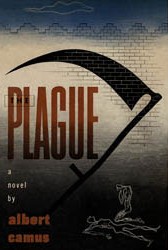
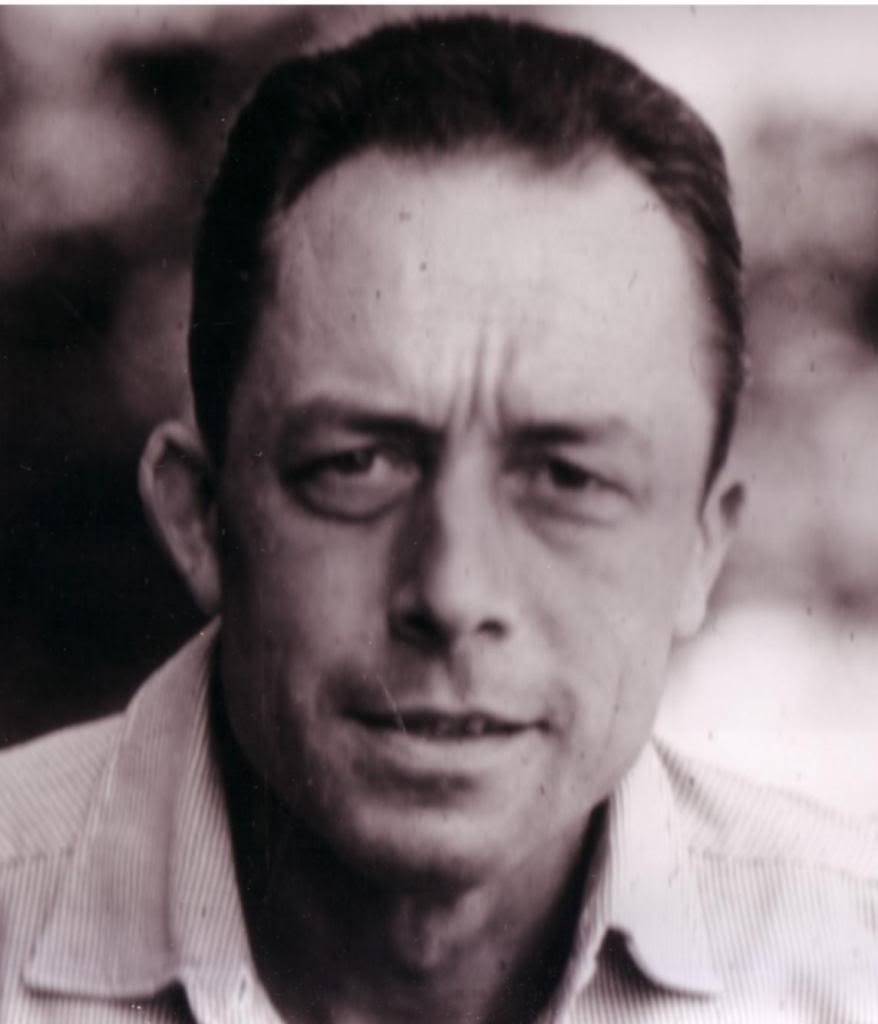
“The Plague” by Albert Camus

“The Plague” by Albert Camus (1948) Translated by Stuart Gilbert

In “The Plague” by Albert Camus, first the rats start dying in Oran, Algeria.  Dead rats are everywhere, in the streets, on doorsteps, in basements.  Then the rats stop dying, and everyone breathes a sigh of relief, only to find that soon some of the people start to die in similar fashion.

Earlier this year, I read Camus’ ‘The Fall’ which impressed me with its deep philosophy, dramatic dialogue, and the vivid character at the center of the story.  Thus I was keen to read another Camus novel.  I decided to read ‘The Plague’.

    “They would plunge together into the dark crowds filling the streets at nightfall; how they mingled, shoulder to shoulder, in the black-and-white moving mass lit here and there by the fitful gleam of a street-lamp; and how they let themselves be swept along with the human herd toward resorts of pleasure whose companionable warmth seemed a safeguard from the plague’s cold breath.”

‘The Plague’ is a much different type of novel from ‘The Fall’.  The style of ‘The Plague’ struck me as very much like reportage, the bare stating of the facts.  It did not strike me at all as a philosophical novel.  I note that some reviewers thought the plague in this book was an allegory for fascism, but I didn’t find any indication of that whatsoever.  I’d be happy if someone explained to me how this novel is an allegory, but as far as I could see, the plague in this book was just the plague.  Besides, all the rats in this book die at the beginning, while the Nazi rats didn’t die until the war’s end.

I found much of the novel dismal and bleak.  You might  ask how anyone could find a story about thousands of people dying a hideous, disfiguring, horrible, and painful death dreary and depressing, but I did.

Parts of the novel were moving.  There is the good doctor Rieux who tirelessly devotes himself to caring for the plague victims, the young man Rambert whose only goal is to get out of the city and back to his girl friend, the priest Father Paneloux who sees the plague as God’s punishment for the people’s misbehavior until his own son is stricken.  As I wrote this last sentence these characters seemed more vivid than they seemed while I read the novel, so maybe this is one of those books that grows on you as you think about it over time.

In ‘The Plague’, they quarantine the entire city of Oran by putting armed sentries at the city gates.  A major plot issue is people who are stuck in the city who would do anything to get out.  In most cities today, there would be no way to impose any sort of quarantine to keep people from leaving, because there are just too many ways out of town.

I much preferred ‘The Fall’ over ‘The Plague’.  In ‘The Fall’, I was completely involved in the story all the way.  In ‘The Plague’, I felt detached from the story, so that it seemed more like news reporting than personally involving for me.  There were many reviews of this novel on the Internet, most praising it highly.   Only a few found the novel less than wonderful.  For me, the last section, Section 5, was very good, but there were many stretches before that which I found less than compelling.

Cheesy Americana

‘The Mammoth Cheese’ by Sheri Holman  (2003)

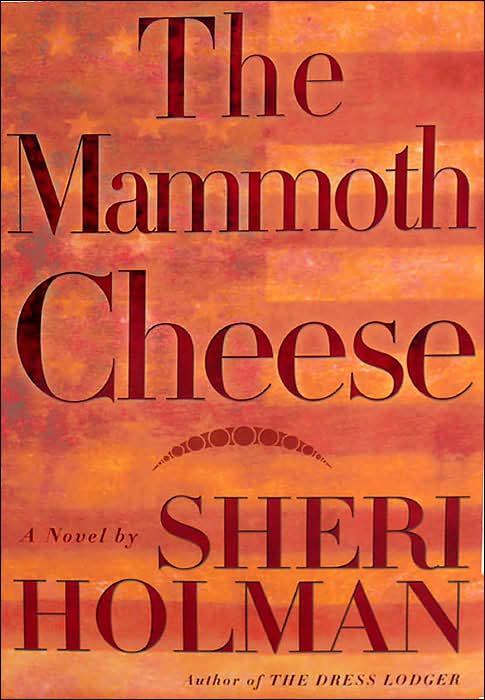
I have read on the Internet a couple of paeans to the ugliness of the cover of the novel ‘The Mammoth Cheese’ by Sheri Holman.  On the cover, we have a United States flag encrusted with cheese so that the stars and stripes barely show through the cheese.  Given the ugliness of the cover as well as the Young Adult sounding title, I think more than a few readers may have stayed away from this novel.

But ‘The Mammoth Cheese’ is not without its supporters.  It was on the 2005 shortlist for the Orange Prize. 

A few years back, I read Sheri Holman’s ‘The Dress Lodger’ which was one of my favorite novels I read that year.  ‘The Dress Lodger’ is an historical novel taking place in a cholera-stricken town in England during the 1830s.  Now, seven years after its publication, I’ve finally gotten to Sheri Holman’s next novel, ‘The Mammoth Cheese’.

This time out, Sheri Holman goes the modern United States realistic fiction route.  This is Anne Tyler territory.  It takes place in a small town in Virginia, Sheri Holman’s birthplace, not far from Tyler’s Maryland.  Here we have a modern American family with the enterprising mother, the drunk ex-husband, the possible boyfriend who helps on the farm and is secretly in love with her, and the hapless growing up daughter.  As friends of the family, we have the homespun but wise Episcopal priest and his adoring homebody wife as well as a bunch of other gawky neighbors.

Sheri Holman is somewhat edgier than Anne Tyler.  One of the plot lines in ‘The Mammoth Cheese’ deals with the 8th grader daughter getting inappropriately involved with her 33-year old teacher.

The characters in this novel seemed too familiar and stereotypical to me.  They all fit together a little too neatly into the tapestry of the novel, leaving out what mystery there might have been.  For me, the most annoying characters were the homespun Episcopal priest and his homebody wife and their Jefferson-imitating son.  There ought to be a law banning walking cliches from novels.  In other words, the good characters (the minister’s family, etc), are too good, and the bad characters (the school teacher and the ex-husband) are too bad.   

Before I mentioned Anne Tyler.  Even though Tyler’s stories are even less provocative than this one, Tyler’s characters are more mysterious.  You get the sense that Tyler’s main characters are too odd to fit in at all in their neighborhoods, yet by the end you appreciate their uniqueness and dignity.  In ‘The Mammoth Cheese’, a short phrase can wrap up each character, and there’s nothing more to say about them.       

There is a political component to the story, because Margaret, the mother in the family, is making the mammoth cheese which they are hauling to Washington to show her support for the guy she helped elect to be President who has vowed to save family farms.  Her possible boyfriend in the novel likes to dress up and speak as Thomas Jefferson, so there are a lot of references to Jeffersonian ideals. In the United States, the time is right for a strong political satire that would get to the root of the severe problems of the new century, and I hope there is someone out there courageous and talented enough to write that book.   This novel is not it, but rather this novel is a small town romance and tragedy with a sprinkle of politics thrown in for good measure.

The novel did hold my interest throughout, and Sheri Holman is a talented writer.  I would have appreciated a deeper more profound insight into the people of a small town in the United States today.

“My novels point out that the world consists entirely of exceptions.” – Joyce Cary

“Herself Surprised” by Joyce Cary (1941)

Newest Cover

In “Herself Surprised”, Irish author Joyce Cary performs a high-wire act.  The entire novel is narrated by Sara Monday, a lively high-spirited maid.  I suppose it would be easier for a man to write a novel in a woman’s voice if the woman were perfect (a Madonna) in every way.  Sara Monday is by no means perfect.  In Sara’s own words, “I too was one of those who can put their conscience to  sleep when they like, just to please themselves.”  Thus Sara gets involved with a series of men throughout the novel, sometimes marrying them, sometimes not, sometimes on the side.

“But since Mr. Hickson had flirted so with me once, touching me, he had to do it again.  And this is the great difficulty for a woman.  How to put an uppish kind of man into his place without hurting him more than he deserves.  For after all, it was no great crime in Mr. Hickson to be a man and like me as a woman.  Or if it was so, then providence must answer for our shapes.”

Maybe now is the time to discuss the author Joyce Cary’s strategy.  ‘Herself Surpirsed’ is the first novel in Joyce Cary’s ‘First Trilogy’.  His idea was to take three people who knew each other well and have each one narrate their own novel.  In their own novel, perhaps the narrator won’t be completely truthful about their own behavior or they might minimize the extent of the problems caused by their behavior.  But by reading another novel narrated by someone close to them, we get a fuller picture.  Thus after reading all three novels we will have a full picture of all three people, faults and all.  Joyce Cary called this a “three-dimensional’ approach to novel writing.

I think this ‘three dimensional’ approach is very valid.  How many times have we read a novel where the narrator seems almost too good to be true, because we do not see this person as others see them but only through their own eyes with their own self-justifications for everything they do?

Not being a woman myself, I’m not the person to judge whether or not Joyce Cary captures a woman’s essence and being in Sara Monday.  Sara Monday has lots of faults not only with men but in her work as a maid where she sometimes steals stuff from the houses and sells it at pawn shops.  But I can say on Sara Monday’s behalf that one would be hard-pressed finding someone more likeable and appealing than Sara Monday.  Sara Monday says about one of her friends,

“Love was the source of all the trouble in the world, and she wished God had left Adam and Eve plain and not stuck the odd bits on them.”

Sara Monday has her own way of putting things.   She also has profound insights into the man and woman situation :

Original Paperback Cover

“Then we said no more for some time, and I saw that I had talked too much and abused him too much.  For to abuse a man is a lover-like thing and gives him rights, which Jimson felt very well.”

Will I read the other two books in the trilogy?  Yes, for sure, after some time spent recovering from and thinking about “Herself Surprised”. I will end with one more quote from Sara Monday.

“We were young together and did not know how to relish the sweet joys of only walking and talking and looking about us, and eating and sleeping in amity and kindness.”

The Fernando Pessoa Way of Looking at Things

Four Short Poems by Fernando Pessoa

Here are four short poems by Fernando Pessoa, one of  my favorite intelligent fellows.  Fernando Pessoa (1888 – 1935) was a poet from Lisbon, Portugal who besides writing many brilliant poems, wrote “The Book of Disquietude” which has been described as “a factless autobiography” and is one of the landmarks of the twentieth century.  It might be a good idea to approach Fernando Pessoa with some care rather than jumping into “The Book of Disquietude”.  Besides reading his short poems, another approach to Pessoa is to read Jose Saramago’s novel ‘The Year of the Death of Ricardo Reis’ which led me to become a full-scale Fernando Pessoa addict.


.

This Morning I Went Out Very Early

    This morning I went out very early,
    Because I woke up even earlier
    And had nothing I wanted to do.
    I didn’t know which way to go,
    But the wind blew hard to one side,
    And I followed in the way it pushed me.
    So has my life always been, and so would I like it always to be –
    I go where the wind takes me and don’t need to think.

.
.
.

I Lie Down in the Grass

    I lie down in the grass
    And forget all I was taught.
    What I was taught never made me any warmer or cooler.
    What I was told exists never changed the shape of a thing.
    What I was made to see never touched my eyes.
    What was pointed out to me was never there: only what was there  was there.

.

.

To See the Fields and the River

    To see the fields and the river
    It isn’t enough to open the window.
    To see the trees and the flowers
    It isn’t enough not to be blind.
    It is also necessary to have no philosophy.
    With philosophy, there are no trees, just ideas.
    There is only each one of us, like a cave.
    There is only a shut window, and the whole world outside,
    And a dream of what could be seen if the window were opened,
    Which is never what is seen when the window is opened.

.

.

Your Eyes Go Sad

    Your eyes go sad. You’re not
    Listening to what I say.
    They doze, dream, fade out.
    Not listening. I talk away.
    I tell what I’ve told, out of listless
    Sadness, so often before…
    I think you never listened,
    So you’re away you are.
    All of a sudden, an absent
    Stare, you look at me, still
    Immeasurably distant,
    You begin a smile.
    I go on talking
    You go on listening – your own
    Thoughts you listen to,
    The smile as good as gone,
    Until, through the loafing
    Afternoon’s waste of while,
    The silence self-unleafing
    Of your useless smile.
 

‘Ransom’ by David Malouf

‘Ransom’ by David Malouf

The novels of David Malouf  have ranged from recent historical Australian settings as in ‘The Great World’ and ‘Harland’s Half Acre’ to ancient Rome at the time of Ovid in ‘An Imaginary Life’. In his latest novel ‘Ransom’, David Malouf takes us back to the time of Achilles, Hector, King Priam and the Trojan War.   It is a simple story.

It is the last year of the Trojan War, the year of the heaviest fighting.  Hector, the son of King Priam of Troy, kills Petroclus, the childhood friend of Greek soldier Achilles.  In revenge, Achilles seeks Hector out and kills him in a fight.  Achilles is so angry about the murder of his friend Petroclus that he ropes Hector’s body to his horse and drags his body back and forth through the streets of Troy for twelve days in a row.  In Troy, King Priam mourns for his son and only wants to give him a decent burial.  So he puts together a king’s ransom of gold and other precious metals to take to Achilles to get Hector’s body back.  Priam figures if he goes not as a king but as one plain man to another, Achilles will relent and give him the body.  Priam hires an ordinary cart driver, Somax, to be his driver for this arduous trip.

King Priam has fifty sons, many of them killed during the Trojan War.  Being king, he has been quite remote from his children, leaving the bringing up of the children to other people.  The cart driver Somax had seven sons, all of them dead by the time of this story.  Somax, being a poor man, has been close to all his children, and now his own children are gone, he takes delight in his only surviving grandchild, a lively crippled four year old girl.  Somax is the kind of person who takes pleasure in all of life, whereas King Priam is a more reserved figure.   Somax with his humor and good nature lightens the tone of this novel.

Stories that go all the way back to the Greek myths and the Trojan War strike me as eternal.  These are our first known stories, and they contain our earliest surviving ideas on what it means to be human. The Greek myths contain so many facets of life within them that even today many writers can create stories around them.  Besides David Malouf, Barry Unsworth and Michel Tournier have written novels based on the Greek myths.   Anne Carson of Canada has done a fine job translating and interpreting for a modern audience the plays of Euripides, Aeschylus, and Sophocles which are based on Greek myths.  Also a few decades ago, Mary Renault and Robert Graves produced some excellent novels using the Greek myths as their starting point.

The writing in ‘Ransom’ is never less than clear, lucid, and lyrical.  Although this is a quite short novel, it covers a lot of territory.  Two of the three main characters in the novel are old men.  Both King Priam and Somax have seen at least their share of troubles, and it is moving to see the interaction between these two men who are so different, one a king and one a cart-driver.  In this respect, ‘Ransom’ is an old person’s novel, necessarily somber,as these two men come to terms and share their common grief over the deaths of their sons.

There is room for so much of human life within the stories contained in the Greek myths.  Can you name other modern or recent novels based on the Greek myths?

The Trojan War, Homer, and the Beginnings of Literature

It all started about thirty two hundred years ago with a quarrel between the goddesses Athena, Hera, and Aphrodite.  The goddess of strife and discord, Eris, wanted to give one of  these three goddesses a golden apple meant for “the fairest”.  The three goddesses couldn’t agree on who was the fairest, so they went to Zeus.  Zeus sent the goddesses to Paris who was the son of Priam, the King of Troy.   Each of the goddesses offered Paris a reward for picking her to be “the fairest”.  Athena offered to make Paris a great general and hero.  Hera offered to make Paris a ruler of a rich and powerful kingdom.  Aphrodite offered Paris the most beautiful woman in the world in marriage. Paris decided that Aphrodite was “the fairest” and should receive the golden apple.  Aphrodite in return caused one of Zeus’ many, many daughters Helen of Sparta, the most beautiful woman in the world, to fall in love with Paris who then brought her to Troy. The trouble was that Helen at the time was married to Menelaus, king of the Greek city state of Sparta.  Agamemnon, Menelaus’ brother and king of Mycenae, then led a huge expedition of Greek ships to Troy to reclaim Helen for his brother.  Thus Helen of Troy was the “face that launched a thousand ships”.

The Greek forces’ first expedition led by Agamemnon to Troy was scattered by a severe storm before it reached Troy, and it took the forces eight years to re-gather.  After that the Greek forces besieged Troy for nine years, culminating in the ploy of the hollow wooden Trojan horse filled with Greek Soldiers.  After the Greeks entered Troy, they perpetrated a massacre of Troy’s sleeping population and the burning of the city.

After the archaeological discovery of the remains of Troy in 1867, many historians now believe there was an actual Trojan War between the Greeks and Troy.  But the story of the Trojan War is now inextricably tied up in myth and legends of the gods.

There was a strong tradition of oral poetry in Greece, and after the Trojan War, it was only natural to place the events of the Trojan War into these oral poems.  These oral poems were passed down from generation to generation.  No one knows if Homer was a real person or a composite of oral poets.  At some point some of these oral poems got written down into what we now call ‘The Iliad’ and ‘The Odyssey’ which are attributed to someone we call Homer.  Some scholars see the name Homer as meaning ‘he who fits the songs together’.   Many scholars believe ‘The Iliad’ and ‘The Odyssey’ did not become fixed texts until six centuries after the Trojan War was supposed to have taken place.  Besides ‘The Iliad’ and ‘The Odyssey’, there is an entire Epic Cycle of poems about the Greek gods and the Trojan War that got written down between the 8th and 6th century BC.  These are the sources for all of the stories that make up Greek myths.

The great Greek dramatists of the 4th century BC, Aeschylus, Sophocles, Aristophanes, and Euripides, built many of their finest plays around these Greek myths.  Greek mythology later became the basis for Roman mythology.

In 1930, Edith Hamilton, an author from the United States, wrote ‘The Greek Way’ which was her earliest expression of her belief in “the calm lucidity of the Greek mind” and ‘that the great thinkers of Athens were unsurpassed in their mastery of truth and enlightenment’.  In 1942 she wrote ‘Mythology: Timeless Tales of Gods and Heroes’ which is now the standard source for the Greek myths.  King Paul of Greece awarded Edith Hamilton the Golden Cross of the Order of Benefaction, making her an honorary citizen of Athens, even though she had never been to Greece before.  Edith Hamilton travelled to Athens to accept the award in a theatre where nodding to the applause, she said, “I am an Athenian citizen! I am an Athenian citizen! This is the proudest moment in all my life.”

‘The Ask’ by Sam Lipsyte

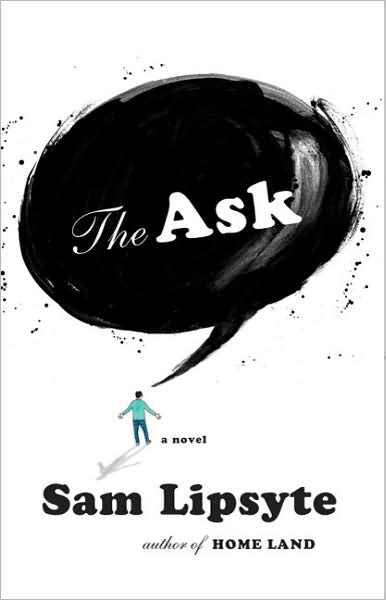
‘The Ask’ by Sam Lipsyte

Things I learned from “The Ask” by Sam Lipsyte

How to politely call someone an idiot

    “You’re like an idiot savant without the savant part.”

A theory on the inevitability of time

    “Time goes by,” said Purdy.
    “Having no alternative.”

Some helpful motherly advice.

    “It’s when they stop trying to destroy you, my mother once said, that you really should worry.”

A new definition of a ‘Change Agent’

    “A change agent brings in the loose change of the rich folks.”

A great tee shirt slogan

    “Thanks for not sharing”

‘The Ask’ by Sam Lipsyte is a novel in the grand tradition of slob fiction and black humor of such books as ‘The Confederacy of Dunces’ and ‘The Good Soldier Schweik’.  Our hero in this novel, Milo Burke, works for a New York University (affectionately called Mediocre U) raising money.  ‘The Ask’ is the newspeak his group uses for asking someone to contribute money to the University.  ‘The Give’ is when the person who has been asked for a contribution actually donates money to the University.

Early on, Milo Burke loses his job by mouthing off to the daughter of a potential donor after he loses his temper.   I think the author missed a huge opportunity when the narrator says , “What I said to MacKenzie , there is no point in repeating”.  There is a point in repeating what Milo Burke said to this woman. This could have been a memorable humorous scene considering what Lipsyte is capable of.  It could have been the high point of the novel.  Why did Lipsyte just let it slide by?

Thus the novel deals with the contemporary issue of unemployment and the United States economic miseries, and later on it deals with the after-effects of the United States’ continuing wars.  These issues are treated with black humor, and ‘The Ask’ is a quite humorous novel.

Nearly all of the characters in ‘The Ask’ are cynical, coarse, bitter, and sarcastic with our hero Milo Burke being the most cynical, coarse, bitter, and sarcastic of all.  Milo Burke is all of these things except in regard to his four year old son Bernie and sometimes his wife Maura.  Even Bernie is pretty cynical.  The novel could have used a straight man or woman, someone who is not cynical, coarse, bitter, and sarcastic, someone for the rest of the characters to play off of.  As it was it was difficult to keep track of all the characters, because they all sounded pretty much the same.  If I put the book down and picked it up later, it was difficult to tell which character was talking, because they all sounded so similar.  The same was kind of true of the plot also.  One wild and crazy event followed after another.  If there had been somewhat reasonable events that occurred between these wild and crazy events, we’d appreciate the wild and crazy events even more.  As it was, the action seemed rather frenetic.

I’d like to see Sam Lipsyte write a novel with just a few characters, perhaps five or so, each character sharply defined and with his or her own distinctive way of talking.  I would want the main character or narrator to be a straight man or woman so we would see the wild antics of the other characters through that calm main person’s eyes.


One Reason Why I’m Not A Poet – ‘This Be the Verse’

‘This Be the Verse’ by Philip Larkin

This poem by Philip Larkin is probably as famous by now as Robert Frost’s classic poems “Stopping by the Woods on a Snowy Evening” and “The Road Not Taken”, but it hasn’t been widely anthologized in high school poetry collections. 

.

.

.

.

                     This Be The Verse

They fuck you up, your mum and dad.
  They may not mean to, but they do.
They fill you with the faults they had
  And add some extra, just for you.

But they were fucked up in their turn
  By fools in old-style hats and coats,
Who half the time were soppy-stern
  And half at one another's throats.

Man hands on misery to man.
  It deepens like a coastal shelf.
Get out as early as you can,
  And don't have any kids yourself.

                                                 Philip Larkin                                                                                          ‘

How could I possibly say it better than Larkin does in this poem?