“To the Lighthouse” by Virginia Woolf
I approached “To the Lighthouse” and Virginia Woolf with much trepidation, having put off reading this book for many years. “Mrs. Dalloway” I read a long time ago and did not get into it much at the time. Then I read some critic complaining of the difficulty of following Woolf’s stream of consciousness technique. I needed no further excuses to avoid reading this book. But, now, spurred on by high praise for “To the Lighthouse” by Hungry Like the Woolf and others, I decided it was high time I read this book.
I am happy to report that I was able to completely get into the spirit and rhythm of “To the Lighthouse”, and enjoyed it immensely. I had to re-read the first thirty pages, but this re-reading allowed me to read the entire novel with enjoyment.
 The novel is about Mr. and Mrs. Ramsay, their eight children, and their several houseguests staying at the Ramsay summer place in the Isle of Skye that is in the Hebrides Islands which are located north and west of Scotland. The first section of the novel, ‘The Window’, is about one idyllic summer day before World War I. Cars were still a rarity, and there were no radios or TVs. The entertainments are going for walks or strolls, fishing or swimming in the plentiful waters, painting, or reading. Mr. Ramsay is an esteemed academic who somewhat enjoys throwing cold water on his family’s plans to visit the lighthouse the next day by accurately pointing out the impending storm. But the real center of the family is Mrs. Ramsay, mother incarnate. A good mother, she is continually thinking about all eight of her children, most especially the youngest, James and Cam. She is always encouraging others to marry and have families so they can be as happy as she is with her family. Mrs. Ramsay can encourage a young man, just by looking at him a certain way, to propose to the young woman he’s been talking to and walking with. . Everyone is enchanted with Mrs. Ramsay’s beauty, and the young woman houseguest, Lily Briscoe, is trying to capture Mrs. Ramsay’s essence in a painting. The painting is not a realistic representation; it consists of blocks of color, of light, of darkness.
The summer idyll of the first section culminates in a spectacular family dinner, where we the readers are gracefully transported into the minds of each family member and all of the houseguests by Woolf’s stream of consciousness technique. It is a technique she uses to help the readers to get deeper into all of the characters’ mindsets at the same time. Here is a quote from “To the Lighthouse” which sums up the stream of consciousness technique.
- “At any rate they (the dinner guests) were off again. Now she need not listen. It could not last, she knew, but at the moment her thoughts were so clear that they seemed to go around the table unveiling each of these people, and their thoughts and their feelings, without effort like a light stealing under water so that it ripples and the reeds in it and the minnows balancing themselves, and the sudden silent trout are all lit up hanging, trembling.”
But all idylls end, and in section two ‘Time Passes’ the Ramsays can no longer visit their summer place, because World War I intrudes. For several years, the summer house is empty except for the old housekeeper who tries to maintain the large house as best she can. Some of the Ramsay family members don’t make it to the third section of the novel, because they pass away due to various causes.
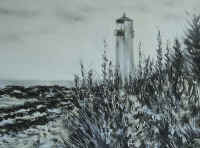 Finally in the last section, ‘The Lighthouse’, which takes place nearly ten years after that first day, some of the remnants of the family finally make it to the lighthouse. Lily Briscoe has returned to the Ramsay summer place to finish the painting she started ten years ago. But all has changed; the idyll is over.
Somewhere I recently read that “To the Lighthouse” is not really a novel; it is more of a prose poem. That may be true, but what a transcendent prose poem it is. I’m quite sure ‘Novel’ is happy to have “To the Lighthouse” in its fold.


Posted by Kerry on January 31, 2010 at 2:03 AM
Tony,
Thanks for the plug. I am very happy you enjoyed it. Your thorough and insightful review makes me want to go read it again. I have Mrs. Dalloway on tap for this year, but may re-acquaint myself with this one too.
Mostly, I am please that you had a very good experience with it. This is one of those books I want everyone to love, as unrealistic as that probably is.
As always, great review.
Kerry
LikeLike
Posted by anokatony on January 31, 2010 at 4:07 PM
Hi Kerry,
When I was writing this post, I looked in your category selection for Virginia Woolf, but she wasn’t listed. Sometime you must write a Virginia Woolf post, because probably many people who go to Hungry Like the Woolf probably are looking for that.
I think with a writer like Virginia Woolf it’s necessary to not be over-influenced by preconceptions and instead take the book at face value. I could have easily convinced myself beforehand that I wasn’t going to like ‘To the Lighthouse’. Fortunately that did not happen.
LikeLike
Posted by whisperinggums on January 31, 2010 at 4:26 PM
LOL I did, straight after reading your post, because of your comment re HLW’s praise…!
LikeLike
Posted by whisperinggums on January 31, 2010 at 10:08 AM
LOL Tony, I like your conclusion. I’ve read this book twice, once in my 20s and again a few years ago. Loved it both times. She’s in wonderful control of a whole range of literary techniques so that the style matches the meaning. The book explores the complexity of life and of human relationships – and the style epitomises this. There’s repetition (and what life/relationships aren’t full of repetition), flowing rhythms and jerky rhythms (and what – well, you know what I’m going to say!). Yet, this ‘stylised’ style never gets boring does it – it’s not so controlled that it becomes dry and mechanistic. Prose poem is probably a good description – but that doesn’t mean it’s not a novel too does it!
LikeLike
Posted by anokatony on January 31, 2010 at 4:27 PM
Hi Whisperinggums,
Yes, ‘To the Lighthouse’ is one of those novels to come back to again to get a fuller meaning. I like the phrase ‘the style matches the meaning’. I sensed that several times during the novel.
Two things I didn’t discuss are the relationship between men and women in the novel and the differences between Mrs. Ramsay’s attitudes versus Lily Briscoe’s attitudes. According to other sources, ‘To the Lighthouse’ is based on Virginia Woolf’s own childhood experiences. Some critics claim that Virginia Woolf is actually Lily Briscoe in this novel.
As always, I enjoy your responses to these posts.
LikeLike
Posted by Derek McCrea on September 5, 2010 at 12:45 PM
Amazing story and it sounds like an amazing read.
LikeLike