Grief Lessons – Four Plays by Euripides
Translated by Anne Carson
As far as we know, the beginnings of literature were the classical Greek dramas from about 2500 years ago. The first famous Greek playwright whose work has survived was Aeschylus, followed by Sophocles, then Euripides. Euripides competed in 22 of the annual Athenian dramatic competitions and won the competition five times. I suppose these dramatic competitions were the classical Greek equivalent of the Booker, and like the Booker, not only Greeks were allowed to compete. Euripides was from northern Africa. Although Euripides wrote many, many plays, only 19 of his plays have survived.
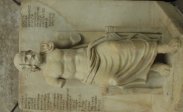 In these classical Greek plays all the many gods have super-human powers, but have the same emotions, the same passions, the same lusts and jealousies as humans, frequently with disastrous consequences for the humans. These gods frequently take the human shape and form. Also there are the humans, and finally there are those who are a mixture of both, being offspring of both a god and a human. These part humans / part gods are the most interesting and tragic ones of all. They have some super-human powers but have all the weaknesses of people.
Theseus : “My advice is endure it. No mortal is untouched by changes of luck, no god either – if poets tell the truth. Don’t gods sleep in one another’s beds? Don’t they throw their fathers into chains and take their power? But all the same they occupy Olympos, they hold on, criminals or not. Will you protest your fate, when gods do not? Leave Thebes then, follow me to Athens.”
The preceding is from Euripides’ play “Herakles” as translated by Anne Carson. The tone is straightforward, clear as a bell, and easy to follow. Anne Carson translating classical Greek is one of those select group of reliable translators including Gregory Rabassa for Spanish, Richard Wilbur for French, Constance Garnet and David Magarshack and Pevear / Volokhonsky for Russian, and Michael Hoffman for German. These translators always select strong works of literature to translate and then get the tone and the story exactly right. I have read many classical Greek plays translated by Anne Carson, and have enjoyed them very much. Anne Carson is also an excellent poet of her own work, including “An Autobiography of Red- A Novel in Verse”. Usually I don’t read most prefaces to works of literature, but Anne Carson’s I do, high praise indeed.
In these Euripides plays, there is the eternal question “Why does God or the gods let terrible things happen to good people?” Perhaps because the Greek gods intermingle with the people so freely and take human form, they probably lead to more dramatic possibilities than the ones in our own religions. That may be one of the reasons that these Greek plays are a high point of world literature. The only works comparable are Shakespeare’s plays. Each of these plays take about an hour to read.
Classical Greece was a high point of literature, yet I have found little from the Roman Empire to compare. I’ve read Virgil’s Aenead and the Satyricon, yet found these works wanting as drama. Can anyone name a work from the Roman empire that they treasure as literature?


Posted by Kerry on October 5, 2009 at 4:48 PM
Great review and makes me want to read Anne Carson translations. I am woefully underread when it comes to Classical Greek literature. You have provided a spur to remedy that. Thanks.
LikeLike
Posted by anokatony on October 5, 2009 at 5:35 PM
Kerry, yes, Anne Carson is special. I found out on Wikipedia she is from Canada. Her translations of these Greek plays make them live and breathe. I remember liking “Autobiography of Red”, her own work, very much too.
LikeLike
Posted by Mad Housewife on May 6, 2010 at 10:35 PM
I’ll have to read Carson’s translations, though my house overflows with such translations. I loved Nox, and the novel in verse sounds good, too.
I’m going to sound pompous here–just like one of the more solemn Romans!–but there is absolutely nothing to compare to Virgil’s Aeneid in Latin. T. S. Eliot considered it the best poem in any language and if only you could read it in Latin you’d understand why. The English doesn’t convey the figures of speech, the emphases of inflected phrases, and so forth. None of the translators really captures it. The same is unfortunately true of other sophisticated literary Roman writers, Petronius, Ovid, and Catullus.
Why does the Greek translate better into English? Perhaps it has something to do with the stark simplicity of the language and power of stories? I have never been able to understand this, but I know it to be true, having studied both languages and come to Latin reluctantly, only to find I liked it more!
So you’ll have to take Latin to appreciate the Romans! (I should start an internet course, ha ha.)
LikeLike
Posted by anokatony on May 7, 2010 at 2:07 AM
Hi. You’d think that there would be hundreds of translators who could translate from Latin to English. Since I won’t be learning Latin (not even an Internet course!) now, which of the less than adequate translations of Aeneid do you think would be best? I still am searching for a Roman work of fiction that I really like, although I did like Martial’s aphorisms.
LikeLike
Posted by Mad Housewife on May 8, 2010 at 3:01 AM
Oh, dear, I’m a fanatic. I just read the Fagles translation of The Aeneid with my class, and though it’s readable it’s not always accurate and sometimes he even adds small comments and lines that are not there. Was his Latin really that good? I would say no. He was a dabbling poet, not a classicist.
I prefer the Fitzgerald and the Mandelbaum.
It’s not the inadequacy of the translators, but the difficulty of translating poetry into English! Imagine translating T. S. Eliot into, say, Spanish, and you get the picture.
Have you read Apuleius’s The Golden Ass? I’m sure you have. That is more readable than the Petronius. Some of those translations are really, really bad…
LikeLike
Posted by anokatony on May 8, 2010 at 3:29 PM
Yes, poetry is difficult to translate, unless the poems are very straightforward like Pessoa’s. I’m trying to think of one other poet besides Pessoa that I’ve enjoyed in translation, can’t think of one.
I have not read or heard of Apuleius’s ‘The Golden Ass’. If it is a reasonable length, might give it a try.
LikeLike
Posted by Mad Housewife on May 13, 2010 at 9:17 PM
This is extremely cheeky of me–but I found an entry at my old blog about Fagles’ translation of The Aeneid while I was looking for something else. If you want to read more about my fanatical championship of The Aeneid:
http://frisbeewind.blogspot.com/2009/09/virgil-robert-fagles-and-margaret.html
LikeLike